246
Driving
Jumpy_en_Chap06_conduite_ed01-2016
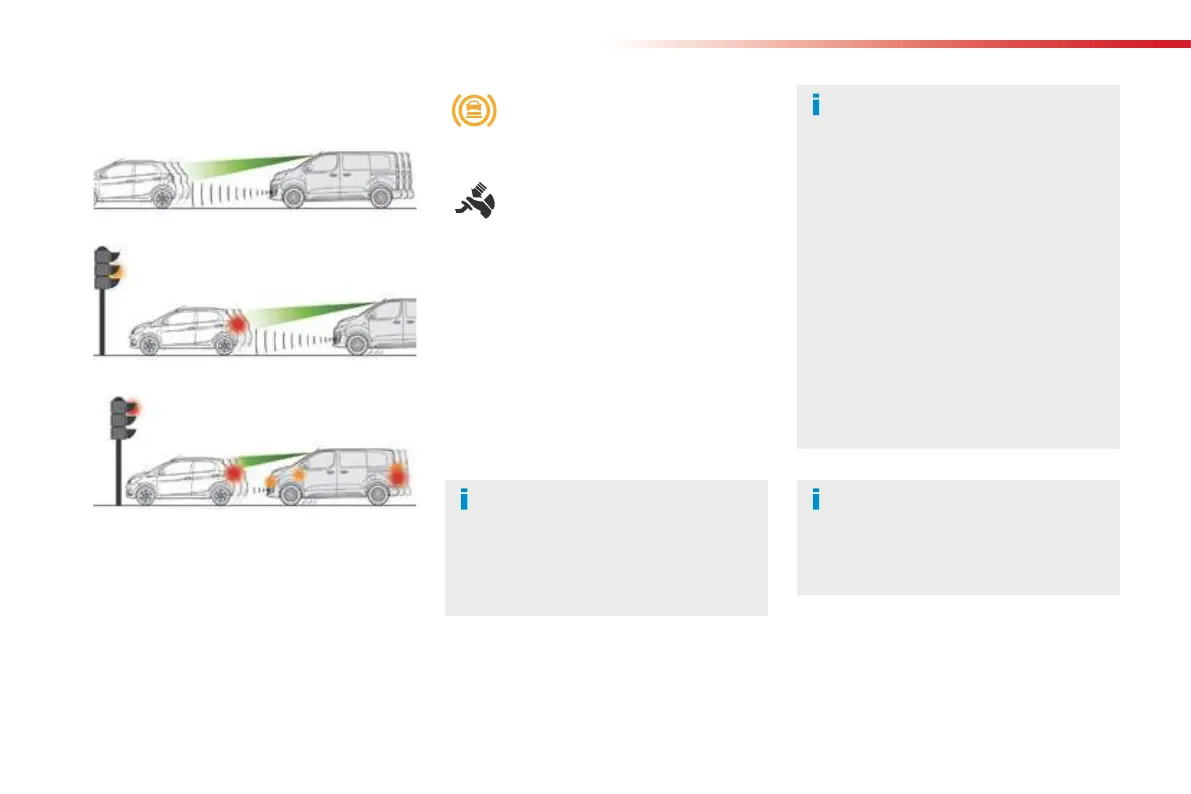
This system, also called automatic emergency
braking, aims to reduce the speed of impact
or avoid a frontal collision by your vehicle
(between 3 and 87 mph (5 and 140 km/h))
where the driver fails to react.
Using a radar and a camera, this system acts
on the vehicle's braking system.
Active Safety Brake
The driver can take back control of the vehicle
at any time by sharply turning the steering
wheel and/or pressing the accelerator pedal.
Operation of the system may be felt by
slight vibration in the brake pedal.
If the vehicle comes to a complete stop,
the automatic braking is maintained
for
1 to 2 seconds.
If your vehicle has a manual gearbox, in
the event of the automatic emergency
braking bringing the vehicle to a
complete stop, the engine may stall.
If your vehicle has an automatic
gearbox, in the event of the automatic
emergency braking bringing the vehicle
to a complete stop, the vehicle will
move off again; press the brake pedal.
If automatic emergency braking is
not activated, you are alerted by the
fixed display of this warning lamp
accompanied by a message.
If the radar and the camera have
confirmed the presence of a vehicle
or a pedestrian, this warning lamp
flashes when the system is operating.
Important: if operation of the
automatic emergency braking is
triggered, you should take back
control of your vehicle and brake
with the pedal to add to or finish the
automatic braking.
The point at which braking is triggered
may be adjusted according to the
reaction from the driver, such as
movement of the steering wheel or
pressing the accelerator pedal.



 To Next Page