Maintenance
131
C3M2-OM-EN-02
Note
The truck must be parked on smooth level ground when adjusting the
chains.
Measuring Chain Stretch
Leaf chain failure is usually a result of gradual elongation as the chain wears. Measure
the chain elongation with a chain wear gauge that displays the elongation of the chain
as a percentage value. Follow the chain wear gauge instructions.
Chains should ideally be cleaned and measured in situ while placed under load. It is
acceptable for the chain to be tensioned by the weight of the carriage and forks.
When checking a chain for wear it is vital that the section that passes over the pulley
is measured as this section experiences the most wear during normal operation.
To check the free lift chains, raise the carriage 1ft (30 cm) off the ground to put
tension on the chains.
To check the main lift chains, raise the mast until the inner upright starts to rise
putting tension on the chains.
Adjusting for Chain Stretch
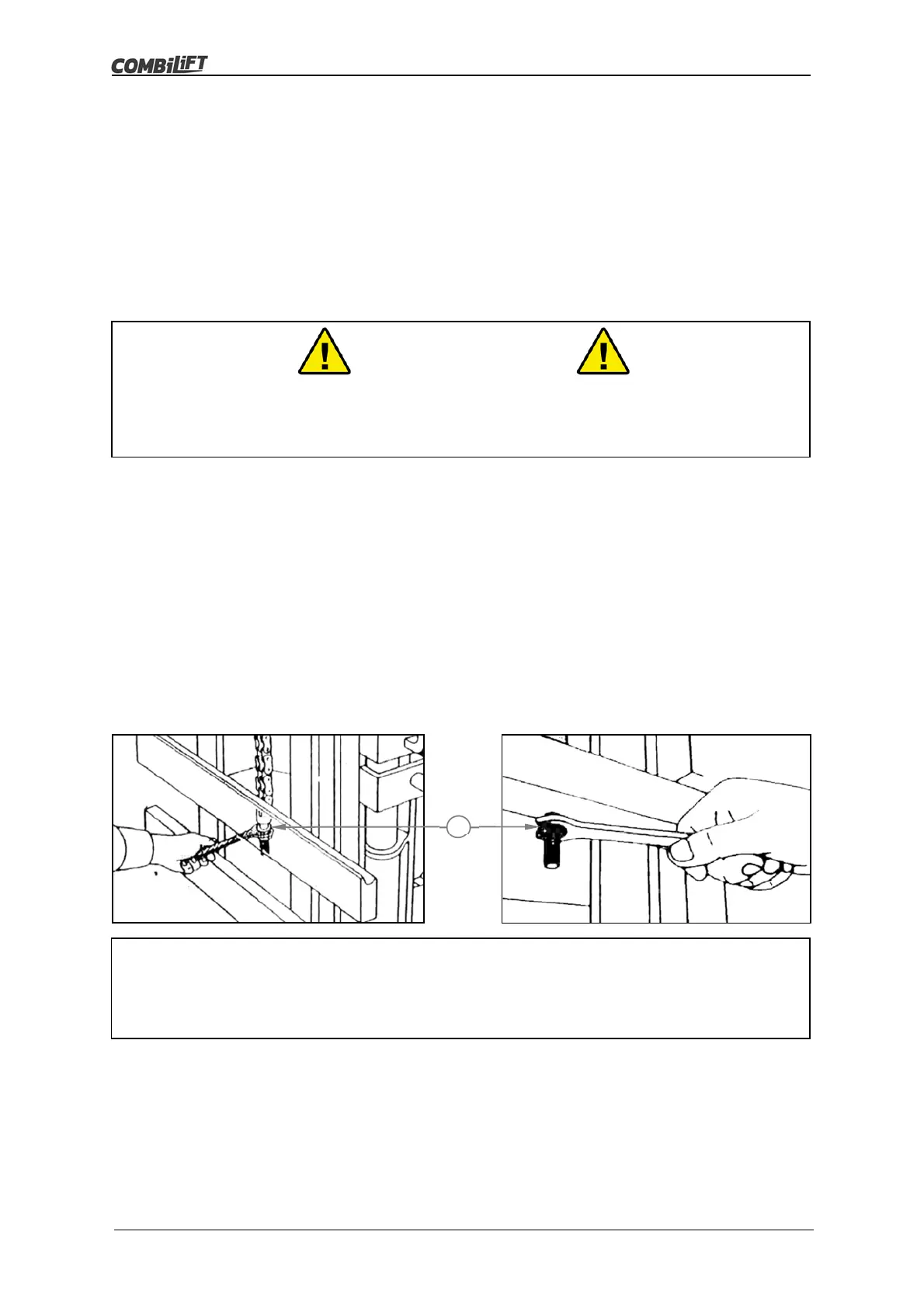
Chain elongation due to stretch (see ‘Measuring Chain Stretch’) can be compensated
for by adjusting the chain anchors (A). However if the full length of the chain anchor is
used up it will be necessary to remove a link.
The chain anchors are located on the fork carriage and also on the mast stages.
Warning
If a chain has reached a level of 2% elongation, a safe time limit must be set
for the chains to be replaced. If a chain has reached 3% elongation, it must
be taken out of service immediately.
A



 To Next Page