Cleaning, Disinfection and Maintenance
6-2
Do not use high temperature, autoclaving or ionizing radiation methods to conduct disinfection.
Do not use chloric disinfectants such as bleaching powder, sodium hypochlorite and so on.
6.3 Daily Care and Maintenance
6.3.1 Capacity, Recharge and Replacement of the Battery
Improper operation may cause the battery to be hot, ignited or exploded or it may lead to the
declination of the battery’s capacity. It is necessary to read the user manual carefully and the
warnings and cautions before using of the rechargeable lithium battery (hereinafter called
Battery).
1) Battery Capacity identification:
Current capacity of the rechargeable battery can be identified according to the battery symbol in the top
right corner on the LCD screen:
For 1200B:
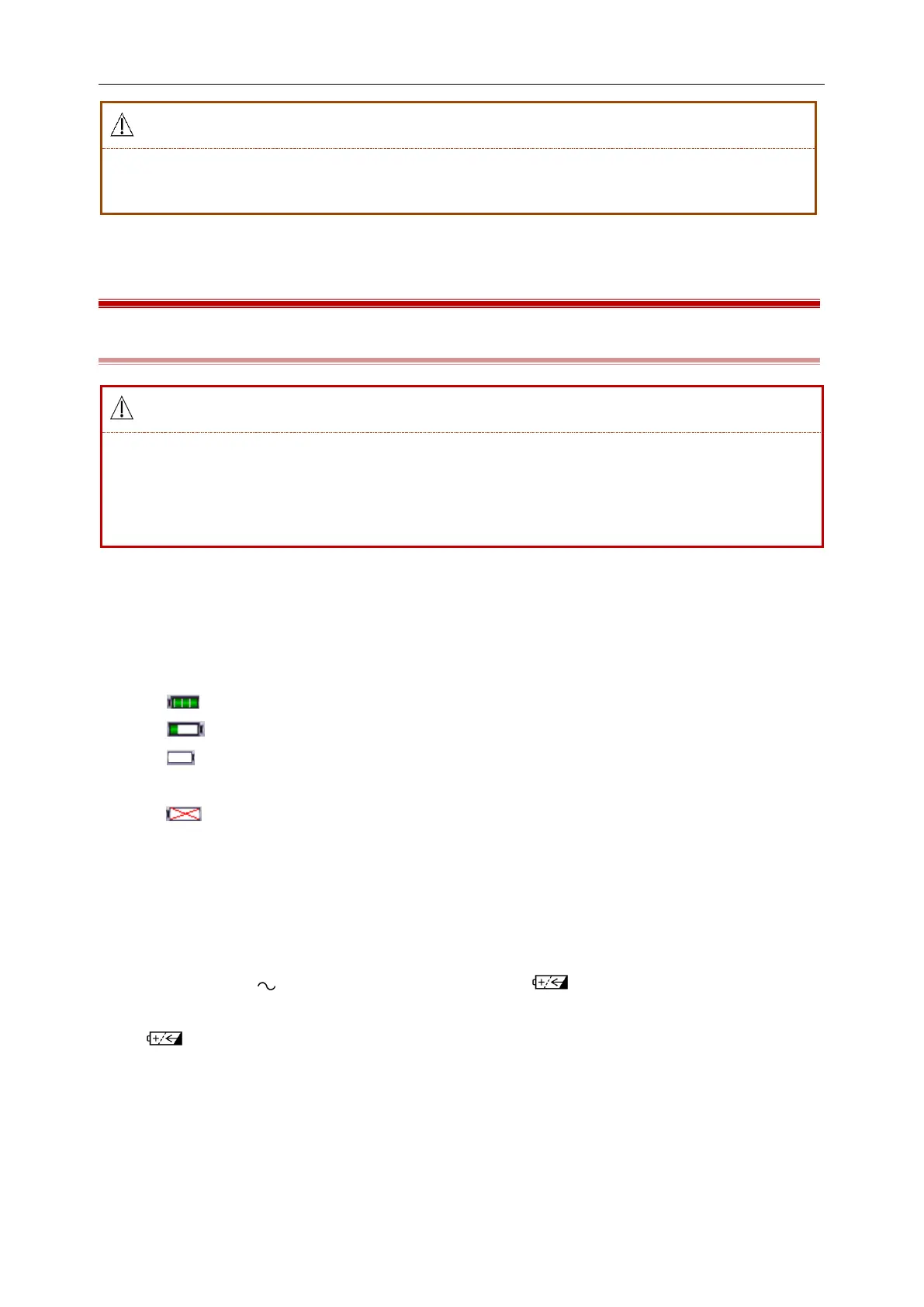
: Full capacity
: The capacity is too low and recharge should be taken into account.
: Capacity is low, it should be recharged immediately; and now “Low Capacity” will display
on the message prompt are on the LCD screen.
: Absence or damage of the battery.
2) Recharge:
This electrocardiograph is equipped with built-in rechargeable lithium battery and its recharge control
circuit. For the power loss in the storage and transportation, for the initial use the capacity of the lithium
battery may be inadequate and the battery should be recharged first before using.
When connect with the AC power supply, the rechargeable lithium battery can be recharged. And then
the AC indicator lamp ( ) and battery recharge indicator lamp ( ) will be light at the same time which
shows that the battery is recharging. When the capacity of the battery is full, the battery recharged indicator
lamp ( ) will off.
3) Replacement:
When the shelf life of the battery is over, or there is peculiar smell, liquid leakage, contact with the local
maintenance engineer or the manufacturer immediately to replace the battery.



 To Next Page