12
MS-DOS User's Reference
[
Protecting your files
File Allocation Table
File Protection
[
The
MS-DOS operating system is a powerful and useful tool for pro-
cessing personal and business information_
As
with
any
computer,
though,
errors
may
occur
and
information may
be
misused_ So, if [
you
are
doing
work
that
cannot
be
replaced
or
that requires a lot -
of
security, you should
protect
your
programs_
You
can
take simple
but
effective measures like
putting
your
disks [
away
when
you're
not
using them,
or
covering
the
write-protect
notch
on
your
program disks. Also,
if
your
disks
contain
valuable
information, you should make backup
copies
of
them
on
a regular [
basis. Another way
to
protect
your
programs
is
by installing
your
equipment
in a
secure
office
or
work
area.
How MS-DOS Keeps Track of Your Files
As
you learned in
the
MS-DOS User's
Guide,
MS-DOS stores files in
directories. In addition
to
directories, it uses an area
on
a disk
called
the
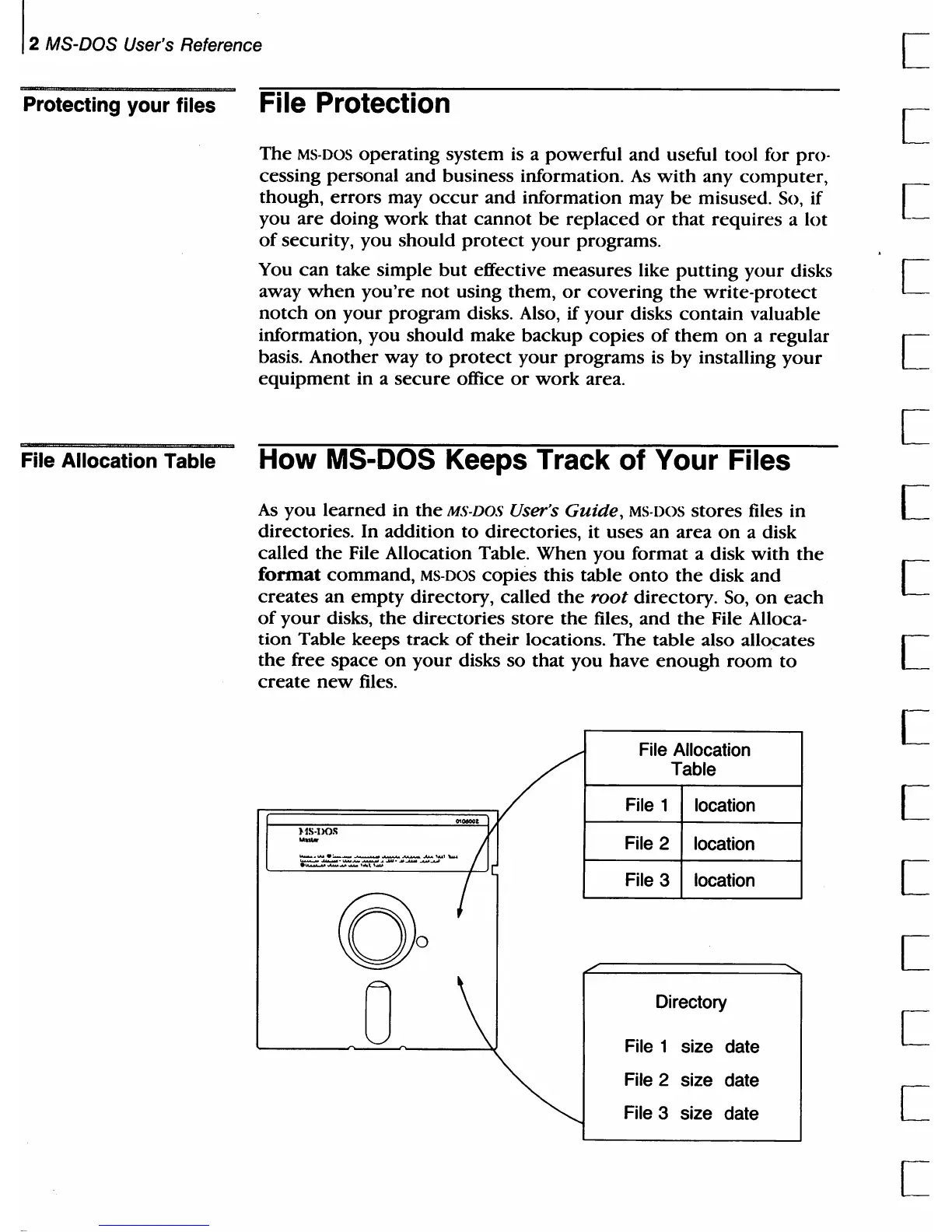
File Allocation Table. When
you
format a disk with
the
format
command, MS-DOS copies this table
onto
the
disk and
creates an
empty
directory, called
the
root
directory. So,
on
each
of
your
disks,
the
directories
store
the
files, and
the
File Alloca-
tion Table keeps track
of
their
locations.
The
table also allocates
the
free space
on
your
disks
so
that
you
have
enough
room
to
create
new
files.
/
File Allocation
Table
File 1
location
O'OoIOOt
y
Hs·nos
'I
File 2
location
;:-::-3'..E::;7'...:=-=":::-":'-'~'
/
/
File 3 location
cO
0
\
Directory
File 1
size date
~
File 2
size date
File 3 size
date
[
[
[
[
[
[
[
[



 To Next Page