EasyManua.ls Logo

ConMed ExcaliburPLUS PC - RF and Output Systems

ConMed ExcaliburPLUS PC
98 pages
Print Icon
To Next Page IconTo Next Page
To Previous Page IconTo Previous Page
Loading...
eceli
25
2
rows,
prevent
the
cross
connection
of
the
multi-
plexed
signal
whenever
one
of
the
keys
is
depressed.
If
one
of
these
transistors
shorts
out,
one
of
the
7-segment
digits
(I1
-
13)
is
written
to
continuously
causing
it
to
be
overdriven
and
glow
brighter
than
normal.
Display
I9
is
lit
through
driver
U7
when
U2
SL3
is
high
and
U4
is
dis-
abled
by Q.
The
internal
circuitry
of
U2
reads
each
digit
data
stored
in
internal
RAM
and
drives
the
segment
output
(BO
-
B3
and
A0
-
A3)
in
sync
with
the
scan
lines.
Current
is
then
supplied
to
the
correct
digit,
displaying
the
appropriate
number.
The
segment
outputs
of
U2
are
con-
nected
to
the
current
driver
(U1)
which
delivers
approximately
40
mA
to
each
segment.
The
dis-
plays
are
common
cathode
variety
so
that
the
cur-
rent
is
supplied
to
the
anode
and
pulled
to
ground
at
the
common
cathode
connection
by
the
scanned
open
collector
driver.
The
keyboard
(Schematic
4.2)
is
part
of
the
front
panel
assembly
and
is
connected
to
the
Display
PWB
through
connector
A2J3.
There
are
also
ground
connections
from
the
front
panel
electro-
static
shield
which
is
incorporated
into
the
mem-
brane
switches.
These
grounds
straps
are
con-
nected
directly
to
the
chassis
and
prevent
EMI
(ElectroMagnetic
Interference)
and
ESD
(ElectroStatic
Discharge)
from
being
conducted
into
the
logic
circuitry
via
the
keyboard.
3.6
Power
Amplifier
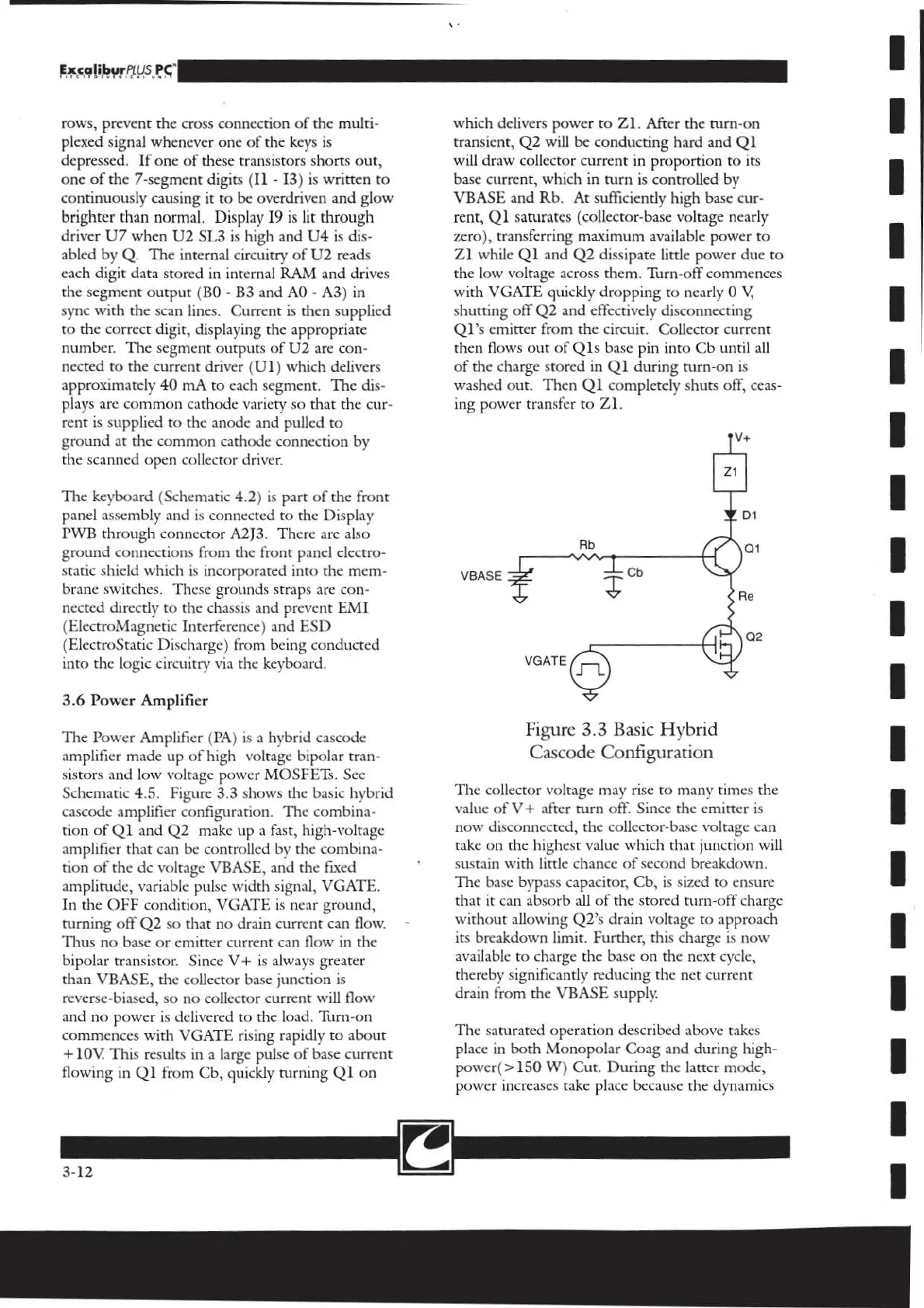
The
Power
Amplifier
(PA)
is
a
hybrid
cascode
amplifier
made
up
of
high
voltage bipolar
tran-
sistors
and
low
voltage
power
MOSFETs.
See
Schematic
4.5.
Figure
3.3
shows
the
basic
hybrid
cascode
amplifier
configuration.
The
combina-
tion
of
O1
and
O2
make
up
a
fast,
high-voltage
amplifier
that
can
be
controlled
by
the
combina-
tion
of
the
dc
voltage
VBASE,
and
the
fixed
amplitude,
variable
pulse
width
signal,
VGATE.
In
the
OFF
condition,
VGATE
is
near
ground,
turning
off
O2
so
that
no
drain
current
can
flow.
Thus
no
base
or
emitter
current
can
flow
in
the
bipolar
transistor.
Since
V+
is
always
greater
than
VBASE,
the
collector
base
junction
is
reverse-biased,
so
no
collector
current
will
flow
and
no
power
is
delivered
to
the
load.
Turn-on
commences
with
VGATE
rising
rapidly
to
about
+10V.
This
results
in
a
large
pulse
of
base
current
flowing
in
Q]
from
Cb,
quickly
turning
Q1
on
3-12
which
delivers
power
to
Z1.
After
the
turn-on
transient,
Q2
will
be
conducting
hard
and
O1
will
draw
collector
current
in
proportion
to
its
base
current,
which
in
turn
is
controlled
by
VBASE
and Rb.
At
sufficiently
high
base
cur-
rent,
Q]
saturates
(collector-base
voltage
nearly
zero),
transferring
maximum
available
power
to
Z1
while
QI
and
Q2
dissipate
little
power
due
to
the
low voltage
across
them.
Turn-off
commences
with
VGATE
quickly
dropping
to
nearly
0
V,
shutting
off
Q2
and
effectively
disconnecting
Q1's emitter
from
the
circuit.
Collector
current
then
flows
out
of
Ols
base
pin
into
Cb
until
all
of
the
charge
stored
in
Ol
during
turn-on
is
washed
out.
Then
O1
completely
shuts
off,
ceas-
ing
power
transfer
to
Zl.
I“
Z1
DI
Pb
Qi
VBASE
cb
Re
o
VGATE
Figure
3.3
Basic
Hybrid
Cascode
Configuration
The
collector
voltage
may
rise
to
many
times
the
value
of
V+
after
turn
off.
Since
the
emitter
is
now
disconnected,
the
collector-base
voltage
can
take
on
the
highest
value
which
that
junction
will
sustain
with
little
chance
of
second
breakdown.
The
base
bypass
capacitor,
Cb,
is
sized
to
ensure
that
it
can
absorb
all
of
the
stored
turn-off
charge
without
allowing
Q2’s
drain
voltage
to
approach
its
breakdown
limit.
Further,
this
charge
is
now
available
to
charge
the
base
on
the
next
cycle,
thereby
significantly
reducing
the net
current
drain
from
the
VBASE
supply.
The
saturated
operation
described
above
takes
place
in
both
Monopolar
Coag
and
during
high-
power(>150
W)
Cut.
During
the
latter
mode,
power
increases
take
place
because
the
dynamics

Related product manuals