EasyManua.ls Logo

ConMed ExcaliburPLUS PC - Page 48

ConMed ExcaliburPLUS PC
98 pages
Print Icon
To Next Page IconTo Next Page
To Previous Page IconTo Previous Page
Loading...
Eco
ec
NS
PAD/DUAL
PAD
and
MONITOR
SET
POINT
buttons
to
determine
when
a
RETURN
FAULT
condition
exists.
The
ASSIST
Resistance
Indicator
is
also
driven
by
software
to
indicate
the
value
of
the
measured
DUAL
FOIL
resistance
in
the
10
to
150
ohm
range.
Portions
of
this
function
are
implemented
on
the
A3
Controller
PWB
and
on
the
A5
Output
PWB.
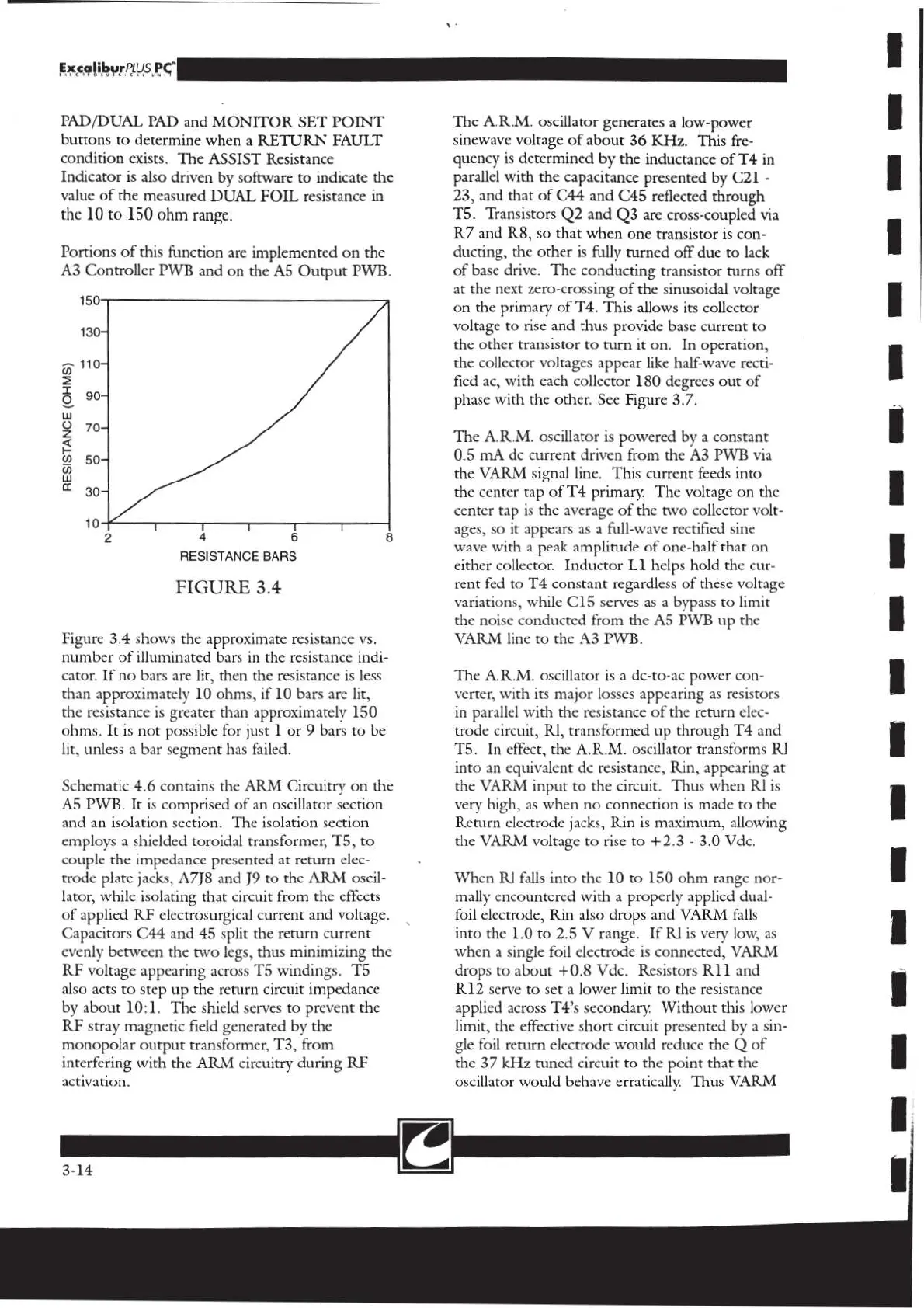
150-
1304
1104
904
704
50”
RESISTANCE
(OHMS)
304
10.
T T
T
T
T
2 4 6
8
RESISTANCE
BARS
FIGURE
3.4
Figure
3.4
shows
the
approximate
resistance
vs.
number
of
illuminated
bars
in
the
resistance
indi-
cator.
If
no
bars
are
lit,
then
the
resistance
is
less
than
approximately
10
ohms,
if
10
bars
are
lit,
the
resistance
is
greater
than
approximately
150
ohms.
It
is
not
possible
for just
1
or
9
bars
to
be
lit,
unless
a
bar
segment
has
failed.
Schematic
4.6
contains
the
ARM
Circuitry
on
the
A5
PWB.
It
is
comprised
of an
oscillator
section
and
an
isolation
section.
The
isolation
section
employs
a
shielded
toroidal
transformer,
T5,
to
couple
the
impedance
presented
at
return
elec-
trode
plate
jacks,
A7J8
and
J9
to
the
ARM
oscil-
lator,
while
isolating
that
circuit
from
the
effects
of
applied
RF
electrosurgical current and
voltage.
Capacitors
C44
and
45
split
the
return
current
evenly
between
the
two
legs,
thus
minimizing
the
RF
voltage
appearing
across
T5
windings.
T5
also
acts
to
step
up
the
return
circuit
impedance
by
about
10:1.
The
shield
serves
to
prevent
the
RF
stray
magnetic
field
generated
by
the
monopolar
output
transformer,
T3,
from
interfering
with
the
ARM
circuitry
during
RF
activation.
The
A.R.M.
oscillator
generates
a
low-power
sinewave
voltage
of
about
36
KHz.
This
fre-
quency
is
determined
by
the
inductance
of
T4
in
parallel
with
the
capacitance
presented
by
C21
-
23,
and
that
of
C44
and
C45
reflected
through
T5.
Transistors
Q2
and
Q3
are
cross-coupled
via
R7
and R8,
so
that
when
one
transistor
is
con-
ducting,
the
other
is
fully
turned
off
due
to
lack
of
base
drive.
The
conducting
transistor
turns
off
at
the
next
zero-crossing
of
the
sinusoidal
voltage
on
the
primary
of
T4.
This
allows
its
collector
voltage
to
rise
and
thus
provide
base
current
to
the
other
transistor
to
turn
it
on.
In
operation,
the
collector
voltages
appear
like
half-wave
recti-
fied
ac,
with
each
collector
180
degrees
out
of
phase
with
the
other.
See
Figure
3.7.
The
A.R.M.
oscillator
is
powered
by
a
constant
0.5
mA
de
current
driven
from
the
A3
PWB
via
the
VARM
signal
line.
This
current
feeds
into
the
center
tap
of
T4
primary.
The
voltage
on
the
center
tap
is
the
average
of
the
two
collector
volt-
ages,
so
it
appears
as
a
full-wave
rectified
sine
wave
with
a
peak
amplitude
of
one-half
that
on
either
collector.
Inductor
L1
helps
hold
the
cur-
rent
fed
to
T4
constant
regardless
of
these
voltage
variations,
while
C15
serves
as
a
bypass
to
limit
the
noise
conducted
from
the
A5
PWB
up
the
VARM
line
to
the
A3
PWB.
The
A.R.M.
oscillator
is
a
de-to-ac
power
con-
verter,
with
its
major
losses
appearing
as
resistors
in
parallel
with
the
resistance
of
the
return
elec-
trode
circuit,
RI,
transformed
up
through
T4
and
T5.
In
effect,
the
A.R.M.
oscillator
transforms
RI
into
an
equivalent
de
resistance,
Rin,
appearing
at
the
VARM
input
to
the
circuit.
Thus
when
RI
is
very
high,
as
when
no
connection
is
made
to
the
Return
electrode
jacks,
Rin
is
maximum,
allowing
the
VARM
voltage
to
rise
to
+2.3
-
3.0
Vdc.
When
RI
falls
into
the
10
to
150
ohm
range
nor-
mally
encountered
with
a
properly
applied
dual-
foil
electrode,
Rin
also
drops
and
VARM
falls
into
the
1.0
to
2.5
V
range.
If
RI
is
very
low,
as
when
a
single
foil
electrode
is
connected,
VARM
drops
to
about
+0.8
Vdc.
Resistors
R11
and
R12
serve
to
set
a
lower
limit
to
the
resistance
applied
across
T4’s
secondary.
Without
this
lower
limit,
the
effective
short
circuit
presented
by
a
sin-
gle
foil
return
electrode
would
reduce
the
Q
of
the
37
kHz
tuned
circuit
to
the
point
that
the
oscillator
would
behave
erratically.
Thus
VARM

Related product manuals