EasyManua.ls Logo

ConMed ExcaliburPLUS PC - Troubleshooting; Understanding Fault Codes

ConMed ExcaliburPLUS PC
98 pages
Print Icon
To Next Page IconTo Next Page
To Previous Page IconTo Previous Page
Loading...
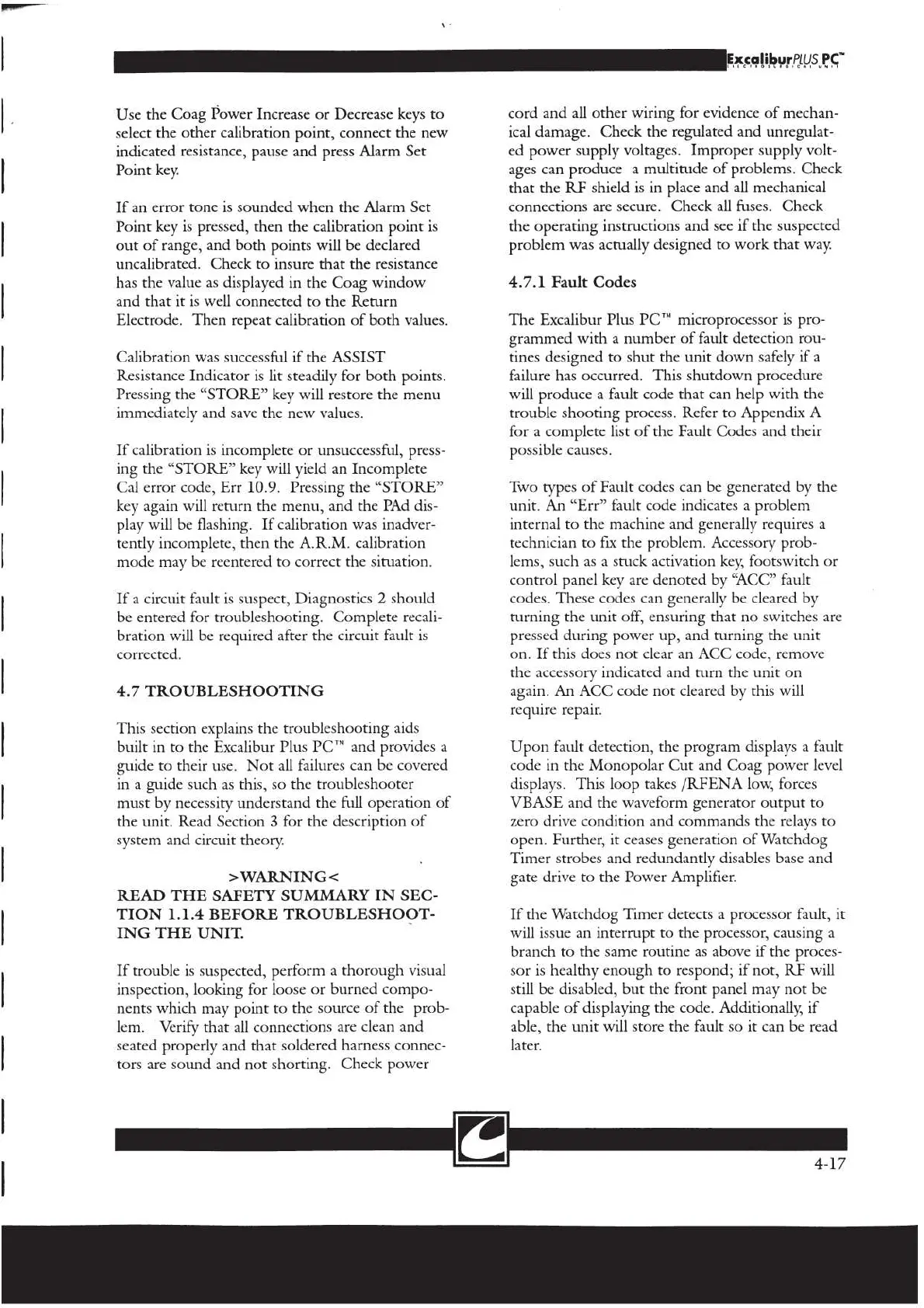
Use
the
Coag
Power
Increase
or
Decrease
keys
to
select
the
other calibration
point,
connect
the
new
indicated
resistance,
pause and
press
Alarm
Set
Point
key.
If
an
error
tone
is
sounded
when
the
Alarm
Set
Point
key
is
pressed,
then
the
calibration
point
is
out
of
range,
and both
points
will
be
declared
uncalibrated.
Check
to
insure
that
the
resistance
has
the
value
as
displayed
in
the
Coag
window
and
that
it is
well
connected
to
the
Return
Electrode.
Then
repeat
calibration
of
both
values.
Calibration
was
successful
if
the
ASSIST
Resistance
Indicator
is
lit
steadily
for
both
points.
Pressing
the
“STORE”
key
will
restore
the
menu
immediately
and
save
the
new
values.
If
calibration
is
incomplete
or
unsuccessful,
press-
ing
the
“STORE?”
key
will
yield
an
Incomplete
Cal
error
code,
Err 10.9.
Pressing
the
“STORE”
key
again
will
return
the
menu,
and
the
PAd
dis-
play
will
be
flashing.
If
calibration
was
inadver-
tently
incomplete,
then
the
A.R.M.
calibration
mode
may
be
reentered
to
correct
the
situation.
If
a
circuit
fault
is
suspect,
Diagnostics
2
should
be
entered
for
troubleshooting.
Complete
recali-
bration
will
be
required
after
the
circuit
fault
is
corrected,
4.7
TROUBLESHOOTING
This
section
explains
the
troubleshooting
aids
built
in
to
the
Excalibur
Plus
PC™
and
provides
a
guide
to
their
use.
Not
all
failures
can
be
covered
in
a
guide
such
as
this, so
the
troubleshooter
must
by
necessity
understand
the
full
operation
of
the
unit.
Read
Section
3
for the
description
of
system
and
circuit
theory.
>WARNING<
READ
THE
SAFETY
SUMMARY
IN
SEC-
TION
1.1.4
BEFORE
TROUBLESHOOT-
ING
THE
UNIT.
If
trouble
is
suspected,
perform
a
thorough
visual
inspection,
looking
for
loose
or
burned
compo-
nents
which
may
point
to
the
source
of
the
prob-
lem.
Verify
that
all
connections
are
clean
and
seated
properly
and
that
soldered
harness
connec-
tors
are
sound
and
not
shorting.
Check power
iburPIUS
PCT
cord
and
all
other
wiring
for
evidence
of
mechan-
ical
damage.
Check
the
regulated
and
unregulat-
ed
power
supply
voltages.
Improper
supply
volt-
ages
can
produce
a
multitude
of
problems.
Check
that
the
RF
shield
is
in
place
and
all
mechanical
connections
are
secure.
Check
all
fuses.
Check
the
operating
instructions
and
see
if
the
suspected
problem
was
actually
designed
to
work
that
way.
4.7.1 Fault
Codes
The
Excalibur
Plus
PC™
microprocessor
is
pro-
grammed
with
a
number
of fault
detection
rou-
tines
designed
to
shut
the
unit
down
safely
if
a
failure
has
occurred.
This
shutdown
procedure
will
produce
a
fault
code
that can
help
with
the
trouble
shooting
process.
Refer
to
Appendix
A
for
a
complete
list
of
the
Fault
Codes
and
their
possible
causes.
Two
types
of
Fault
codes
can
be
generated
by
the
unit.
An
“Err”
fault
code
indicates
a
problem
internal
to
the
machine
and
generally
requires
a
technician
to
fix
the
problem.
Accessory
prob-
lems,
such
as
a
stuck
activation
key,
footswitch
or
control
panel
key
are
denoted
by
“ACC”
fault
codes.
These
codes
can
generally
be
cleared
by
turning
the
unit
off,
ensuring
that
no
switches
are
pressed
during
power
up,
and
turning
the
unit
on.
If
this
does
not
clear
an
ACC
code,
remove
the
accessory
indicated
and
turn
the
unit
on
again.
An
ACC
code
not
cleared
by
this
will
require
repair.
Upon
fault
detection,
the
program
displays
a
fault
code
in
the
Monopolar
Cut
and
Coag
power
level
displays.
This
loop
takes
/RFENA
low,
forces
VBASE
and
the
waveform
generator
output
to
zero
drive
condition
and
commands
the
relays
to
open.
Further,
it
ceases
generation
of
Watchdog
Timer
strobes
and
redundantly
disables
base
and
gate
drive
to
the
Power
Amplifier.
If
the
Watchdog
Timer
detects
a
processor
fault,
it
will
issue
an
interrupt
to
the
processor,
causing
a
branch
to
the
same
routine
as
above
if
the
proces-
sor
is
healthy
enough
to
respond;
if
not,
RF
will
still
be
disabled,
but
the
front
panel
may
not
be
capable
of
displaying
the
code.
Additionally,
if
able,
the
unit
will
store
the fault
so
it
can
be
read.
later.
[2
4-17

Related product manuals