19
Using the Web Interface
Configure USB routing on the USB routing page:
1. Determine the DM NVX devices that are to be paired:
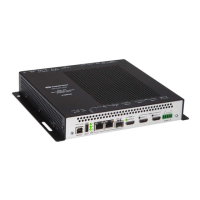
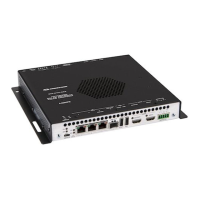
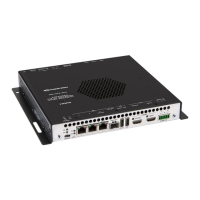
• One DM-NVX-35x(C) device functions as the local extender; that is, the
DEVICE port connects to a computer or other host device.
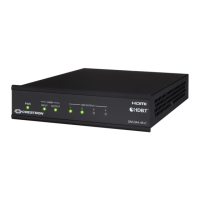
• One DM-NVX-D80-IOAV device functions as the remote extender with host
port functionality for connection to a USB mouse, keyboard, or other
peripheral device.
Continue with the following steps for each DM NVX device.
2. In the USB Mode drop-down list, select Local for the DM-NVX-35x(C) local
extender. For the DM-NVX-D80-IOAV, USB Mode is set to Remote by default
and cannot be changed.
3. In the Transport Mode drop-down list, select either of the following:
• Layer 2: Enables Layer 2 transport of USB 2.0 data. This mode is compatible
with DM-NVX-35x(C) and DM-NVX-D80-IOAV devices as well as
USB-EXT-DM extenders.
• Layer 3: Enables Layer 3 transport of USB 2.0 data across VLANs. This mode
is compatible with DM-NVX-35x(C) and DM-NVX-D80-IOAV devices only.
For Layer 2 transport, the Local Device ID field displays the MAC address of the
DM NVX device that is being configured. For Layer 3 transport, the Local Device
ID field displays the IP address of the DM NVX device that is being configured.
4. Set Automatic USB Pairing to Enabled or Disabled.
NOTE: When DM-NVX-35x(C) firmware is upgraded from version
2.0.3900.00056 or earlier to a later version, automatic USB pairing defaults to
Disabled. If factory default settings are restored, automatic USB pairing is set to
Enabled.
5. For DM-NVX-35x(C) devices in Local USB mode, do either of the following:
• If Transport Mode is set to Layer 2:
a. Set Multiple Device Support to Disabled. (At the time of publication of
this document, the DM-NVX-D80-IOAV does not support Layer 2
multipoint applications.)
b. In the Remote Device ID text box, enter the MAC address of a single
remote extender.
• If Transport Mode is set to Layer 3:
In the Remote Device ID text box, enter the IP address of a single remote
extender.



 To Next Page
 Loading...