EN - 8 A-306-1
CAUTION–DO NOT drop the Battery or expose it to mechanical shock.
CAUTION–Only use the Battery for its intended purpose.
NOTE–Operating time will degrade with Battery use and age.
NOTE– Store your Battery in a cool, dry location when not in use. This will help to assure the longevity of your Battery.
NOTE– Charging the Battery below 50°F (10°C) or above 104°F (40°C) may degrade the performance. The Battery will not charge above 45°C.
Initial Battery Operation
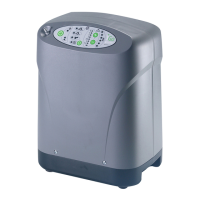
ThenewbatterypackagedwithyouriGoPortableOxygenSystemisnotfullycharged.BeforeusingyouriGoforthersttime,youmustinstallandfullydischargethenfully
charge the battery.
1. Using battery power only, operate the iGo until the battery is fully drained. The unit will turn off and the power failure alarm will sound.
2. Connect the AC Power Cord and plug in to completely charge the battery. This may require up to 4.5 hours of uninterrupted charging.
In the event of a power interruption, the iGo Portable Oxygen System will automatically switch to the battery operation if installed. When AC power is restored, the battery will
automatically start recharging. If the battery is not present during a power interruption, the Power Fail alert will activate and the iGo will stop operation. When power is
restored, unit will resume oxygen production unless the Power Button was pressed to stop the Power Fail Alert.
Typical Battery Recharge Time
Thetypicaltimetorechargeyourbatteryfromafullydischargedconditionis2.0hoursto4.5hoursdependentupontheowsetting.IftheBatteryistoowarm,chargingwill
notbeginuntilitsufcientlycools.Extremetemperature(highorlow)mayextendchargetime.
OPERATING YOUR IGO
WARNING
Do not leave iGo running when not in use. Do not leave cannula unattended while unit is delivering oxygen. High concentrations of oxygen can cause rapid
burning. Keep the equipment in a well-ventilated area.
1. Checktoseeiftheairlterisinplacebeforeusing.Iftheairlterneedstobecleaned,washwithsoapywaterandallowtodrybeforeusing.Ifnecessary,replacewitha
newairlter.
2. Plug unit into AC Power, DC Power, or make sure there is a charged Battery installed.
NOTE–Every time a button is pressed or when a change to the power source occurs, the iGo will give a short audible chirp.
3. Connect the tubing to the oxygen outlet and the cannula.
DANGER
If tubing becomes disconnected during operation, iGo does not alert. Check ow at the cannula to verify oxygen delivery.
4. Attach a standard nasal cannula to the oxygen outlet and to your nose and face. Breathe normally through the cannula.
CAUTION–To ensure there is adequate ow to deliver oxygen, the length of the tubing must not exceed 50 feet (15.2m) when using Continuous Flow Mode, and must
not exceed 35 feet (10.5m) when operating in PulseDose Mode for adequate breath detection.
5. PressandholdthePowerButtontoturnyouriGoOn.WhentheunitisturnedOn,allthelightsonthecontrolpanelwillilluminatebrieyandaudiblealertwillbriey
activate.
a. When using External Power:
1) In PulseDose mode: After a few seconds, the External Power, Normal Oxygen, and Flow Rate lights will remain lit. The Flow Indicator Light will pulse with each
breath. If a battery is installed, the Battery Status Lights will either illuminate indicating battery charge level or cycle indicating battery is charging.
2) In Continuous Flow mode: After a few seconds, the External Power, Normal Oxygen, Flow Indicator, and Flow Rate lights will remain lit. If a battery is installed,
the Battery Status Lights will either illuminate indicating battery charge level or cycle indicating battery is charging.
b. When using Battery Power:
1) In PulseDose mode: After a few seconds, the Normal Oxygen and Flow Rate lights will remain lit. The Battery Status Gauge Lights will also be lit indicating
battery charge level. The Flow Indicator Light will pulse with each breath.
2) In Continuous Flow mode: After a few seconds, the Normal Oxygen, Flow Rate, and Flow Indicator lights will remain lit. The Battery Status Gauge Lights will
also be lit indicating battery charge level.
NOTE–The DeVilbiss iGo has an oxygen sensing device (OSD
®
) to monitor oxygen purity once the oxygen stabilization process is complete (after approximately the
rst 20 minutes of operation). Once stabilized, the OSD monitors the oxygen purity and will alert if purity falls below an acceptable level.
6. TochangeyourDeliveryMode,presstheModeSelectbutton.TheiGowillcomeonatthelastmodeandowsettingused.
a. ContinuousFlowOperation-WhenoperatinginContinuousFlowMode,acontinuoussupplyofoxygenwillowthroughyourtubingandnasalcannula.
b. PulseDose Operation - When operating in PulseDose mode, an alert will beep after 30 seconds if a breath is not detected. If another 60 seconds elapses and no
breath is detected, the unit will switch to Continuous Flow at the last Continuous Flow setting used.
NOTE-PulseDosedramaticallyextendstheusetimeoftheiGoPortableOxygenSystemofferingincreasedmobilitywithimprovedcomfortandincreasedefciency.Many
usersndPulseDoseoxygendeliverymorecomfortablethancontinuousowdeliverysystems.
WARNING
PulseDose Flow settings should be determined for each patient individually. Settings from Continuous Flow applications may not be applicable to PulseDose
Mode.
As with conserving devices, the iGo may not be able to detect some respiratory efforts in PulseDose mode.
CAUTION–Do not use with other equipment (i.e. humidier, nebulizer, etc.) when in PulseDose delivery mode. The iGo will not detect a breath and will default to Continuous
Flow.
NOTE–A pediatric or low-ow cannula should not be used in PulseDose delivery mode. The reduced diameter of the cannula causes too much back pressure and will affect
the oxygen volume delivered.
NOTE–PulseDose delivers oxygen in a very short “puff.” It does not deliver oxygen continuously. The length of time that PulseDose delivers oxygen will not vary from breath to
breath. The time is set in correlation to the patient’s prescription setting.


 To Next Page
 Loading...