ROUTINE UTILIZATION & MEASUREMENT
34
5.2.3. Results
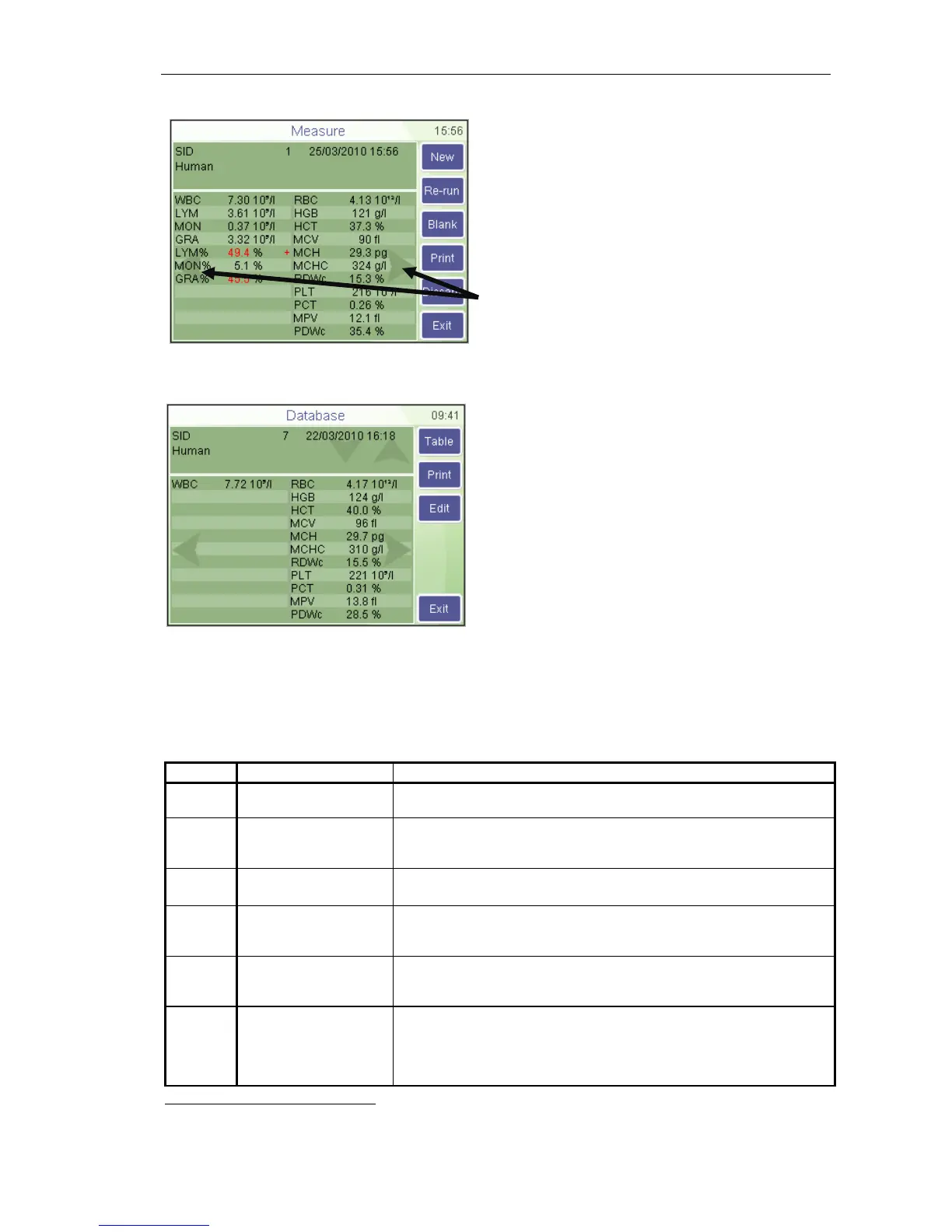
When analysis is complete, the
following screen is displayed, including
all measured and calculated parameters
as well as the WBC, RBC, and PLT
histograms.
Results, histograms and other data will
be stored automatically in the memory.
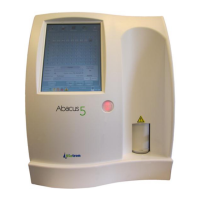
To look at histograms in detail, tap the
arrows (left/right) to see further details.
A
A
b
b
a
a
c
c
u
u
s
s
J
J
u
u
n
n
i
i
o
o
r
r
3
3
0
0
N
N
D
D
doesn‟t contain the 3-part diff results.
5.2.4. Warning flags
Analyzer SW displays warning flags for each individual measurement to notify user
about status of results. The following table summarizes warning flags and gives
explanation of their possible cause and a few hints to overcome the problem.
No WBC 3-part
differential
Possible lyse problem. May occur in pathological lymphocytosis.
HGB blank is high, or no
HGB blank
Repeat the blank measurement. If HGB blank is not stable there are
probably bubbles in the WBC chamber: Run a cleaning and try blank
again. Close the side door if open during measurement.
WBC blank is high, or no
WBC blank
Repeat the blank measurement, or run prime lyse and try blank again.
Possible lyse contamination, or noise problem.
linearity range exceeded
in WBC stage
The analyzer found that the cell count is higher than the linearity range of
the analyzer. Make a pre-dilution, and run the same sample in prediluted
mode
RBC cells found in
sample during WBC
stage
RBC cells were detected during the WBC measurement. Either the lyse
reagent is not effective enough (volume should be increased) or the
RBC‟s in the sample are somewhat lyse resistive
Probably large PLTs or clumped PLTs are present in the sample. Usually
caused by the nature of the sample. cat and goat samples tend to clump.
Intensive, but careful mixing of the sample (e.g. Vortex) can help remove
the clumps. If the rerun sample gives the same results, consider that
WBC and NEU values seem higher because of the clumps. Lyse
*
Only in Abacus Junior 30


 To Next Page