EasyManua.ls Logo

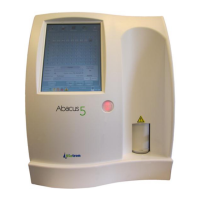
Diatron Abacus 5 - User Manual

Diatron Abacus 5
165 pages
Print Icon
To Next Page IconTo Next Page
Loading...
OM-A5-01-1229
Revision history
Rev.
Date
Edited by
Sections affected
Approved by
0.1.1
2008-OCT-07
Csaba Magyar
ALL initial revision
1.0.17
2009-FEB-25
Csaba Magyar
1.0.17 closing revision
Csaba Magyar
1.0.18
2009-MAR-28
Miklos Svarcz
1.0.18-finalised version
Svarcz Miklós
1.0.20
2009-APR-15
Csaba Magyar
Troubleshooting
1.0.21
2009-MAY-25
Csaba Magyar
1.1.1
2009-JUN-10
C.Magyar
SW revision - update
1.2.1
2009-JUN-11
C.Magyar
Reorder
1.2.2.
2009.JUN-12
C. Magyar
Accommodate changes and review reordering
1.2.3.
2009.JUN.15
C. Magyar
Edit
1.2.5
2009-JUN-30
C.Magyar
Limited features removed
1.2.6
2009-AUG-14
C.Magyar
Menu system review
1.2.7
2009-SEP-16
C.Magyar
List of accessories
1.2.8
2009-OCT-14
C.Magyar
SV cleaning (11.5.1), Result interpretation (sect 6), Reag.cons update,
Fluidic schematics (14.1-3); Measurement principles detailed;
1.2.9
2009-OCT-29
C.MAGYAR
Xb description; measurement methods
1.2.10
1.2.11
2009-12-12
C.Magyar
Autoloder prep.
1.2.12
2010-01-18 -
2010--02-17
Z.Borbás
Rewording, parameter clean-up, screen-shots, pictures, drawings, re-
structuring, Autosampler, reagent lock
1.2.13
2010-02-24.
Z.Borbás
Improved flagging description
1.2.14
2010-03-03
C.Magyar
Troubleshooting added
1.2.15
2010-04-12
C.Magyar
Update to SW 1.0.339
1.2.16
2010-04-15
C:Magyar
XB related functions removed
1.2.17
2010-06-04
C.Magyar
Screenshot updates, Measurement related troubleshooting temporarily
removed
1.2.18
2010-06-11
C.Magyar
SV cleaning revised
1.2.19
2010-06-29
C. Magyar
Reagent filtering method (specs) ultramicro filtered
1.2.20
2011-02-14
C.Magyar
X-B functions reinserted. Based on review by David Lopez;
based on 2
nd
review by GyA; Vienna sales office removed;
installation by service > service manual; load qc values added
X-B explanations included along with screenshots; sw versions updated in
the top; “set date and time” removed from installation section; reagent
lock section rephrased; troubleshooting part rearranged; reagent
consumption updated; printout samples updated;
EMC Class A specific information added to section 1.1.3;
Reagent replacement procedure: steps to replace containers added:
section 15.1.11; meas related troubleshooting received hard cleaning; 1
st
(approval page) added; garbage can icon added (section 1.1.3)
Á. Gyetvai
A. Galgóczi
1.2.21
2011-03-10
C.Magyar
New SV cleaning added to SV cleaning chapter
1.2.22
2011-04-29
A.Tremmel
Update screens; to match FDA release
1.2.23
2011-07-06
D. Lopez de
Quintana
Intensive review and update for US release.
1.2.24
2011-07-14
D. Lopez de
Quintana
Added section for Bar Code Symbologies, updated TAB file format,
changed recommendation for shear valve cleaning from 300 to 1200,
updated External Devices settings to add LIS TCP/IP “listener” port
information
1.2.25
2011.08.31
D. Lopez de
Quintana
Added Indications for Use statement
Qualified sample handling to include only venous blood
Updated performance characteristics
Removed references to refrigerated samples
Added table of background limits
1.2.26
2011.12.31
D. Lopez de
Quintana
Updated analytical measuring range
1.2.27
2012.02.11
D. Lopez de
Quintana
Updated Indications for Use and removed references to Research Use
Only (RUO) parameters
1.2.28
2012.03.07
M. Switzer
Correct Blank Limit and AMR errors
1.2.29
2012.11.22
T. Jozsi
General Update, reagent consumption update

Table of Contents

Questions and Answers

  • J
    Jessica FrostJul 31, 2025
    What to do if Diatron Laboratory Equipment SR gives grinding noise?
    • J
      Jennifer NixonJul 31, 2025
      If your Diatron Laboratory Equipment's SR (Sample Rotor) is making a grinding noise or the software displays SR error messages, it could be due to several reasons: * The front panel might not be closed properly. * The opening might not be aligned with the sample rotor door. * There might be liquid in the SR. If you see traces of salt, contact your service engineer. * The washing head may be contaminated with blood or salt. Excessive salt buildup can prevent the wash head from lifting effectively, causing the sample rotor door to get stuck.
  • D
    Darren RiceAug 4, 2025
    What to do if Diatron Laboratory Equipment shows SV error at the first startup?
    • J
      Jessica MartinAug 4, 2025
      If you encounter an SV error during the initial startup of your Diatron Laboratory Equipment, the shear valve (SV) might not be turning. Ensure that the pull tab has been removed. Also, check the shear valve for free movement by hand, rotating it to confirm it's not stuck.
  • J
    Jeff ReyesAug 13, 2025
    What to do if Diatron Laboratory Equipment SR does not turn into the analyzer?
    • M
      Michael McclureAug 13, 2025
      If the SR (Sample Rotor) on your Diatron Laboratory Equipment doesn't turn into the analyzer, even with the front panel open, check the washing head for contamination, such as blood and salt.
  • R
    Rodney JohnsonAug 17, 2025
    How to fix SV leakage in Diatron Laboratory Equipment?
    • T
      Teresa YoungAug 17, 2025
      If you're experiencing SV leakage with your Diatron Laboratory Equipment, it might be due to the upper disc not sitting properly on the lower disc. To resolve this, open the unit and reseat the upper disc.
  • X
    xfordAug 21, 2025
    What to do if Windows XP Embedded operation system errors appear in Diatron Laboratory Equipment?
    • L
      Lindsay DavisAug 21, 2025
      If you encounter Windows® XP® Embedded operation system errors on your Diatron Laboratory Equipment, accept the error message and repeat the operation. If such error messages continue to occur, restart the ‘Abacus 5’ analyzer.
  • R
    Rebecca ZimmermanAug 26, 2025
    Why Diatron Laboratory Equipment has mechanical problems?
    • E
      Eric GoodwinAug 26, 2025
      Most mechanical problems with Diatron Laboratory Equipment arise due to physical blockages of the moving parts. If the problems are caused by severe blocks, contact your service engineer to determine the cause and resolve the issues.
  • V
    victoriamaciasNov 7, 2025
    Why does the needle carriage keep dropping back in Diatron Laboratory Equipment?
    • J
      Jennifer TaylorNov 7, 2025
      If the needle carriage in your Diatron Laboratory Equipment keeps dropping back during initialization, it could be due to several reasons related to salt build-up or wash head positioning: * The wash head and surrounding area should be free of salt build-ups. * Salt build-up or a thick salt layer at the bottom or inside the wash head can block needle movement. * The needle's through-hole in the vertical carriage should be free of salt. * Salt around the needle can damage it and affect sampling quality. * The wash head position relative to the needle and SR might be incorrect. * The wash head might be coming down too far, leaving no room for the SR door to turn. * The vertical rod holding the wash head may not be correctly inserted or pushed up to the maximum, causing the was...

Summary

Indications for Use

For Your Safety

General Safety Precautions

Crucial safety advice for handling the analyzer and its components.

Environmental and Physical Requirements

Guidelines on operating conditions, space, ventilation, and weight support.

Electrical and Disposal Safety

Specifies electrical requirements, grounding, and safe disposal of waste.

Operational Limitations and Emergencies

Outlines known limitations and procedures for emergency situations.

Product Support

Installation

Analyzer Package Contents

Lists all items included in the main analyzer and Autosampler packages for setup.

General Overview and Principles of Operation

Analyzer Overview

Introduces the analyzer, its technology, user interface, and connectivity.

Principles of Operation

Explains the core measurement technologies used by the analyzer.

Analyzer Components

Details the analyzer's internal components and their locations (front, back, sides).

User Interface

User Interaction Methods

Explains how to use the touch screen, Start button, mouse, and keyboard.

Graphical User Interface (GUI)

Describes the GUI structure including Quick Links, Display Area, and Status Display.

Menu System Navigation

Details access to primary menu items, system navigation, and safety codes.

Startup and Shutdown Procedures

Startup Overview

Outlines the importance of proper startup and shutdown for analyzer performance.

Analyzer Startup Process

Details the step-by-step process for powering up and initializing the analyzer.

Analyzer Shutdown Procedures

Describes procedures for logging off, shutting down, or preparing for shipment.

Sample Measurement

Sample Handling and Types

Covers supported sample tubes, collection, handling, and identification.

Running Samples

Details manual and automatic sample processing modes, including Autosampler functions.

Result Display and Reporting

Explains how results are displayed and printed.

Result Interpretation

Result Screen Layout

Explains the four main areas of the result screen for data interpretation.

Database Functions

Database Overview and Navigation

Explains database overview, scrolling, sorting, and selection methods.

Database Record Management

Covers importing, exporting, sending to LIS, saving files, and deleting records.

Calibration

Calibration Process

Guides through automated and manual calibration procedures and viewing history.

Quality Control (QC)

QC Setup and Measurement

Covers setting references, running QC, and viewing results and diagrams.

X-B Data Analysis

Explains X-B data and diagrams for trend analysis of parameters like MCV, MCH, MCHC.

Patients

Patient Management

Explains how to define and store patient information in the database.

Multi-User Mode

User Roles and Management

Defines user roles, creation, deletion, and privilege management.

Settings

Customization and Interface Settings

Customizes UI appearance, language, sound, and input methods.

System and Device Configuration

Configures laboratory info, external devices (LIS), system behavior, and profile limits.

Parameter and Data Settings

Adjusts printer settings, X-B constants, and user management.

Instrument Diagnostics

Analyzer Self Tests and Information

Explains running self-tests, viewing system information, and their results.

System Logs and Status

Covers reviewing system logs, reagent status, and operational statistics.

Maintenance

Accessing Analyzer Components

Instructions for opening/closing the front panel and removing side panels.

User Maintainable Parts

Identifies key user-serviceable parts like shear valve and wash head for cleaning.

Software Maintenance Functions

Details software-driven procedures for cleaning, draining, priming, and filling.

Reagent Replacement

Guides on how to replace reagent containers and reset software counters.

Reagent Locking

Reagent Key Functionality

Explains the reagent locking feature and the use of hardware keys for measurement counts.

The Daily Routine

Daily Routine Steps

Outlines the sequence of daily tasks for analyzer operation and maintenance.

QC and Calibration Notes

Provides tips and recommendations for blank measurements, QC, and calibration procedures.

Troubleshooting

Error Message Handling

Covers software and pneumatic error messages and their interpretation.

Mechanical and Result Issues

Addresses mechanical problems (rotor, needle, valve, dilutor) and measurement result issues.

Accessories

Appendix

Reagent Consumption

Provides consumption data for reagents per function in milliliters.

Display Ranges

Lists display ranges and selectable units for measured parameters.

Fluidic System Diagram

Diagram illustrating the analyzer's fluidic system layout.

Printed Report Formats

Shows examples of detailed and listed printout formats.

Parameter Calculation

Details the formulas used for calculating various hematology parameters.

Specifications

Lists technical specifications like dimensions, weight, throughput, and reagents.

Performance Characteristics

Presents data on precision, accuracy, linearity, carryover, stability, and ranges.

Reagent System

Describes the diluent, lyse, and cleaner reagents used by the analyzer.

Tab File Format

Explains the format of tab-separated files for data export.

Diatron Abacus 5 Specifications

General IconGeneral
BrandDiatron
ModelAbacus 5
CategoryLaboratory Equipment
LanguageEnglish

Related product manuals