55
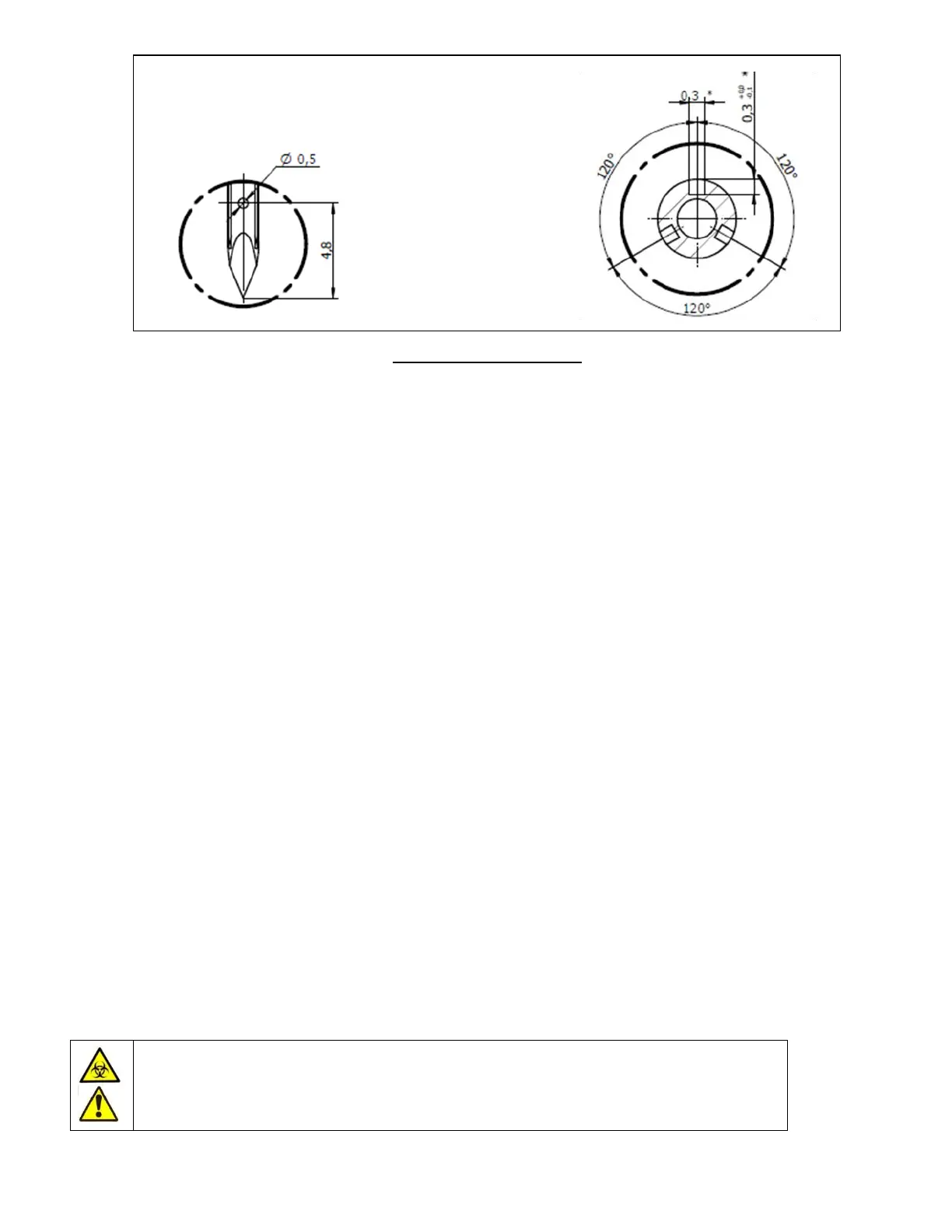
Figure 30. Sampling Needle
8.1.3 Open or Closed Sample Tubes
The ‘Abacus 5’ can process both open and closed sample tubes in manual mode using the sample rotor. Manually
presented sample tubes must be mixed properly before being presented to the ‘Abacus 5’ analyzer.
Only closed sample tubes will be automatically processed by the optional Autosampler. Open sample tubes placed in
the Autosampler will be skipped and not processed.
8.1.4 Sample Collection and Handling
Please consider the following when collecting and handling blood samples:
The ‘Abacus 5’ analyzer aspirates 110 µL of sample in both closed and open vial modes. Under the following
conditions, the ‘Abacus 5’ may aspirate less than 110 µL of sample, but will detect and flag any inadequate
sample aspirations:
o The sample tube does not vent properly and contains residual vacuum
o The viscosity of the blood is very high
The ‘Abacus 5’ is unable to aspirate the last 8 mm (0.31 inches) or 0.3 to 0.5 ml of sample volume.
Make sure that the sample tube is filled to the sample level line indicated by the tube manufacturer. The
anticoagulant not only prevents the coagulation of blood, but also dilutes it. If the volume of blood is too low,
than this dilution can adversely affect measurement results.
Ensure that the blood and anticoagulant are properly mixed by inverting it at least 8 times. Do not shake the
sample as this could damage blood cells.
A minimum of 30 minutes should elapse between taking the blood sample and running it on the ‘Abacus 5’
for analysis to ensure that the interaction of blood and anticoagulant has fully stabilized. Check the data
sheet of the sample tube for the exact period of time.
Use only K3-EDTA anticoagulated fresh whole blood as sample.
Analyze blood samples within 7 hours of collection.
Samples should be analyzed at room temperature.
Do not deliver or store the samples at temperatures above normal body temperature.
All samples should be handled as potentially infectious material and treated as a biohazard.


 To Next Page