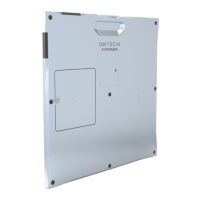
The EXT 1824G is a flat panel digital X-ray detector designed for industrial use, offering advanced radiographic capabilities through its DRTECH Extream series. This device is engineered for high resolution and sensitivity, enabling the capture of digital images with low X-ray doses. Its lightweight and thin design, coupled with wireless LAN communication (IEEE 802.11n*), enhances portability and operability.
Function Description
The primary function of the EXT 1824G is to detect X-rays and convert them into high-resolution digital images. It supports two main exposure modes: AED (Automatic Exposure Detection) Mode and S/W Trigger Mode. In AED Mode, the detector automatically senses the actual amount of X-rays without requiring a direct connection to the X-ray generator, acquiring and transmitting image data based on exposure time. The S/W Trigger Mode also operates without a direct generator connection, but requires the user to press an "Acq. Start" button on the software to initiate image acquisition when X-rays are being emitted.
The detector transmits image data via wireless communication (IEEE 802.11abgn, 5GHz/2GHz Wifi) or through a wired LAN connection (1G-Ethernet). The wired connection offers faster data communication and continuous power supply, reducing the need for frequent battery charging and replacement. The system includes a workstation (PC) or a portable console PC for image processing, display, and storage.
Important Technical Specifications
- Model: EXT 1824G
- Purpose: EOD, Industrial NDT
- Pixel Pitch: 76 µm
- Scintillator: Gadox (Gadolinium Oxysulfide)
- Image Matrix Size: 2304 x 3072 pixels
- Effective Imaging Area (H x V): 233.472 x 175.104 mm
- Image Acquisition and Transfer Time: < 4 sec (with HR Mode), < 3 sec (with HT Mode)
- Rated Power Supply:
- Wireless: Powered by battery pack (DRTECH Corporation/Powerlinx / EVS-MBP-Y / 7.4V, 4000mAh)
- Wired: Powered by power adaptor using tether interface (XP Power / AHM85PS12 / DC12V 7.08A)
- Power Consumption: Max. 24 W
- Network Interface: Gigabit wired / WIFI (2.4G, 5G)
- Dimensions (W x H x D): 265(W) x 215(H) x 21.8(D) [±0.5 mm]
- Weight: 1.7 kg
- IP Grade: IP67
- Operating Temperature: 0℃ to 45°C (or -20 to 45 °C with External Battery)
- Operating Humidity: 30 to 85% RH (Without Condensing)
- Operating Atmospheric Pressure: 700 to 1060 hPa
- Storage Temperature: 0℃ to 45°C (12h Storage -40 to 70 °C)
- Storage Humidity: 5 to 95% (Without Condensing)
- Storage Atmospheric Pressure: 500 to 1060 hPa
- Battery Pack (EVS-MBP-Y): Lithium Polymer, 2S1P (2 series 1 parallel), Output DC +7.4V, Approx. 500 cycles of use, 163 mm x 148 mm x 7 mm, 0.24 kg.
- Battery Charger (EVS-BCS): Simultaneous charging for 2 battery packs, Charging time 3 hours, Rated Power Supply DC +12V, 6A Max., 255 mm x 180 mm x 35 mm, 0.5 kg.
- Adaptor (AHM85PS12): Rated input 100-240Vac / 1.0A, 50/60Hz; Rated output 12V, 7.08A.
- WIFI Module: IEEE 802.11abgn (2T2R), Data Rate up to 300Mbps, Operating Frequency IEEE 802.11abgn ISM Band (2.400GHz ~ 2.4835GHz, 5.150MHz ~ 5.825MHz), 2 x UFL connector or printed antenna.
- Bluetooth Module: Bluetooth 4.1, Data Rate 1 Mbps, Operating Frequency 2.4 ~ 2.48 GHz, Operation Range 100 meters.
Usage Features
- System Configuration: The EXT 1824G can be used in both wireless and wired configurations. Wireless operation requires a battery pack, while wired operation uses a DATA(LAN) cable which also supplies power, eliminating the need for a battery pack.
- Battery Management: The detector uses dedicated battery packs (EVS-MBP-Y) and a dedicated battery charger (EVS-BCS). The charger can charge two battery packs simultaneously in approximately 3 hours. Users are advised to fully charge batteries before use and to replace deteriorated battery packs.
- Power Save Management: The detector features "Sleep Mode" and "Deep Sleep Mode" to conserve battery life. In Sleep Mode, the detector can be operated within 2 seconds. In Deep Sleep Mode, it cannot be operated until canceled, requiring up to 10 seconds to wake up.
- Image Data Retransmission: If the detector disconnects from the AP during image data transmission, it can save unsent image data in its memory. Users can then download the image file or retransmit the last shot image data after reconnection using the acquisition mode of the ECali1 software.
- User Interface: The detector includes LED indicators for ready status (Green/Orange) and wired/wireless mode (AP lamp), an OLED display for battery level, operating modes (HR/HT), and SSID, a power button, and an AP button for wireless connection options.
- Workstation Requirements: A workstation with Windows 7 64-bit SP1 (Professional Edition or higher), Intel Core i7 or higher CPU, 8GB or higher RAM, 1TB or higher hard disk, and a Gigabit LAN card (Intel® PRO 1000 Series) is recommended for optimal performance.
- Safety Precautions: Users must follow safety guidelines, including using only dedicated cables and power supplies, avoiding wet hands, not placing heavy objects on cables, and securely plugging in power cords. The equipment should not be disassembled or modified without authorization.
Maintenance Features
- System Diagnostic: The ECali1 software includes a system diagnostic function that should be run at least once a year to ensure safe and operable condition.
- Calibration: To maintain optimal performance, the system must be calibrated. Calibration can be performed using the provided calibration data CD, especially after system installation or repair.
- Cleaning and Disinfection: The equipment should be wiped with a dry cloth slightly dampened with a neutral detergent. Solvents like alcohol, thinner, or benzene should not be used, as they can damage the surface. Cleaning should only be performed when the power is off.
- Daily Inspection: Before each use, users should inspect cables for damage, ensure secure power cord connections, and check the detector for loose screws, broken parts, or foreign substances on connectors.
- Monthly Inspection: Similar to daily inspection, ensuring no loose screws, broken parts, or foreign substances on external connectors.
- Yearly Inspection: A performance test or self-diagnosis using a phantom or resolution chart should be performed annually.
- Irregular Inspection/Calibration: Calibration should be performed if exposure conditions change significantly.
- Battery Disposal: Before discarding battery packs, terminals should be covered with adhesive tape or other insulators to prevent fire or explosion. Battery packs are recyclable and should be disposed of according to local regulations.
- Environmental Considerations: The equipment should be stored and operated within specified temperature, humidity, and atmospheric pressure ranges to prevent malfunction. It should not be exposed to high temperatures, high humidity, direct sunlight, or areas prone to vibration or unstable surfaces.

 Need help?
 General

 To Next Page