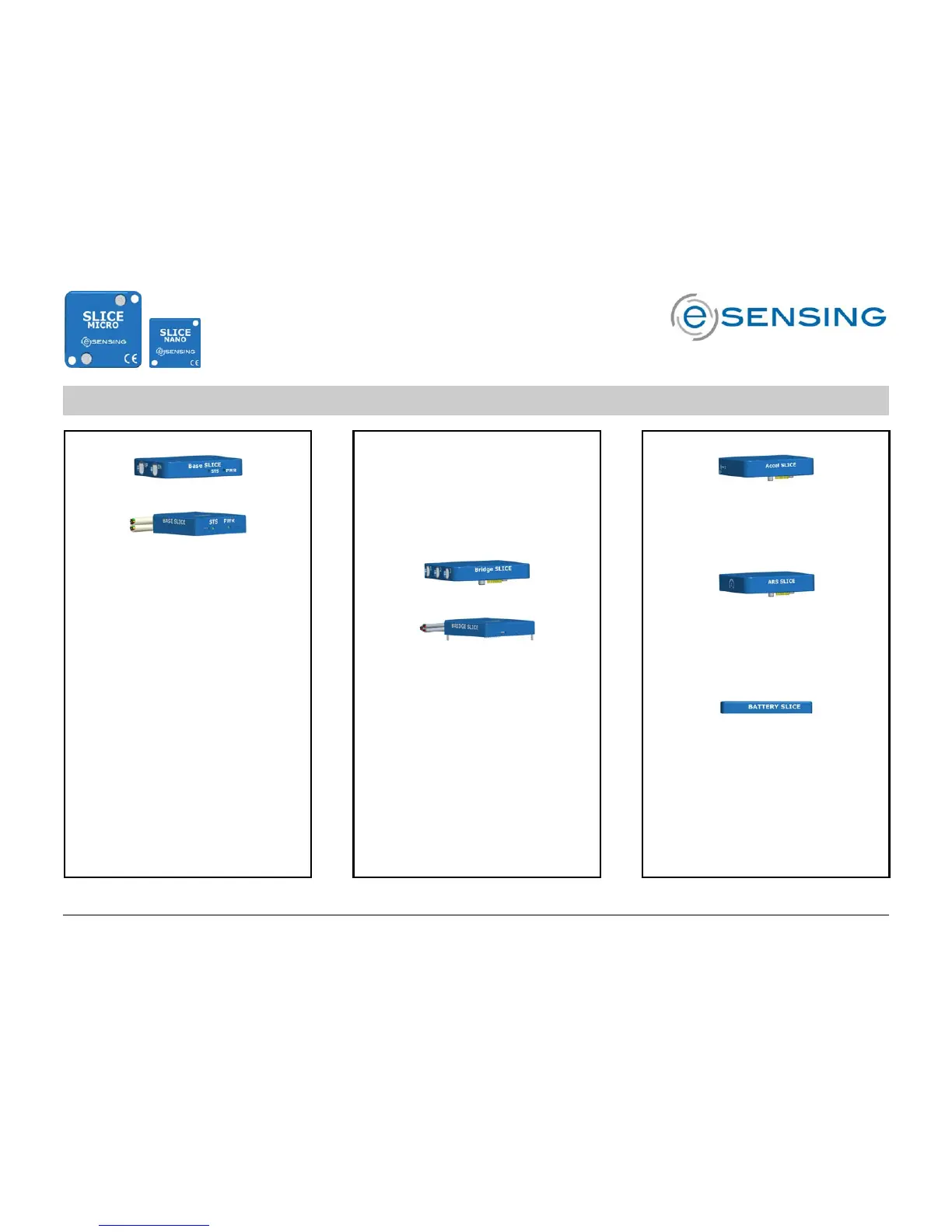
APPENDIX B - Base and Bridge SLICE support@dtsweb.com
April 2010 ©Diversified Technical Systems, Inc. - All Rights Reserved
SLICE MICRO Base
SLICE
NANO Base
Power:
- 7-15 VDC input voltage to entire stack
via Base
- 100 mA maximum current draw
- Reverse current protection
- Remote power control input for
turning unit on/off
Communication:
- USB from Base (Stack) to PC and
module to module
- DTS software using Windows
®
XP,
Vista
Trigger:
- Contact closure
Data Storage:
- 6 Gbyte non-volatile flash
- 120k samples/sec/channel maximum
- Recorder or circular buffer mode
Environment:
- 0 to 50°C operating temperature
- Rated to 500 g, 4 msec half-sine
System:
- One Base supports a maximum
current draw of 1 A total per stack
- Sensor excitation shuts down when
not recording
- Exceeds SAEJ211 response
SLICE
MICRO Bridge
SLICE NANO Bridge
Three differential, programmable sensor
channels:
- 2.5 or 5.0 V excitation via one
20 mA current-limited source per
channel (voltage set at factory)
- ±2.4 V input range (2.5 V center)
- DC to 40 kHz bandwidth
- 1.0 to 1280 gain
- Auto offset range = 100% of
effective input
- 16-bit SAR, one ADC per channel
- Software-adjustable, 5-pole Butter-
worth, low-pass, anti-alias filter
(1 Hz – 40 kHz)
- ½ bridge and shunt emulation support
- 120 mA maximum current draw
(depends significantly on sensor load)
SLICE MICRO Accel
- 3 internal accelerometers
- Options from 50 to 2000 g
- 65 mA maximum current draw
SLICE
MICRO ARS
- 3 internal angular rate sensors
- Options from 300 deg/sec to
50000 deg/sec
- 75 mA maximum current draw
SLICE
NANO Stack Battery
- Charges whenever input power is
connected to the Base
- ~15 minutes from complete discharge
to full charge (10.5 VDC, 100 mA, at
input connector on Base)
- Discharge rates:
~16 seconds at 1 A
~2 minutes at 400 mA
Specifications may be revised without notice. Drawings not to scale.


 To Next Page