UFM2/UBT User Manual
Page 2 Issue 1.1b July 20
1.2 How Does It Work?
The UFM2 and UBT meters use a cross correlation transit time algorithm to provide accurate flow
measurements.
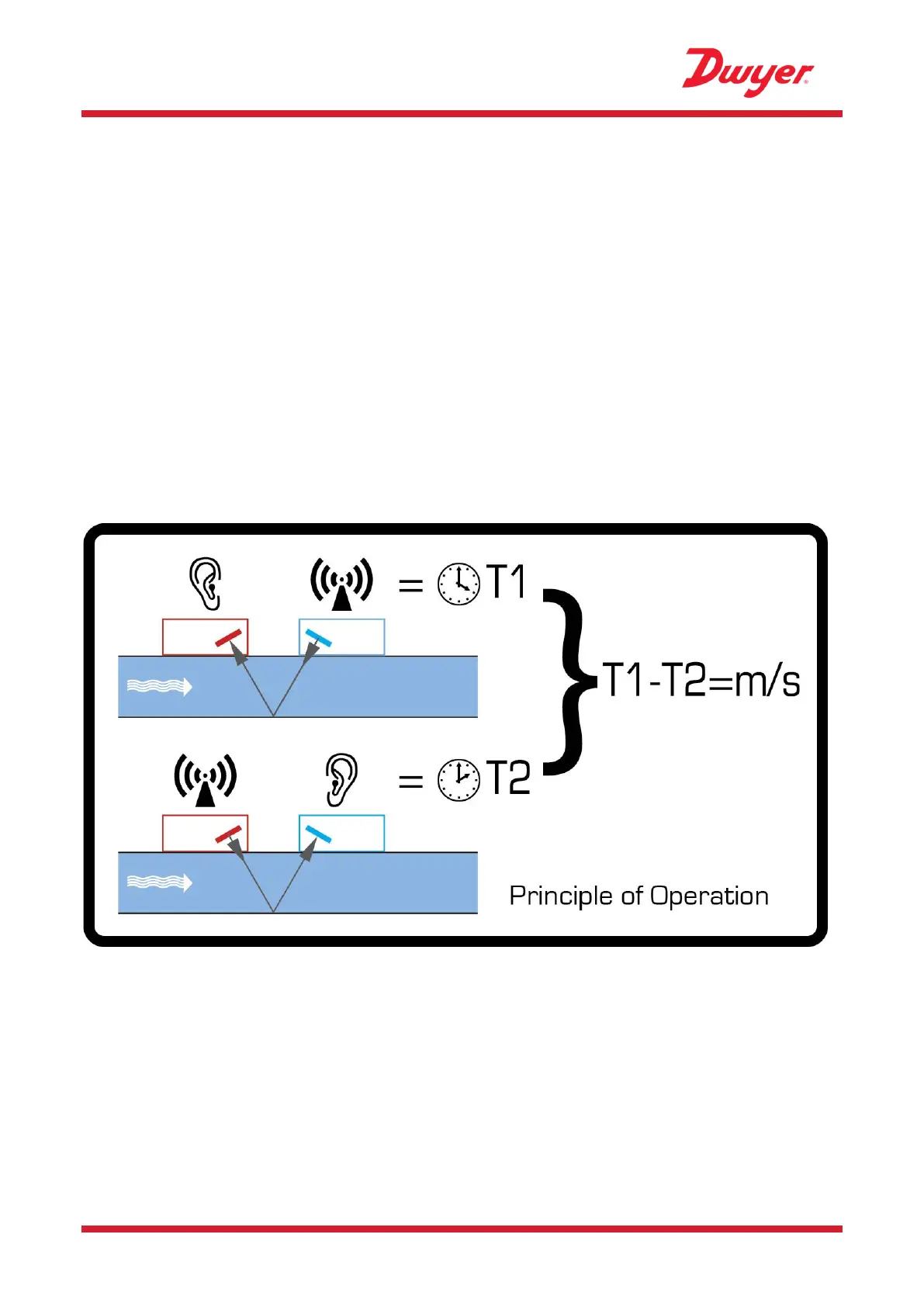
An ultrasonic beam of a given frequency is generated by applying a repetitive voltage pulse to the
transducer crystals. This transmission goes first from the downstream (blue) transducer to the
upstream transducer (red) as shown in the upper half of Figure 1. The transmission is then made in
the reverse direction, being sent from the upstream transducer (red) to the downstream transducer
(blue) as shown in the lower half of Figure 1. The speed at which the ultrasound is transmitted
through the liquid is accelerated slightly by the velocity of the liquid through the pipe. The
subsequent time difference T1 – T2 is directly proportional to the liquid flow velocity.
With the UBT, two temperature sensors measure the difference in temperature between the supply
and return of the flow system being monitored. The temperature difference, in combination with the
volume of water that has flowed through the system, is then used to calculate the energy transferred
to or from the water.
Figure 1 Principle of Transit-Time operation


 To Next Page