6
VFOs
and RIT/XIT
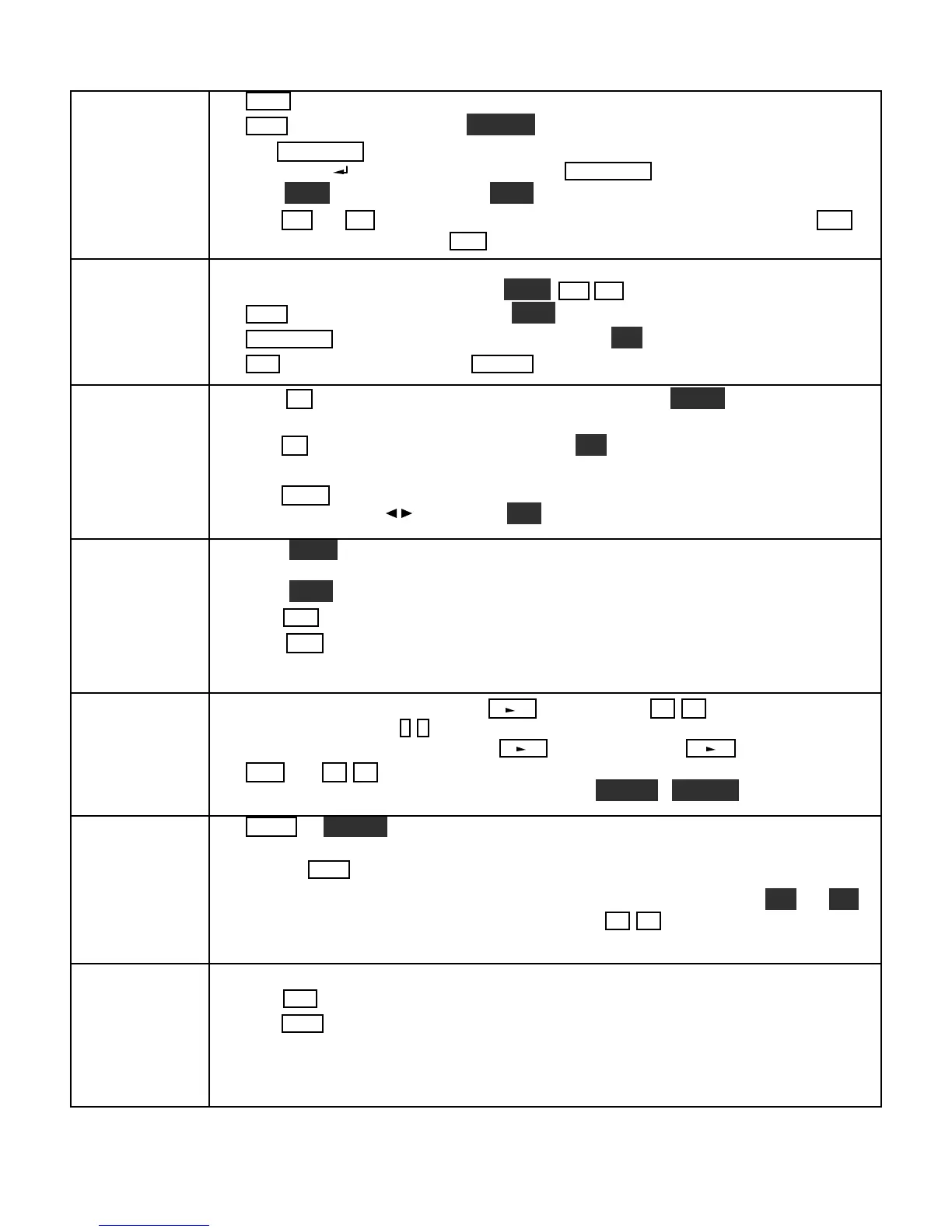
RATE {21} selects10 or 50 Hz VFO/RIT tuning. See VFO menu entries, pg. 52.
FIN E {21} selects 1-Hz steps. C OARSE selects large steps (MAIN menu, VFO CRS).
Tap FREQ ENT {21}to enter frequency in MHz using numeric keypad & decimal point.
Tap return ( ) to complete the entry, or tap F R EQ ENT again to cancel. (Pg. 15.)
Hold SCAN to start/stop scanning. SC AN must be preceded by a memory recall (pg. 39).
The R I T and XIT offset knob {17}has LEDs that show -/0/+ offset (pg.16). Tap CLR
{16}to zerothe offset. Hold CLR for > 2 sec. to add the offset to VFO A, then zero it.
Transmit,
ATU, and
Antenna
Controls
The TX LED {4} indicatesthat the K3 is intransmit mode. The ∆f LED turns on if the
RX andTX frequencies are unequal (SPL I T, RIT/XIT, cross-mode, etc.). (Pg. 13.)
XMI T {8} is equivalent to PTT {35}. TUNE puts out full CW power in any mode.
ATU TU N E {8} initiates antenna matching (pg. 22). ATU enables or bypasss the ATU.
ANT selects AN T1 or ANT2. RX AN T selects main or RX antenna (KXV3).
NB, NR,
and Notch
Tap NB {12}to enable DSP and I.F. noise blanking. Hold LEVEL to set DSP NB level
(VFO A) and I.F. NB level (VFO B). Fully CCW is OFF in both cases. (Pg. 25.)
Tap NR {12}to turn on noise reduction. Hold ADJ to tailor noise reduction for the
present band conditions (pg. 25).
Tap NTC H {12} once to select auto-notch (NTCH icon), and a secondtime to select
manual notch (adds icon). Hold MAN to adjust manual notch frequency. (Pg. 25.)
SPLIT,
BSET,
and SUB
Hold SPL I T {13}to enter split mode (RX on VFO A, TX on VFO B). If VFOs A and B
are on different frequencies in SPLIT mode, the Delta-F LED (∆f) will turn on (pg. 13).
Hold BSET {13}to adjust VFO B / sub RX settings independently of VFO A (pg. 37).
Tap SU B {20} to turn on the sub receiver (pg. 37). VFO B controls its frequency.
Hold SUB {20} to link the two VFOs (VFO A is then the master). This allows diversity
receive with main and sub if two different antennas are used (pg. 37).
Memories,
Messages, and
DVR
To store a frequency memory, tap V M {14}, then: tap M1 -M4 {15} to save a per-band
quick memory; or tap 0-9 to save a general-purpose quick memory; or rotate VFO A to
select from memories 0-99, thentap V M again to save. Tap M V to recall. (Pg. 16.)
REC and M1 -M4 {15} are also used to record & play voice/CW/DATA messages. The
KDVR3 option is required for voice messages and AF REC / AF PLAY (pg. 29).
Menus MEN U & CONFI G {8} access the MAIN and CONFIG menus. VFO B selects entries;
VFO A changes parameters. In general, CONFIG menu entries are used less often.
Tapping DISP {8} within menus shows information about each entry on VFO B (pg51).
Up to 10 menu entries can be assignedto programmable function switches. PF1 and PF 2
{16} are dedicated programmable functions. Any of M1 -M4 {15} can be used as Tap
and/or Hold programmable functions if they’re not being used for message play (pg 51).
Other
Features
RX andTX EQ (MAIN menu) provide 8 bands of receive/transmit equalization (pg. 35).
Tap AFX {18}to enable the selected audio effect (see CONFIG:AFX MD, pg. 51).
Tap DISP {8} and use VFO B to show time, supply voltage, etc. on VFO B (pg. 36).
The ALARM function (MAIN:ALARM menu entry) can be used to remind you about a
contest, net, or QSO schedule, and can eventurn the K3 on at alarm time (pg. 36).
The KIO3 module provides a rich set of AF {33} and digital {32} I/O (pg. 17).



 To Next Page