-40-
OBJECTIVE: Show variations of project 419.
Connect the whistle chip (WC) across points B & C.
Whistle Chip Sounds (II)
Project #420
OBJECTIVE: Show variations of project 419.
Whistle Chip
Sounds (III)
Project #421
OBJECTIVE: Show variations of project 419.
Whistle Chip
Sounds (VI)
Project #424
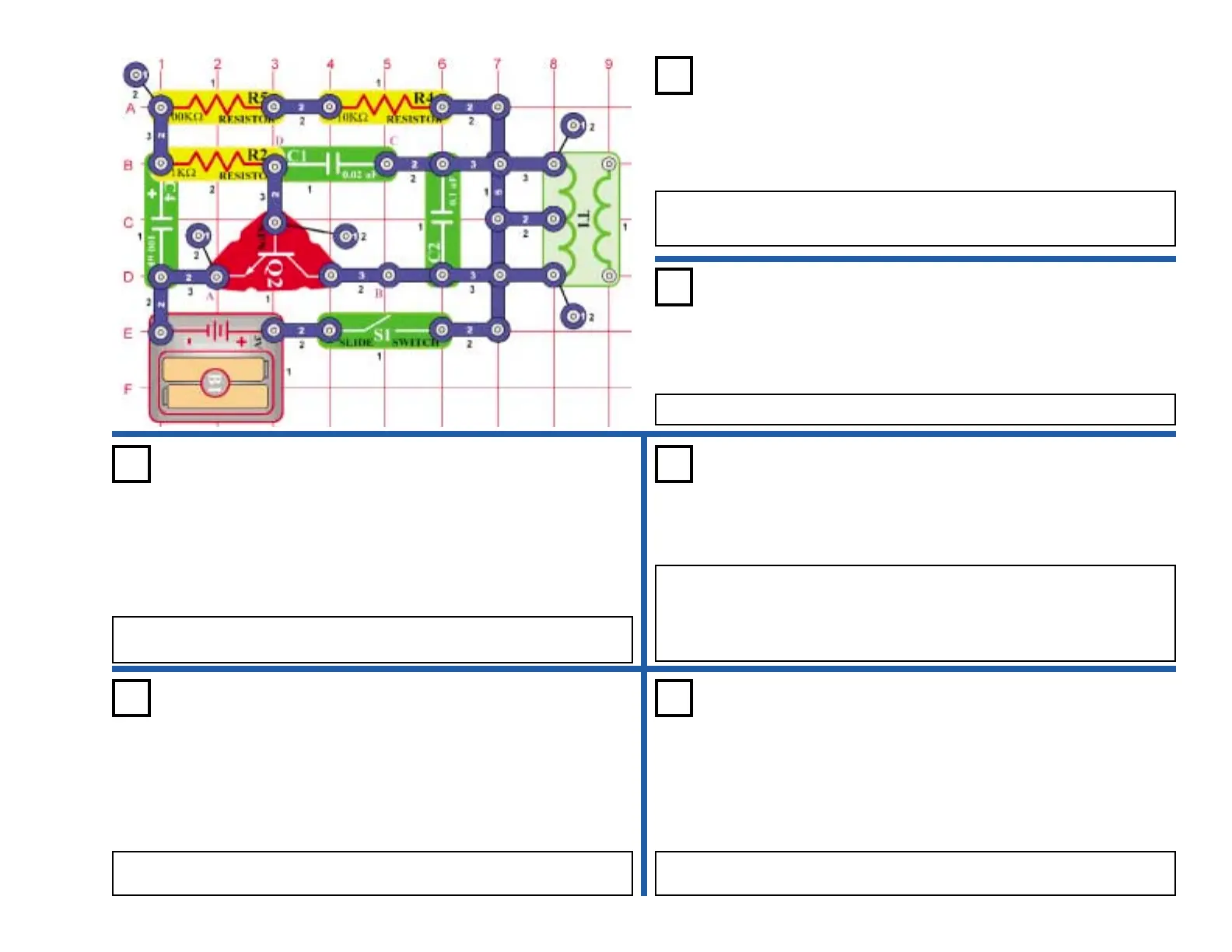
OBJECTIVE: To make sounds from the whistle chip.
Turn on the switch (S1). As the circuit oscillates, the plate in the whistle
chip vibrates and generates sound.
Whistle Chip Sounds
Project #419
Use the circuit in project 419. Connect the whistle chip (WC) across
points C & D. You should hear a faster sound.
OBJECTIVE: Show variations of project 419.
Whistle Chip
Sounds (V)
Project #423
Use the circuit in project 419. Connect the whistle chip (WC) across
points B & C. The time the sounds on is shorter then in project 421.
Use the circuit in project 419. Replace the 10µF capacitor (C3) with the
470µF capacitor (C5). Connect the whistle chip (WC) across points A &
B and turn on the switch (S1). There is a small delay, then the whistle chip
(WC) sounds for a minute and stops. The circuit then starts up again.
OBJECTIVE: Show variations of project 419.
Whistle Chip Sounds (IV)
Project #422
Use the circuit in project 419. Connect the whistle chip (WC) across
points C & D. In this project, the whistle chip sound is the shortest.



 To Next Page