-5-
MORE DO’s and DON’Ts of Building Circuits
After building the circuits given in this booklet, you may wish to experiment on
your own. Use the projects in this booklet as a guide, as many important design
concepts are introduced throughout them. Every circuit will include a power
source (the batteries), a resistance (which might be a resistor, lamp, motor,
integrated circuit, etc.), and wiring paths between them and back. You must be
careful not to create "short circuits" (very low-resistance paths across the
batteries, see examples below) as this will damage components
and/or quickly
drain your batteries. Only connect the ICs using configurations given in the
projects, incorrectly doing so may damage them. Elenco
TM
Electronics is not
responsible for parts damaged due to incorrect wiring.
Here are some important guidelines:
ALWAYS include at least one component that will limit the current through a
circuit, such as the speaker, lamp, whistle chip, capacitors, ICs (which
must be connected properly), motor, microphone, photo resistor, or
fixed resistors.
ALWAYS use the 7-segment display, LEDs, transistors, the high frequency IC,
the SCR, the antenna, and switches in conjunction with other
components that will limit the current through them. Failure to do
so will create a short circuit and/or damage those parts.
ALWAYS connect the adjustable resistor so that if set to its 0 setting, the current
will be limited by other components in the circuit.
ALWAYS connect position capacitors so that the “+” side gets the higher voltage.
ALWAYS disconnect your batteries immediately and check your wiring if
something appears to be getting hot.
ALWAYS check your wiring before turning on a circuit.
ALWAYS connect ICs, the FM module, and the SCR using configurations
given in the projects or as per the connection descriptions for the
parts.
NEVER try to use the high frequency IC as a transistor (the packages are similar,
but the parts are different).
NEVER use the 2.5V lamp in a circuit with both battery holders unless you are
sure that the voltage across it will be limited.
NEVER connect to an electrical outlet in your home in any way.
NEVER leave a circuit unattended when it is turned on.
NEVER touch the motor when it is spinning at high speed.
For all of the projects given in this book, the parts may be arranged in different
ways without changing the circuit. For example, the order of parts connected in
series or in parallel does not matter — what matters is how combinations of these
sub-circuits are arranged together.
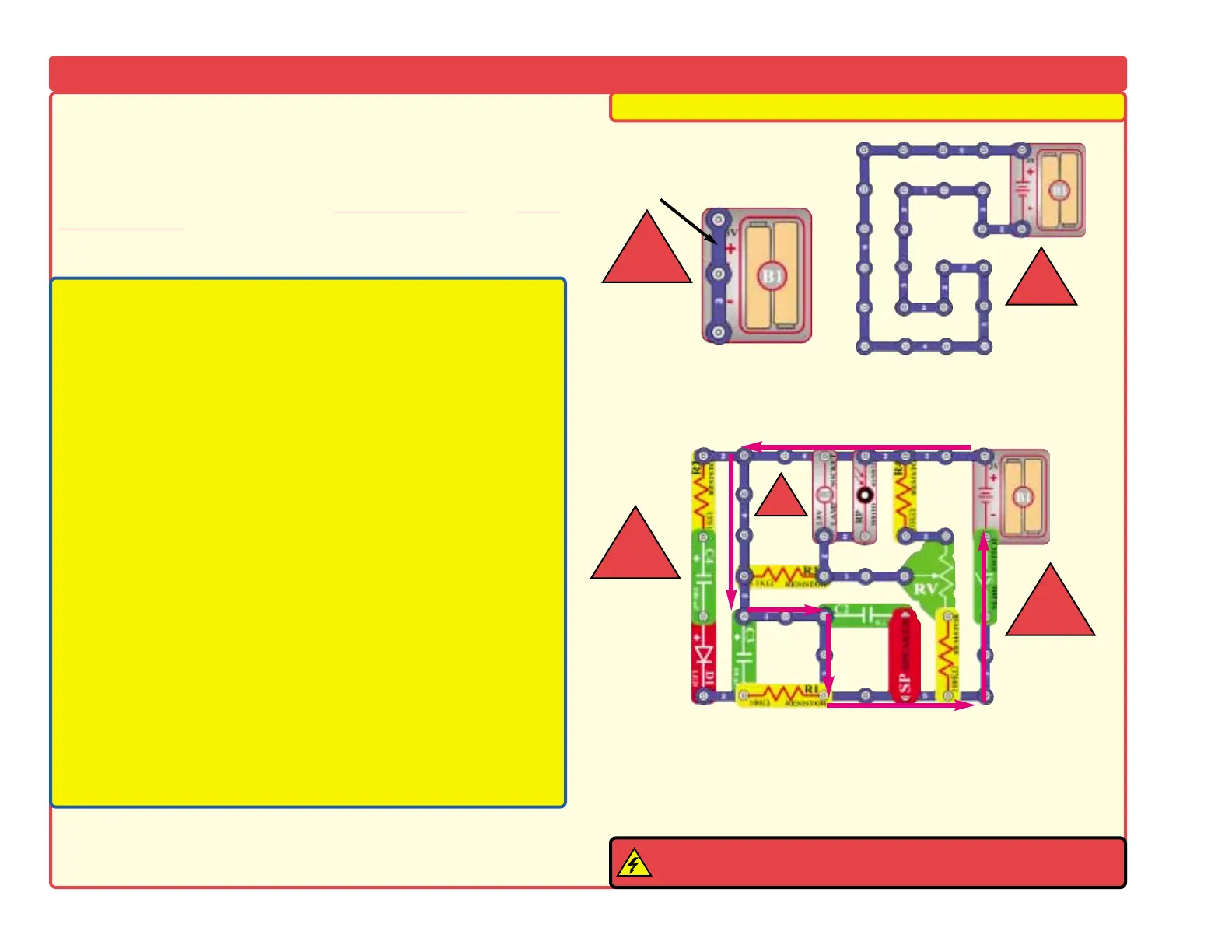
Examples of SHORT CIRCUITS - NEVER DO THESE!!!
You are encouraged to tell us about new circuits you create. Upon
review, we will post them with your name, age, and hometown in a special
section on our website. If we use them in future manual revisions, we will
send you a copy of the manual so you can show your family and friends.
Send your suggestions to Elenco
TM
Electronics.
WARNING: SHOCK HAZARD - Never connect snap circuits to the
electrical outlets in your home in any way!
Placing a 3-snap wire directly
across the batteries is a
SHORT CIRCUIT.
This is also a
SHORT
CIRCUIT.
When the switch (S1) is turned on, this large circuit has a SHORT
CIRCUIT path (as shown by the arrows). The short circuit prevents any
other portions of the circuit from ever working.
!
!
!
!
NEVER
DO!
NEVER
DO!
NEVER
DO!
NEVER
DO!
NEVER
DO!
!



 To Next Page