8
Enertech Global IOM, XT Models
Unit Placement
When installing a geothermal heating and cooling
unit, there are several items the installer should
consider before placing
the equipment.
1. Service Access. Is there enough space for
service access? A general rule of thumb is at
least 2 feet in the front and 2 feet on at least one
side.
2. Unit Air Pad. All vertical geothermal heating
and cooling equipment should be placed on
either a formed plastic air pad, or a high density,
closed cell polystyrene pad. Downow units
should be placed on a non-combustible base.
This helps eliminate vibration noise that could be
transmitted through the oor.
3. The installer has veried that all applicable
wiring, ductwork, piping, and accessories are
correct and on the job site.
Section 3: Installation Considerations
Duct Work
All new ductwork shall be designed as outlined
in Sheet Metal and Air Conditioning Contractors
National Association (SMACNA) or Air Conditioning
Contractors of America (ACCA) or American
Society of Heating, Refrigerating and Air
Conditioning Engineers (ASHRAE) handbooks.
All supply/return plenums should be isolated
from the unit by a exible connector (canvas) or
equivalent to prevent transfer of vibration noise
to the ductwork. The ex connector should be
designed so as not to restrict airow. Turning vanes
should be used on any transition with airow over
500 CFM. If the unit is installed in a unconditioned
space, the metal ductwork should be insulated
on the inside with berglass insulation or similar
insulation to prevent heat loss/gain and to absorb
air noise. If the unit is being installed with existing
ductwork, the ductwork must be designed to
handle the air volume required by the unit being
installed. When running a cooling or heating load on
a building, size ductwork accordingly to the building
design load and heat pump CFM.
Industry Standard: When sizing ductwork use 400
CFM per Ton.
As a general rule, maximum recommended face
velocity for a supply outlet used in a residential
application is 750 FPM. Maximum recommended
return grille velocity is 600 FPM. Systems with higher
velocity, are likely to have noise problems.
In buildings where ceilings are 8 feet or more, at
least 50 percent of the return air should be taken
back to the heat pump from the ceiling or high
sidewall location and not more than 50 percent
from the oor or low sidewall location.
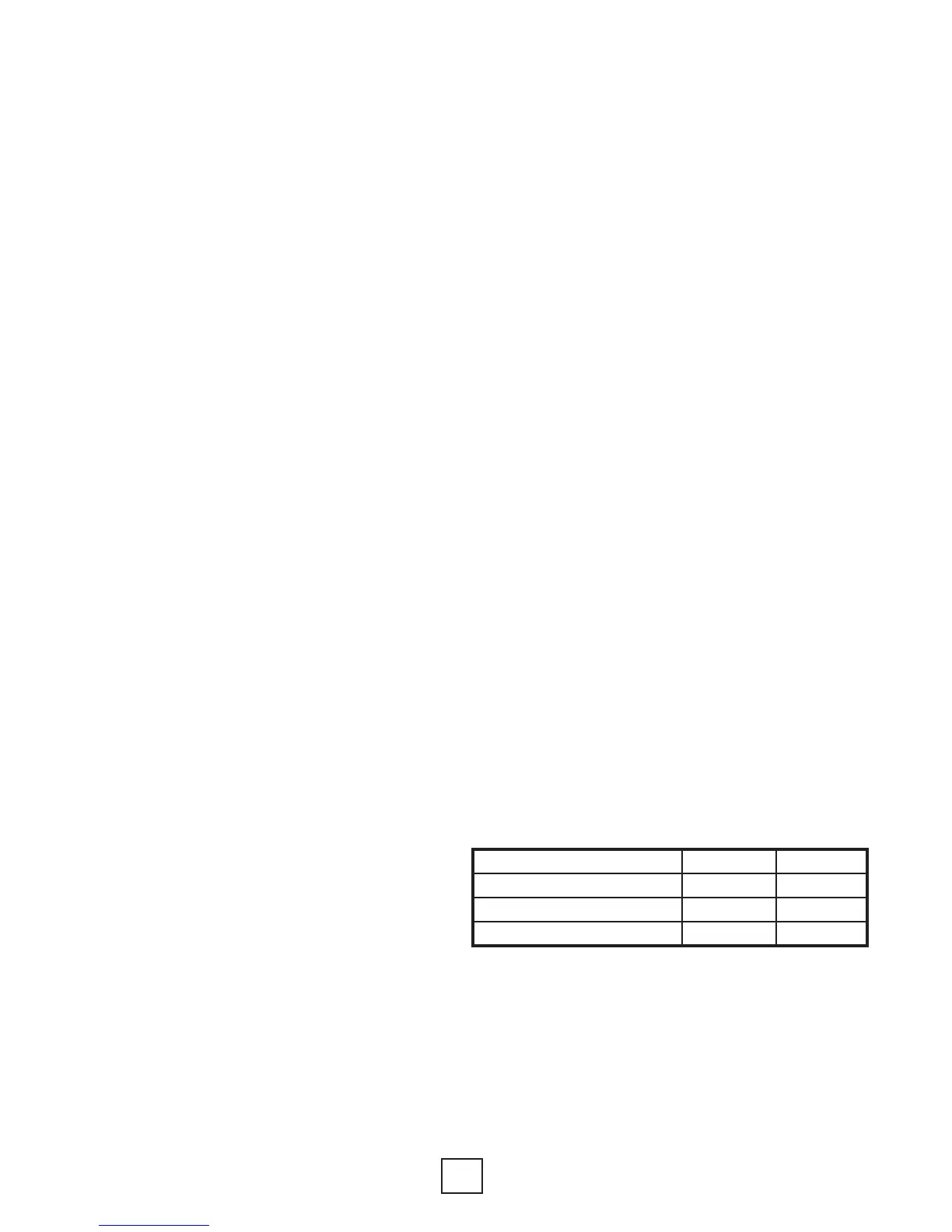
Table 1: Maximum Air Velocities
Location Supply Return
Main Ducts 900 FPM 600 FPM
Branch Ducts 700 FPM 600 FPM
Grills, Registers, Diffusers 750 FPM 600 FPM


 To Next Page