SOLUTIONS
Page 29
Owner’s Manual
4. Calculating site airflow requirements:
A typical heavy duty HEPA fan/filter unit has a 1000 CFM (cubic
feet per minute) capacity with a new filter. Units are typically
derated by 25%, so a 1000 CFM unit is derated to 750 CFM by
the hyiegenist when calculating actual site airflow requirements.
Example #1: A room measuring 20 x 20 ft with a 10 ft ceiling
encloses 4000 CF of air. To meet the 4X per hour change
rate the fan/filter unit must be capable of pulling 267 CFM
of air (4000 x 4/60) from the containment area and
maintain a minimum negative pressure of -0.020”WC.
Example #2: Room size is 20 x 50 with 12 ft ceiling. Requires
(20 x 50 x 12) CF x 4 / 60 = 800 CFM or 2 units (of a 1000
CFM fan/filter unit... remember the fan/filter unit is derated
to 750 CFM).
Example #3: Room size is 100 x 100 with 16 ft ceiling.
Requires (100 x 100 x 16) CF x 4 / 60 = 10667 CFM or
15 fan/filter units (of a 1000 CFM unit).
5. The containment area pressure should be monitored at various
points to confirm adherence to abatement requirements.
Remember that air is a medium, and air pressure is not identical
throughout the containment area. The pressures at specific
locations within the containment area vary due to distance, room
temperature, proximity to openings, room geometry, etc. Typically
one manometer is used for every two “rooms” that have a
doorway and attached hallway, up to 1000 square ft.
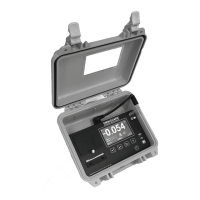
5. Using a manometer that provides highly accurate pressure
readings, timestamped logging of all readings, and audible
alarm and printouts of all logged readings protects workers and
the public from accidental exposure to airborne hazards and
provides proof of containment to protect employers from
environmental contamination lawsuits.
NOTE: It is important that there be no kinks or
sharp bends in any part of the tubing. Any blockage
could inhibit accurate recording of the pressure
in the containment area.


 To Next Page