T-IM114b P15/62
T20
Series
OPERATION TABLE
4.0 SAFETY NOTES & CAUTIONS
4.1 Warnings
The warnings and cautions that follow must be followed,
they are repeated as applicable within the text of these
‘Instructions for use’ to emphasise their importance. Ensure
you are familiar with them before using the table.
WARNINGS
The T20 Series of table have been designed to
minimise the possibility of accidental
electrosurgery burns. Contact with any metal
surfaces (e.g. table side rail, or other equipment
etc.) can cause burns during electrosurgery
and must be avoided.
The T20 tables are not rated as AP or APG and
should not therefore be used in the presence
of explosive gases.
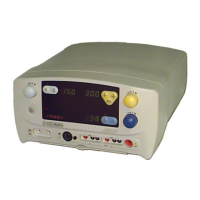
The T20 tables have been designed for patients
weighing up to 300kg (47 stone) with their centre
of gravity (normally the umbilicus) positioned
close to the column on the trunk sections.
However patient positioning and additional
loads from accessories can compromise table
stability and strength. Ensure that loading does
not compromise table stability or damage the
table (see graphs in section 6.4).
To comply with BS EN 60601-1:1990 some
accessories have been designed for a
maximum evenly distributed load, see the ‘User
Handbook’ supplied with each accessory.
With the table in (or during transition into) the
‘castor’ or ‘wheel’ orientation, the centre of
gravity of the patient (normally the umbilicus)
should lie no more than 200mm away from the
centre of the column. Whenever this is not
practical the table should be adequately
supported (e.g. by at least two able people).
The head and leg sections are designed to
support and position the corresponding part
of the patient’s weight only. Damage leading to
failure of the section may be caused if
excessive weight is applied. Take care when
handling these sections to avoid strain and
ensure no body parts or objects are trapped
when replacing or adjusting them.
Only use Eschmann accessories and sections
that are compatible with this table. When parts
are replaced during maintenance procedures,
ensure that ONLY parts supplied by, or from,
Eschmann Equipment are used. Alternatives,
although similar, may affect the safety of the
table. Eschmann cannot be held responsible
for service, modification or adjustments to the
equipment, when performed by other than
Eschmann accredited personnel.
Where given, descriptions and illustrations of
patient operating positions, and positioning
procedures, are for guidance only. It is the
responsibility of the operating surgeon to make
sure that the positions, and the positioning
procedures are appropriate for the operation
to be performed, and the safety of the patient.
(See section 6.0).
During any table positioning procedure care
should be taken to ensure the patient’s safety.
In particular during Trendelenburg and tilt
movements the patient should be supported
to ensure they remain secure on the tabletop.
The patient’s weight should be supported
whenever the sections are adjusted or removed
from the table during repositioning.
During ANY movement of the table or tabletop,
ensure that no part of either patient or hospital
staff, or object (e.g. drapes, infusion tubing,
diathermy connections, ECG cords etc.) can
become trapped between any moving and/or
stationary equipment, or in a pinch point,
causing injury or damage to equipment.
Particular table movements that should be
operated with care are reducing the height and
Trendelenburg, which can cause trapping
situations. Always ensure adequate slack is
available in drapes and tubing for the movement
required (e.g. maximum Trendelenburg).
When moving the table (e.g. in or out of theatre)
with a patient (maximum weight 135kg for T20-a
and T20-s, or 200kg for T20-m, see section 5.1)
always ensure that the patient‘s limbs are
secure on the tabletop to prevent crushing or
trapping them against another object, always
use cot sides (available as an accessory).
Always keep the patient under observation (e.g.
check respiratory and circulatory system and
for the possibility of pressure sores etc.) and
correctly positioned whilst on the table.
Ensure that electrical equipment connected to
the communication port (available during
maintenance procedures only) complies with
appropriate electrical safety standards. Note
that standards compliance of this product may
be affected if noncompliant equipment is
attached to the communication port.


 To Next Page