P6/62 T-IM114b
1.0 PRELIMINARY INFORMATION
WARNING
Read this preliminary information carefully and
note ALL of the warnings, cautions and safety
notes contained within these ‘Instructions for
use’ before using this Operation Table. Keep
these ‘Instructions for use’ close-to-hand at all
times for reference.
1.1 General
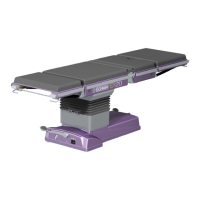
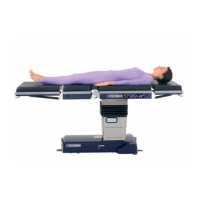
1.1.1 T20 Series operation tables are classified as
battery powered, mobile, general purpose, four section
operation tables. Their intended function is to support and
position a patient, in conjunction with their associated
accessories, during general surgical operations and
procedures in an operating theatre. Their intended
application is for use by medically qualified personnel,
trained in the use of the T20 Series powered operating
tables, during surgical operations and procedures in
accordance with these instructions.
1.1.2 These ‘Instructions for Use’ should be referred to
for details of the following T20 Series Powered Operation
Tables, see the table’s Serial Number Plate for the actual
table Serial Number and REF No.:
T20-a Catalogue (REF) number prefixed T20
Serial Numbers (SN) prefixed T2AC*...... or above.
T20-s Catalogue (REF) number prefixed T20
Serial Numbers (SN) prefixed T2SB*...... or above.
T20-m Catalogue (REF) number prefixed T2M
Serial Numbers (SN) prefixed T2MA*...... or above.
* The last digit of the SN prefix is the design modification
state, this may increase during the build life of the tables.
NOTE: Some models have ‘Denyer’, ‘USA’, or ‘Euro (Kifa)’
accessory side rails, standard Eschmann accessories
that locate onto these may not fit, please check with
Eschmann Equipment before purchasing accessories.
1.1.3 The T20 Series operation tables and accessories
must only be used as detailed within these ‘Instructions
for use’. Failure to do so could result in injury to patients or
users, or damage to the operation table and accessories.
Always ensure that all warnings and cautions detailed
within these ‘Instructions for use’, are strictly complied with.
Appendix 1 is provided for Hospitals that wish to keep a
log of those people trained in the safe use of this table.
Eschmann Equipment offers full training in the safe use of
these tables, please contact our After Sales Service
Department for details.
1.1.4 ‘Instructions for use’ and ‘Service manuals’ (see
section 3.3.9) as applicable should be readily accessible
for reference prior to and when operating, cleaning and
servicing the operation table. All manuals are available from
Eschmann Equipment, see inside front cover for address.
1.1.5 Ensure the table has been correctly installed
before starting to use it, see section 3.0.
1.1.6 All servicing and maintenance procedures should
be carried out by engineers who have been trained by
Eschmann. Training, a Service, or a Service Contract can
be arranged through our After Sales Service Department
(see inside front cover for contact details). Do not remove
the table covers at any time (danger of accessible mains
voltage), this should only be carried out during maintenance
procedures. Ensure that the operation table is regularly
serviced and checked for safety at least every six months.
1.2 About this manual
1.2.1 Within the text of these ‘Instructions for use’ the
following terminology is used:
i)
Left and right
. The terms ‘left’ and ‘right’ refer to
the side of the table when viewed from the long trunk
end (i.e. the head end with the table in its normal
configuration, head section fitted to the long trunk
as shown in Fig. 2.1). This is also the patient’s ‘left’
and ‘right’ when lying on the tabletop in a supine
position, with their head on the head section and
with the table in its normal configuration.
ii)
Auto-level
. The term ‘auto-level’ is used to describe
the automatic sequence of movements to return the
table to a preprogrammed position by pressing and
holding a single handset button. This does not affect
the head or leg sections, or any other manually
operated, or powered accessory, fitted to the table.
iii)
LEDs.
This abbreviation is used when referring to
the various indicator lights on the table or handset
which are light emitting diodes (LEDs).
iv)
Cranially and Caudally.
The term ‘cranially’ (head
section moves away from column) and ‘caudally’ (leg
section moves away from column) are used to
describe tabletop movement (table in the normal
orientation). Normal table orientation is with the head
section in the long trunk, normal patient orientation is
with the patient’s head on the head section.
1.2.2 These ‘Instructions for use’ have been split into
specific sections for ease of finding information (see the
main headings in ‘Contents’). Where applicable and within
each section, adequate cross references to other sections
are made to eliminate the need to duplicate information.
1.2.3 Section 5 (Operation) details how to use the T20
Series of tables and operate their controls correctly. It is
strongly recommended that the user has read and is
familiar with sections 1, 2 and 4 before passing onto
section 5 and starting to use this operation table.
1.2.4 Within this manual the sections in bold type
headed ‘WARNING’ give guidance on possible actions that
could lead to injury of the patient, or theatre staff, and
potential damage to the operation table. Sections headed
‘CAUTION’ give guidance on possible actions that could
lead to damage of this operation table which could then
lead to injury of the patient, or theatre staff.


 To Next Page