T-IM114b P7/62
T20
Series
OPERATION TABLE
1.3 Table description
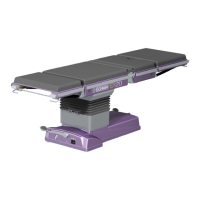
1.3.1 The T20 Series of four section operation tables
have been designed to provide facilities for General
Surgery, including Minimal Access procedures, Urology
and Gynaecology, Thoracic, Ophthalmic and ENT,
Neurosurgery, Plastic and Maxillo-Facial surgery, and non-
traction Orthopaedic Surgery, they allow for intra-operative
radiography using a C-arm image intensifier. They are not
suitable for Orthopaedic procedures requiring traction.
1.3.2 Careful design has minimised traps for potential
contamination stopping fluid entering the table during
normal use, cleaning and disinfection procedures. They
are stable, rigid in use and the robust construction provides
protection from patient trolley or C-arm knocks whilst still
providing easy access for servicing.
1.3.3 Tabletop movements (i.e. Trendelenburg, height,
tilt, break and traverse) are electrically powered and
incorporate ‘soft start and stop’ motions for patient comfort
and safety. The pedestal base is foot operated and the
standard head and leg sections are hand operated (see
sections 5.1 and 5.2 respectively).
1.3.4 The T20 Series of table are easy to operate,
theatre staff can quickly learn how to use them correctly
and safely. Tabletop control is provided by a corded
handset, or an optional footswitch (for Trendelenburg and
height control only) or an optional infrared handset. Hand
controls override footswitch control at all times and if a
corded handset is plugged into the table this will take
precedence over the infrared handset.
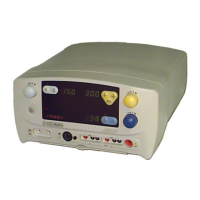
1.3.5 Power for all powered table movements is
provided by internal rechargeable batteries. There are two
battery sets, main batteries and standby batteries. These
are recharged by an internal battery charger which requires
connection to mains voltage using the mains cord supplied.
Note: If the main table batteries fail or become critically
low (i.e. warning indicators were ignored and batteries have
not been recharged) the table cannot be powered directly
from the mains. However by depressing and holding the
standby battery switch, powered table movements can
again be achieved (using power from standby batteries).
1.3.6 In emergencies (e.g. handset failure or a critically
low battery) a standby control panel on the column can be
used to control the table (however this MUST be limited to
emergency use ONLY, certain safety features are over-
ridden when this panel is used, see section 4.6.5). It may
be required to press the standby battery switch if the main
battery charge level is too low.
1.3.7 The bases on T20-a and T20-s tables are fitted
with enclosed multidirectional castors, that can be engaged
at any table height, making it easy to move on most theatre
floors. They have two foot pedals providing either castor,
wheel or braked orientations. The T20-m table is provided
with four large castors that can be adjusted by a single
foot pedal to provide wheel and castor modes and a braked
position (see section 5.1).
1.3.8 Visual indicators have been restricted to essential
functions and information only (e.g. table switched ‘on’ see
section 5.3.2.2, battery level indication and battery charging
state see section 5.3.1). Audible signals are only used to
signal that the table has been switched ‘on’ for a long time
without operation and that it should be switched ‘off’ see
section 8.1, a ‘beep’ is also provided when switching ‘on’
(the audible inactivity ‘beep’ can be configured ‘off’ during
a service if required).
1.3.9 Tabletops have a lightweight X-ray translucent
surface (designed to reduce shadows on images) and an
X-ray cassette tunnel with the facility for an X-ray cassette
(430mm x 340mm) to be placed at any point beneath the
full length of the patient’s body, see section 6.3. The
standard side rails allow placement of clamps and most
standard accessories. Simple button operated catches
release the head and leg sections when required.
1.3.10 The tabletop can be adjusted into the following
patient positions:
♦ Supine with C-arm access to patient from nipple
region to feet
♦ Supine with C-arm access to patient from groin to
head
♦ Supine Extension with C-arm access to break area
(Cholecystectomy-type procedure)
♦ Supine Flexion (‘Lawn chair’ position)
♦ Lateral
♦ Lateral Extension with C-arm access to break
(Nephrectomy position)
♦ Supine Lithotomy with C-arm access to whole of
the Urinary tract
♦ Supine Lithotomy with or without Trendelenburg
♦ Prone with or without extension at waist or hips (with
C-arm access)
♦ 90° Chair position with patient’s knees at the same
level as the heart, offset to the head end.
1.3.11 For additional information see section 6.0 for
patient positioning notes, section 6.2 for the obese patient,
6.3 for radiographic procedures and 6.4 for illustrations
and details of safe loading.
1.3.12 Castor covers (spats) are supplied as an optional
item with the T20-m table. These can be fitted by an
Eschmann Engineer at any time, please contact the After
Sales Service Department.


 To Next Page