T-IM114b P29/62
T20
Series
OPERATION TABLE
5.3.3.2 Handset button functions
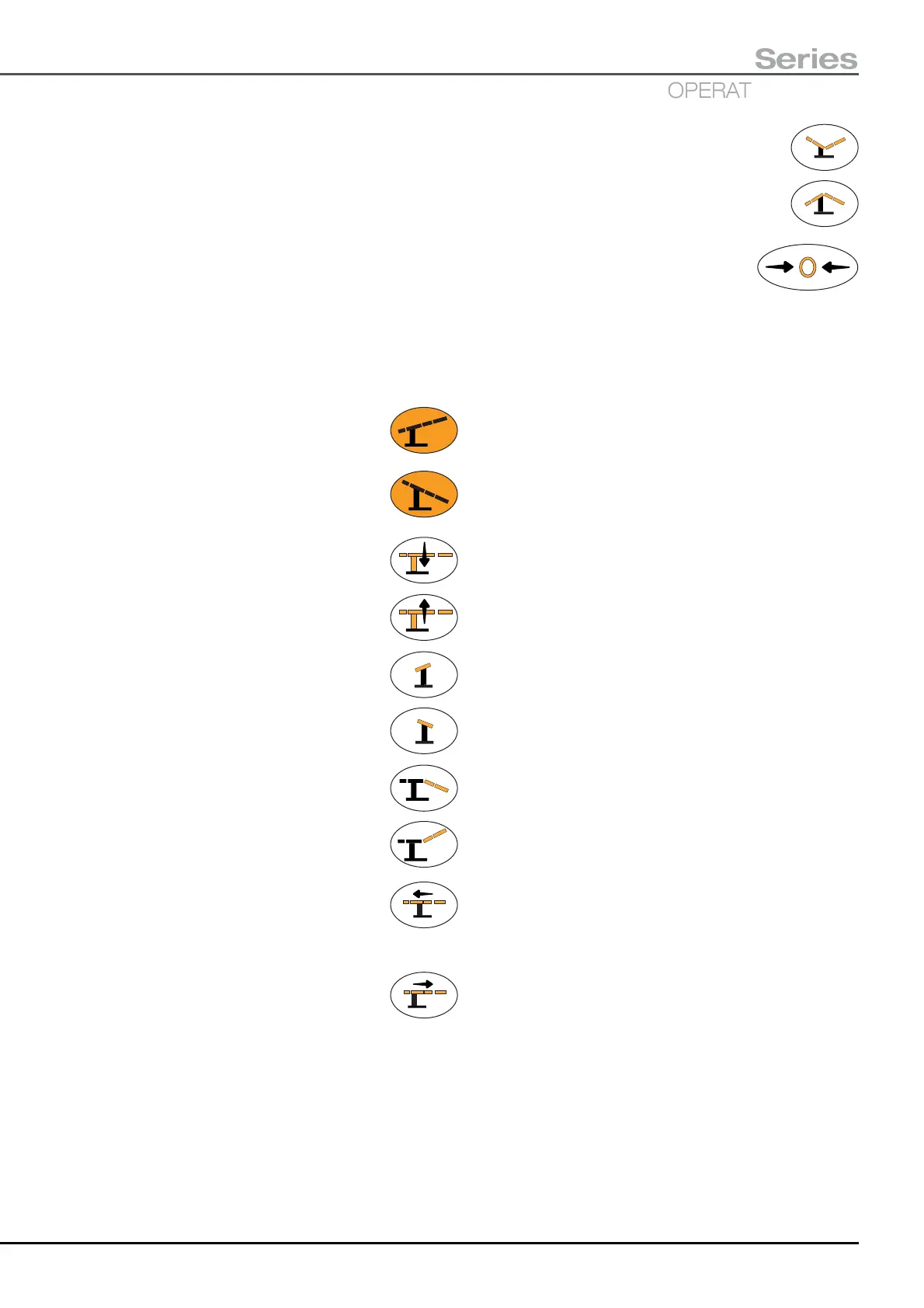
Handset buttons have their function indicated by graphics
printed on the handset, see Fig. 5.12.
To activate the required tabletop motion press and hold
the appropriate button until the required amount of change
in tabletop position has been achieved, then release the
button. The actual motion for each button is fully detailed
below, refer to Fig. 5.12 for button reference.
Note: Buttons B1 and B2 provide the described movement
for a table top in the normal orientation (head section in
long trunk) with the patient’s head on the head section. If
the patient orientation is reversed button functions B1 and
B2 are also reversed.
B1 Trendelenburg (orange button). Press to
rotate the tabletop in the Trendelenburg
(head down) direction.
B2 Reverse Trendelenburg (orange button).
Press to rotate the tabletop in the
Reverse Trendelenburg (head up)
direction.
B3 Height down. Press to lower the whole
tabletop.
B4 Height up. Press to raise the whole
tabletop.
B5 Tilt left - Press to tilt the whole tabletop
down on the left-hand side when viewed
from the long trunk end.
B6 Tilt right - Press to tilt the whole tabletop
down on the right-hand side when viewed
from long trunk end.
B7 Break down - Press to move the tabletop
in the break down (Extension) direction.
B8 Break up - Press to move the tabletop in
the break up (Flexion) direction.
B9 Traverse Cranially - Press to move the
tabletop Cranially (i.e. the tabletop will
traverse and increase the distance
between the end of the long trunk section
and the column).
B10 Traverse Caudally - Press to move the
tabletop Caudally (i.e. the tabletop will
traverse and decrease the distance
between the end of the long trunk section
and the column).
B11 Extension - Press to move table into
Extension.
B12 Flexion - Press to move table into
Flexion.
B13 Return to Level - Press to return the
tabletop to a ‘preset’ level position.
This may invoke all powered
movements to achieve the ‘preset’
level position. The sequence of movements is tilt,
Trendelenburg and Break together, a short pause and
then maximum traverse cranially. (Note: Height is not
affected).
Tilt, Trendelenburg and Break motions will pause
momentarily when passing through a ‘level’ position.
Note that ‘Break’ is level when the trunk sections are in-
line with each other, they will not be horizontal unless
Trendelenburg is horizontal.


 To Next Page