P26/62 T-IM114b
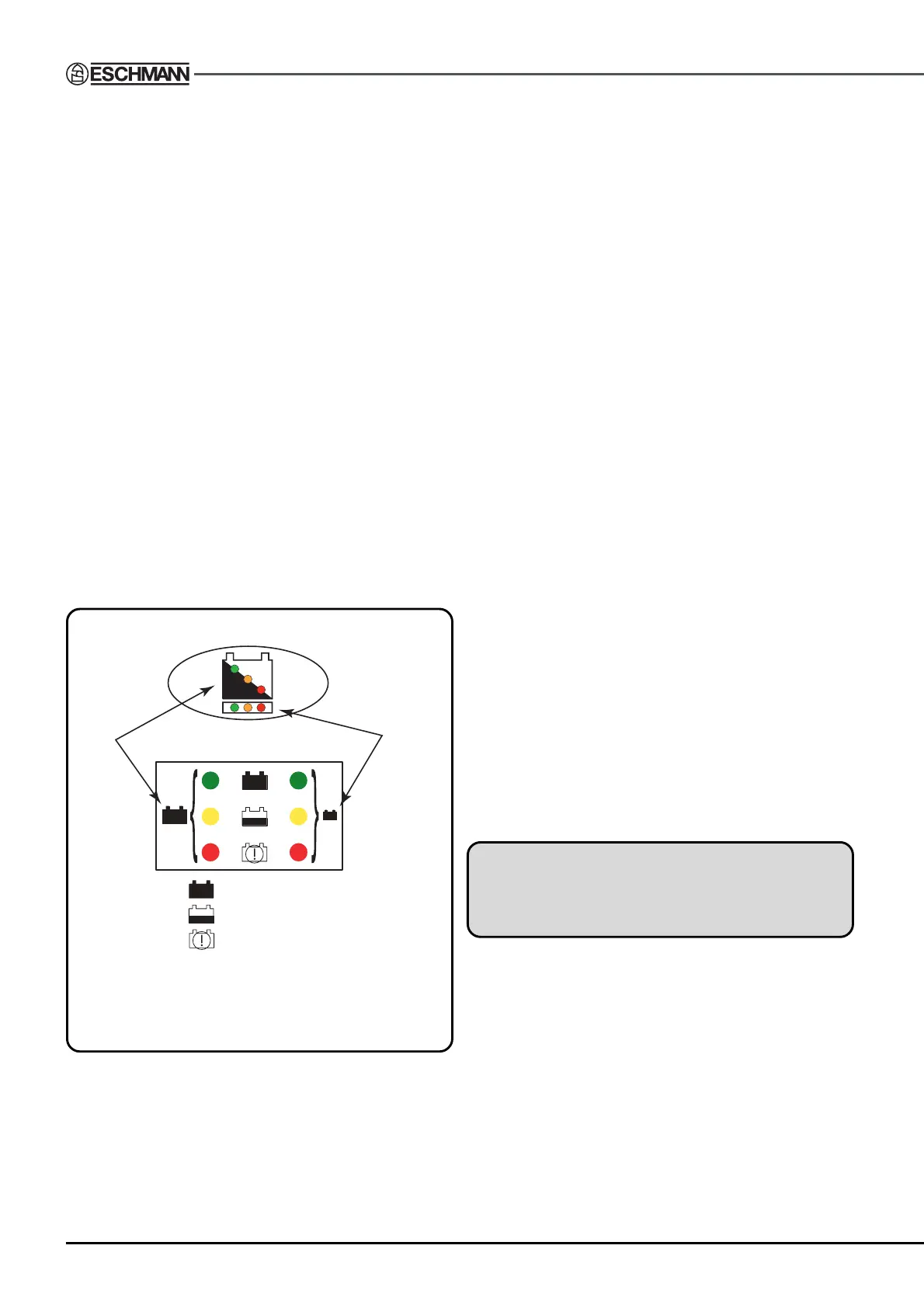
Main battery level indicator:
Green LED ‘on’ = Battery level satisfactory.
Amber LED ‘on’ = Low battery. An indication that
the remaining battery charge is only adequate for
one day’s average use. Batteries MUST be
recharged at the end of the current shift.
Red LED ‘on’ = Critically low battery. An indication
that the remaining battery charge is critically low.
Batteries MUST be recharged as soon as possible
and before the next procedure. Charging during the
current procedure is not recommended.
Standby battery level indicator:
Green LED ‘on’ = Battery level satisfactory.
Amber LED ‘on’ = Low battery. Battery level is low
and only adequate for two or three Trendelenburg
movements, they MUST be recharged at the end of
the current shift.
Red LED ‘on’ = Critically low battery. Battery level is
critically low and only adequate for one Trendelenburg
movement. They MUST be recharged as soon as
possible and before the next procedure. Charging
during the current procedure is not recommended.
= 'Trickle' charge
= 'Top-up' charge
= 'Bulk' charge
Handset (battery charge level)
Main
Standby
Table (battery charging state)
Fig. 5.10 Handset and charging indicators
Note T10-m has only one charging LED
indicating the level for both batteries.
When the main battery ‘critically low’ warning is indicated
the table cannot be operated by either handset or the
footswitch. To continue to operate the table either connect
it to a suitable mains supply and recharge the batteries
(see 5.3.1.2) or use the standby batteries (see 5.3.1.4).
Note: The standby control panel can be used even when
the ‘critically low battery’ indication is given but note the
warning in section 5.3.4.
5.3.1.2 Battery charging
To recharge the table batteries (normal and standby)
connect the mains cord supplied with the table (do not
use any other mains cord) into the mains inlet (item 18,
Fig. 2.2 for T20-a and T20-s tables, or item 3 of 2.3 for
the T20-m table).
Connect the mains cord to a suitable mains supply (check
mains voltage is 100-240V, 50-60Hz) and switch the supply
‘on’ if controlled by a switch.
The battery charging LEDs (items 7 and 8 of Fig. 2.2 for
T20-a and T20-s tables, or item 2.3 for the T20-m table)
will illuminate ‘red’ to indicate ‘bulk’ recharge, ‘amber’ to
indicate that the batteries are in a 2 hour ‘top-up’ charge
and will illuminate ‘green’ to indicate a fully charged battery
on ‘trickle’ charge (Note. The T20-m table only has one
LED indicating both main and standby charging state).
The batteries should be fully charged within six hours (if
the table is not in use) but it is safe to leave the mains
supply ‘on’ when the batteries are fully recharged and both
LEDs are ‘green’ (or in the case of the T20-m table the
single LED is ‘green’). See CAUTION in section 5.3.1.1.
Note: Always ensure the table is switched ‘off’ to minimise
the battery charging time.
It is recommended that the mains cord is stored on the
‘T’ Series accessory trolley (an accessory) to avoid loss
and inadvertent use of an incorrect mains cord. It should
be wrapped around the cable cleats.
5.3.1.3 Battery changing
Batteries in the table base should only be changed by service
personnel. They should last for many years if recharged
regularly and should not require user intervention (also see
section 8.6.3 for the caution concerning disposal).
5.3.1.4 Standby batteries
WARNING
The standby batteries are for emergency use
only and will only provide power for a few
movements.
The table is provided with standby batteries to cover the
unlikely event of a main battery failure or fault. To use the
standby batteries, the standby battery switch (see item 1,
Fig. 2.2 for T20-a and T20-s tables, or item 1 Fig. 2.3 fot
T20-m table) must be pressed and held depressed whilst
the required motions are conducted using the normal hand
and foot controls.
The standby batteries are only used when the standby
battery switch is depressed and they are automatically
recharged during the normal battery charging process.



 To Next Page