P32/62 T-IM114b
5
5
5
5
10
10
135kg
300kg
200kg
15
15
10
55
22
22
22
11
11
11
11
33
33
124
22
22
15
15
81
15
7
8
7
8
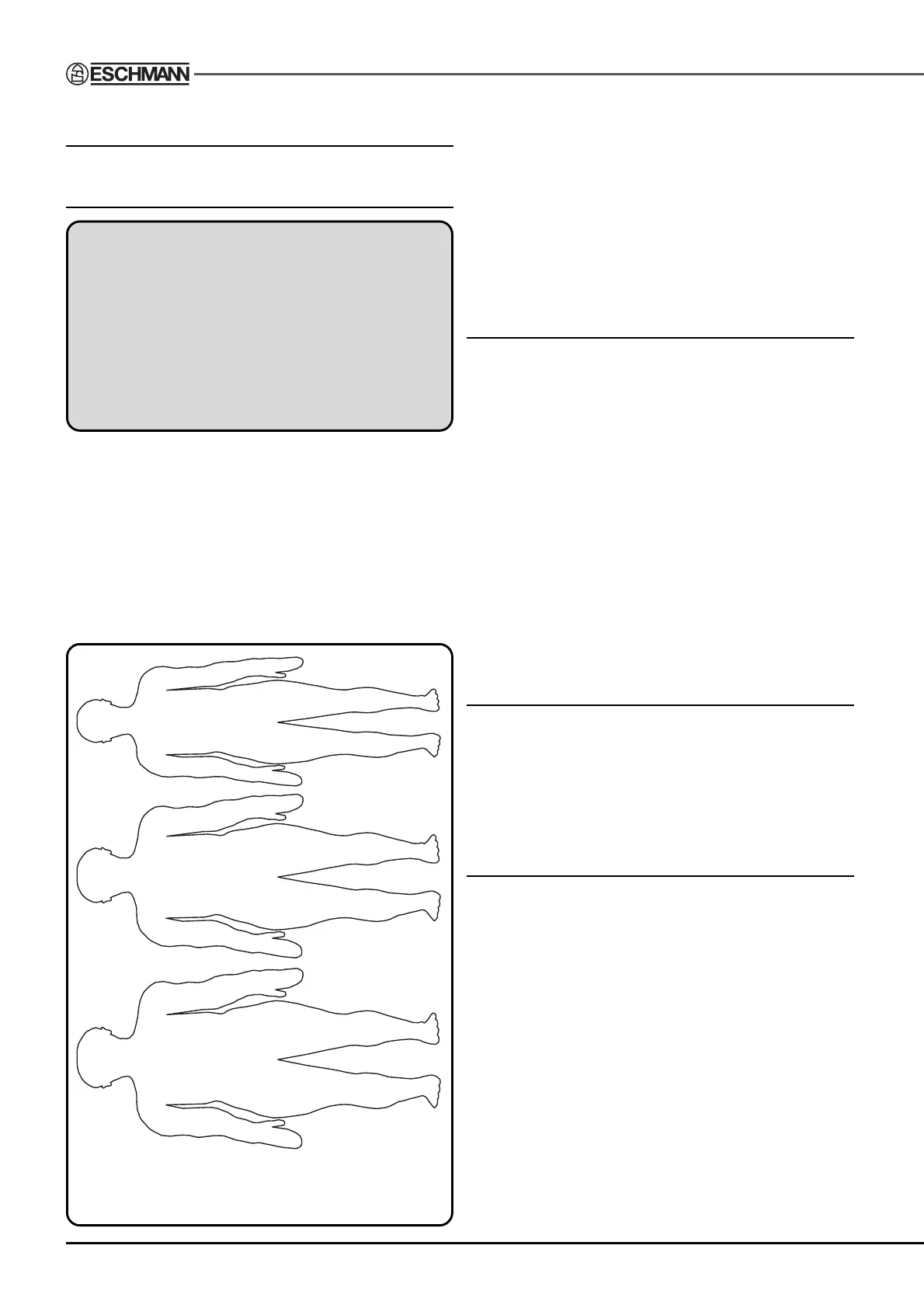
Fig. 6.1 Approximate patient weight
distributions
6.0 PATIENT POSITIONING
6.1 General
WARNING
Do not use any table sections or accessories
without the correct Eschmann mattress or pad in
place (except for accessories such as the
lightweight leg section which can be used for short
periods of use, without a mattress, during patient
positioning). Mattresses are an important part of
the antistatic pathway and help prevent pressure
sores developing.
Ensure the patient’s weight is evenly distributed and that
the mattress or pad is correctly positioned on each section
of the table. Check at frequent intervals during long
procedures to ensure that pressure sores are not being
promoted. See section 5.2.6 for details on attaching and
removing mattresses.
Note the graphics in section 6.4 which provide maximum
loading details for various table positions. The normal
maximum loading, for the patient’s centre of gravity (C of G)
in various positions is shown in Figs. 6.3 and 6.4. For
guidance on the treatment of the obese patient, see
section 6.2.
The Figures in section 6.4 provide details of various patient
positions that can be arranged with the T20 Series of table.
Note that these illustrations are examples only and care
should be taken to ensure patient safety and table stability.
The terms caudally and cranially are explained in section
1.2.1 (iv).
6.2 Treatment of the obese patient
Always ensure that the table is correctly loaded to maintain
stability within the guidelines shown in the graphs of section
6.4 noting the maximum patient weight of 300kg. Note that
the centre of gravity for the maximum patient weight of
300kg must not be outside of the top plateaux section of
the graphs.
Several width extenders can be placed on either side of the
table to help support the patient but note the maximum load
for this accessory and that width extenders should not be
attached to each other (also see Warnings and Cautions in
the width extenders ‘User Handbook’ ).
The table should not be moved across the floor with a
patient weight over 135kg (T20-a and T20-s tables) or
200kg (T20-m table). Although it is possible to place the
T20-a and T20-s table into ‘castor’ or ‘wheel’ with a patient
over 135kg and up to 300kg this is not advised.
6.3 Radiographic procedures
All ‘C-arm’ image intensifiers are suitable for use with this
table.
Fig. 6.2 shows typical patient positions for imaging the
upper and lower torso with the patient in the Supine
position. The graphics would equally apply to patients in
the Prone position.
6.4 Table positions and safe loading
In Figures 6.5 to 6.10, common table and patient positions
and safe loading graphs are provided, to give guidance on
patient positioning and table loading. Because it would not
be possible to cover every situation these should be
considered as examples only. Refer to Figs. 6.5 to 6.10
and then use Figs. 6.3 and 6.4 to establish the maximum
patient weight allowed for that configuration. The weight of
additional accessories fitted to the table should be included
in any estimation of correctly applied loads.
Figs. 6.3 and 6.4 show graphs of the position of the
maximum patient weights (centre of gravity) that can be
positioned on the table in four table configurations. Because
all variations can not be covered, a degree of interpolation
is required by the user, to ensure that table stability is
maintained. Fig. 6.1 provides an approximate patient
weight distribution for guidance.


 To Next Page