IP Series Installation Manual Function 2: CO lines
E.1
Function 2: CO lines
The IP Series system can operate on a station-by-station basis as a PBX or as a combined key/PBX
system using standard loop start lines. If a station has line keys programmed, the user accesses
the lines by pressing one of these keys or by dialing 9 (or 8 or 71–76). If a station does not have
line keys programmed, the user always accesses CO lines by dialing 9 (or 8 or 71–76).
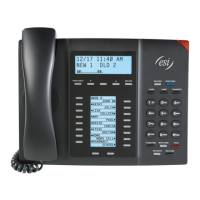
Note: To provide additional visual indication of CO line usage, an idle phone’s LCD will show
on/off-hook line status.
Since the system handles call transfer and auto attendant functions efficiently, operating in the
PBX mode provides more programmable feature keys for other uses and the opportunity for glare is
greatly reduced.
Note: All phone programmable keys (except x100; its first key is a day/night key [see page G.5]) are
defaulted as not being programmed. Use extension button mapping (Function 35; see page
F.13) to assign line keys system-wide; for individual stations, refer to the User’s Guide.
Important: Where any gray shading (■) appears in an example, it represents values either
unavailable to the function or unused in the particular example.
Function 21: CO line programming
This function allows you to program analog, T1 or PRI COs:
CO PROGRAMMING
1=ALG 2=T1 3=PRI
Enter 1 for analog CO programming, 2 for T1 CO line programming or 3 for PRI CO line programming.
When you modify the system configuration by changing cards, CO lines will need to be re-
programmed. Default answer ring assignment for CO lines is ID1.
• The CO lines are numbered 1–66. You can connect up to 60 loop-start CO lines to the system if it
has 303 or 600 port cards installed (six lines on each port card). You can connect up to 66 lines if
the system has one or more DLC cards; lines installed via T1 can be loop, ground, E&M, or DID.
• All CO lines are programmed to route callers during the day mode and then can be programmed
to route callers differently during the night mode. The display will show “
D
” or “
N
” to distinguish
which mode is currently being programmed. Lines that are to be programmed alike can be
grouped to simplify programming.
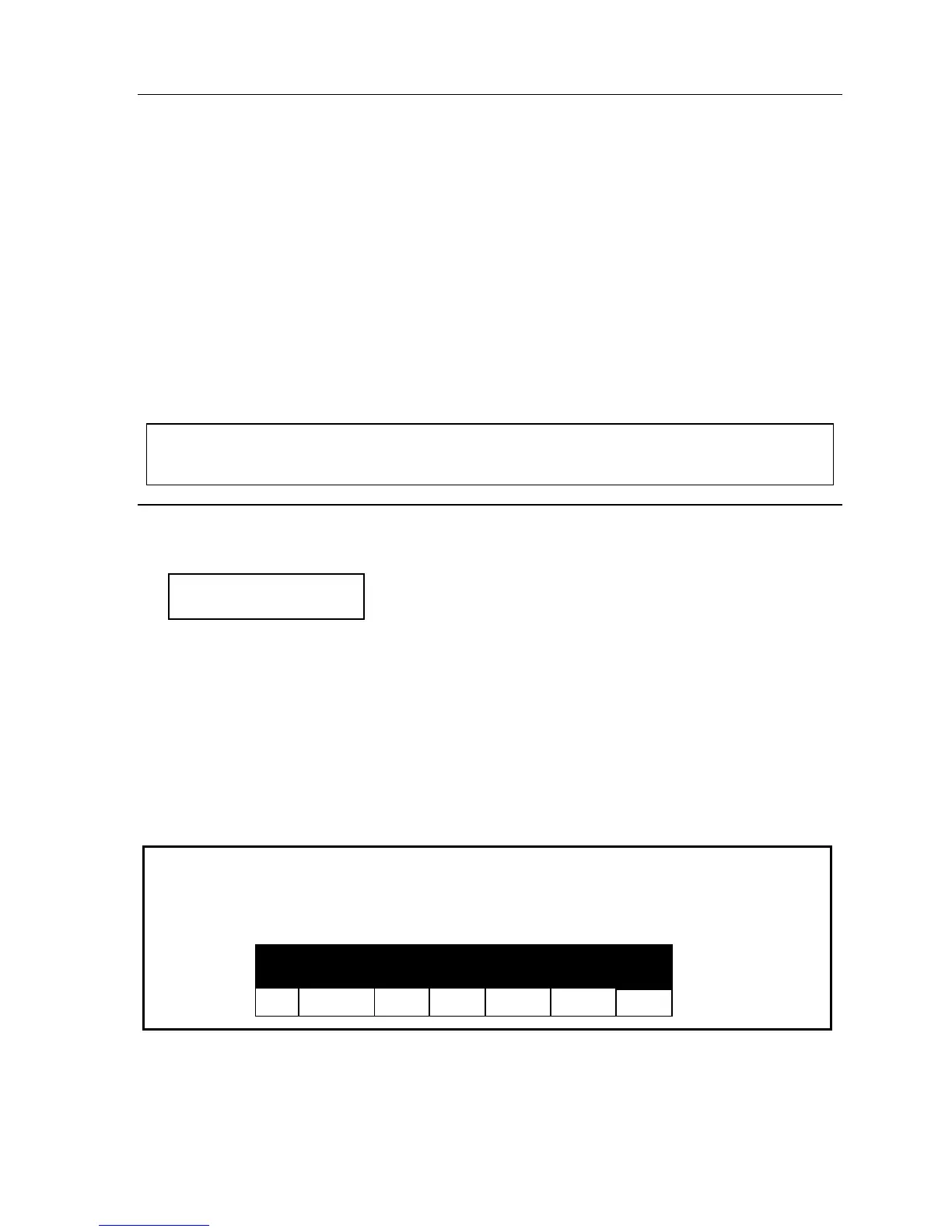
Example: Here is a completed Programming Worksheet for incoming calls on Line 1 that
are to ring live to Extension 100 but finally get answered by the auto atten-
dant’s main greeting after nine rings. (The step numbers correspond to the
following explanation.)
1.
CO
2.
Name
2.
OUT
4.
Ring 1
Ring 3
Ring 5
Ring 9
1 CO line 1 9 X100 X100 X100 ID1



 To Next Page