AvediaStream e2535/e3635 and e2655/e3655 Encoders V1.1
10 Administrator’s Guide
1 Getting Started
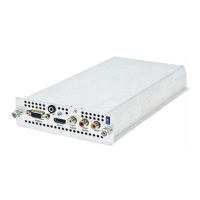
AvediaStream Encoders create a single IPTV stream on your building, campus or
metropolitan-area IP network from the output of various video devices. You can use them to
distribute the output from a variety of Standard Definition and High Definition AV devices such
as video cameras, DVD players, set-top boxes and professional SDI feeds.
The AvediaStream e26xx/36xx encoders accept SD and HD content inputs (up to 1080p
50/60Hz). The encoders allow scaling of both resolution and frame rate in the output stream.
The e36xx encoders allow scaling of any input to any output resolution and frame rate up to
1080i 50/60Hz. The AvediaStream e26xx encoders allow up to 576i in the output transport
stream.
The following procedures must be performed for the encoder to perform correctly. These
procedures are summarised in this section:
1. Connecting the AV Source
Before the encoder can stream audio/video on the network, an AV source must be connected.
See Physical Interfaces on page 12 for details on how to connect your AV equipment to the
encoder.
2. Connecting to the Network
Connect the encoder to the network.
For more information, see the AvediaStream Installation Guide.
3. Powering the Encoder
Connect the encoder to a power source.
For more information, see the AvediaStream Installation Guide.
4. Configuring the IP Address of the Encoder
By default, the encoder requires a DHCP Server to be available on the network to assign it an
IP address.
There are two methods of assigning a static IP address to the encoder, if required:
● Use the serial Admin Interface to configure the IP address. For more information refer to
Admin Interface on page 19.
● Temporarily set up a DHCP server on an isolated network. Once an IP address is
assigned to the encoder, you can configure a static IP address using the Web
Management Interface. For more information refer to Network Configuration on page 22.
Allocating a static IP address for the encoder allows continued operation without a DHCP
Server.
5. Naming the Encoder
Provide a name for the encoder so you can easily identify it in the future. This can be done
using the AvediaServer Director application (shown in Figure 8 on page 19) I) or the Web
Interface General Page (shown in Figure 9 on page 21).
6. Configuring Audio/Video Input
The device starts encoding and streaming automatically when an appropriate AV source is
connected. It may be necessary to configure the type of video source connected. Refer to
Encoding and Streaming on page 32 for more information.


 To Next Page