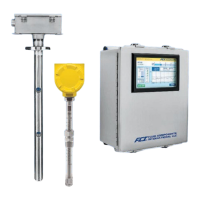
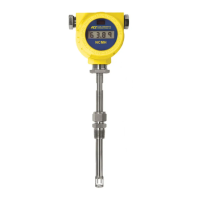
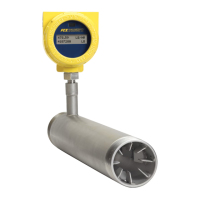
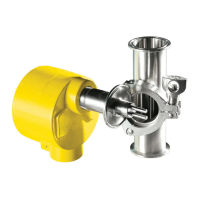
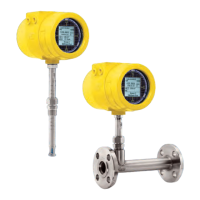
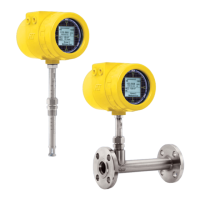
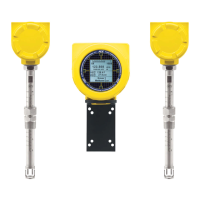
The MT86 and MT86HT are air and gas mass multipoint flow meters designed to measure mass flow in pipes, ducts, or stacks, accurately handling irregular flow profiles. These meters can measure flow from up to eight individual sensing points, averaging the individual flow signals to provide an output signal representing the total mass flow. This output signal can operate up to four different output modules.
Function Description:
The flow meter consists of one or more flow elements connected to a flow transmitter. Each flow element contains sensing points, with each point having two pairs of thermowells. One thermowell pair houses a heating element and an active Resistance Thermal Detector (RTD), while the other pair contains a reference RTD and an empty thermowell tube for mass equalization. The two pairs of thermowells are physically separated to allow process media flow between them while preventing thermal interaction.
The flow transmitter's basic functions include providing power to the flow element, measuring the temperature differential (ΔT) between the two RTDs as a function of resistance, amplifying and linearizing the resistance differential (ΔR) measurement of the flow element input signal, and providing an output signal. The linearized signals from the sensing points are then averaged and converted into the final output signal (e.g., 4-20 mA, 0-5 VDC, 0-10 VDC). The flow transmitter also includes a diagnostic alarm, indicated by a flashing Light-Emitting-Diode (LED) on the control board if a problem exists with a sensing point.
Important Technical Specifications:
- Process Connection: 2-inch male NPT or 2-inch 150-lb. raised-face carbon steel flange.
- Number of Sensing Points: Up to 8 sensing points.
- Insertion Length: Determined by duct dimensions at the measurement site.
- Material of Construction: All wetted parts are 316 stainless steel with nickel braze filler per AMS 4777.
- Local Enclosure: NEMA 4X enclosure with 1-inch female NPT connection ports, stainless steel, QDC connector.
- Remote Enclosure: NEMA 4X enclosure. Flow elements use 8-conductor, 22 AWG, Kapton insulated foil shielded cable.
- Operating Pressure: Standard MT86 is 0-50 PSIG, higher depending on application.
- Operating Temperature:
- Standard flow element: -50 to 350 °F (-46 to 177 °C).
- High temperature (HT) element: -50 to 850 °F (-46 to 454 °C).
- Flow transmitter: 0 to +150°F (-18 to 66 °C) with LCD or -50 to 150 °F (-46 to 66 °C) without LCD.
- Flow Range: 0.25 to 150 fps in gas under standard conditions (14.7 PSIA @ 70 °F).
- Flow Element Assemblies: May have 1, 2, 3, or 4 separate flow element assemblies, with a minimum of 2 sensing points per flow element.
- Input Power:
- Standard: 100-130 VAC or 200-270 VAC, 50/60 Hz, 50 watts maximum.
- Optional: 18-36 VDC, 50 watts maximum.
- Output Signal: 4-20 mA current loop (1000-ohm load), optional 10-50 mA (400 ohm load max), 0-5 VDC (2 mA current max), 1-5 VDC (2 mA current max), 0-10 VDC (2 mA current max).
- Interconnecting Cable: 24 AWG (minimum) 8-conductor shielded cable with PVC insulation (100 feet maximum). Longer distances possible with heavier gauge wire for heater circuit.
- Turn Down Ratio: 2:1 to 100:1 within flow element range, customer specified.
- Accuracy: ±3% of full scale at calibration temperature; ±5% of full scale with temperature compensation over a 200°F range.
- Repeatability: ±1% of full scale.
- Approvals: F.M., C.S.A., and CENELEC approvals available for all MT series multipoint mass flow meters.
Usage Features:
- Automatic Operation: The flow meter is fully automatic in normal monitor mode, operating from factory default settings.
- Flow Totalizer: Accumulates the total quantity of media passed over time. An optional backup battery preserves the accumulated count during power loss (estimated 3-year life). The totalizer display can be reset by shorting two connector terminals on the display board.
- Zero-Based and Non-Zero Based Calibration:
- Zero-Based: Output signal's low-limit (4 mA) equals zero flow. This is the factory default.
- Non-Zero Based: Low-limit output signal (4 mA) equals the minimum calibrated flow, which is a value greater than zero. Used when minimum flow rate does not approach zero and turndown ratios are small.
- Output Signal Readout: Provides instant readout of mass flow, showing flow rates within the calibrated range.
- Rate Limit Board (Optional): Allows adjustment of the output signal's rate of change, useful for stabilizing output with fluctuating measured flow.
- Mass-to-Volume Converter (Optional): Converts mass flow signal to a signal representing actual cubic feet per minute or feet per second (actual velocity).
- FES-200 Flow Element Simulator (Accessory): Simplifies field verification by providing variable resistance to input a Delta "R".
Maintenance Features:
- Low Maintenance Design: No moving parts or mechanical parts subject to wear.
- Calibration Verification: Verify calibration every 18 months minimum; recalibrate if necessary.
- Electrical Connections: Periodically inspect cable connections, terminal strips, and blocks for tightness, physical soundness, and corrosion.
- Enclosures: Verify moisture barriers and seals are intact.
- Electrical Cables: Periodically inspect power, flow element, and output cables for insulation deterioration.
- Flow Element Mounting Connections: Verify seals are performing properly, checking for process media leakage and deterioration of gaskets/environmental seals.
- Flow Element Assembly: Periodically remove for inspection of debris, foreign matter, scale build-up, corrosion, stress cracking, or build-up of oxides, salts, or foreign substances. Thermowells must be physically intact and free of excessive contaminants. Clean with a soft brush and compatible solvents as needed.
- Troubleshooting: Includes quick-check tables for common problems (no output, flashing LED, unexpected outputs) and detailed procedures for checking resistance readings, power supply voltages, flow element operating voltages, and flow element current.
- Field Calibration Techniques: Procedures for adjusting Delta "R" values, span, and zero using an FC81 Field Calibrator or precision decade boxes.
- EPROM Replacement Procedure: Instructions for replacing the EPROM (U14) on the control board, which stores calibrated flow rate data and performance curves.
- Circuit Board Replacement: General procedures for replacing control and input boards. Spare input boards are factory pre-adjusted for specific flow meter and flow element sensing points.
- Switch Point Calibration and Verification: Procedures for adjusting and verifying field-adjustable switch point relays.
- Analog Output Test Procedure: Verifies output module operation by applying a test signal to sweep through the full signal range.
- Totalizer and Rate Display Check: Procedures for setting decimal points and period jumpers for rate display.
- Repair: FCI recommends contacting customer service for repairs, as unauthorized component-level repairs may void the warranty. Field-repairable items are limited to fuses.

 Need help?
 General

 To Next Page