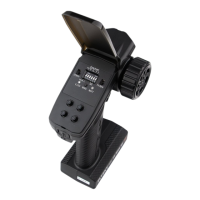
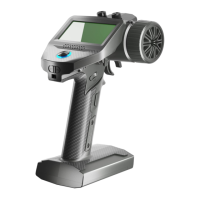
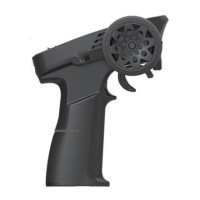
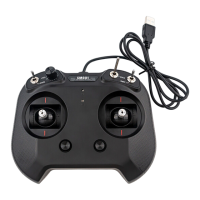
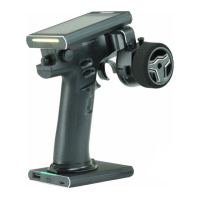
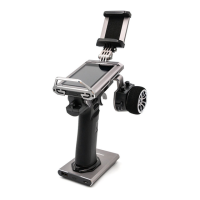
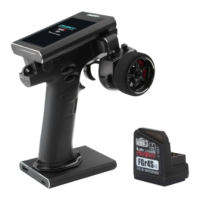
The FS-MG7 is a 7-channel transmitter designed for remote control of model cars and boats, compatible with the 2.4GHz ANT Automatic Frequency Hopping Digital System. It features a compact and ergonomic design, aiming for comfortable handling. A notable feature is the ability to set ESC (Electronic Speed Controller) parameters directly from the transmitter. It also includes a "Beginner Mode" to assist new users.
Function Description:
The FS-MG7 transmitter provides control over 7 channels:
- CH1 (Steering Wheel): Controls left/right steering and light signals.
- CH2 (Throttle Trigger): Controls forward/backward movement of the model car and light signals.
- CH3 (Switch CH3): Switches the model car speed level.
- CH4 (Switch CH4): Switches the model car speed level and the ESC battery type (Li-ion/Ni-MH).
- CH5 (Switch CH5): Enables/disables the winch function or switches the model car speed level, and sets the ESC operate mode.
- CH6 (CH6 Button): Controls light signals and switches the model car speed level.
- CH7 (CH7 Button): Used for four-wheel steering switching (front wheel steering, front and rear wheels reversal steering, front and rear wheels in the same steering, and rear wheel steering) and switches the drag brake strength of the ESC.
The system supports both one-way and two-way communication modes, with two-way being the default. In two-way mode, the receiver can send information back to the transmitter.
Important Technical Specifications:
Transmitter (FS-MG7):
- Compatible Receivers: FS-R7D, receivers with ANT protocol.
- Compatible Models: Cars or boats.
- Number of Channels: 7.
- RF: 2.4GHz ISM.
- Maximum Power: <20dBm (e.i.r.p.) (EU).
- 2.4GHz Protocol: ANT.
- Distance: >150m (Ground distance without interference).
- Resolution: 4096.
- Input Power: 4~9V DC/AAA*4 (requires 4 AAA batteries).
- Working Current: 83mA/6V.
- Low Voltage Alarm: < 4.2V.
- Antenna: Single built-in antenna.
- Online Update: No.
- Temperature Range: -10°C ~ +60°C.
- Humidity Range: 20% ~ 95%.
- Color: Black.
- Dimensions: 120.572.6145.2mm.
- Weight: 134g.
- Certifications: CE, FCC ID: 2A2UNMG700.
Receiver (FS-R7D):
- Compatible Transmitters: FS-MG7.
- Compatible Models: Cars.
- PWM Channels: 7.
- Number of Lights: 6.
- RF: 2.4GHz ISM.
- 2.4GHz Protocol: ANT.
- Input Power: 3.5~9V/DC.
- Working Current: < 90mA/5V.
- Maximum Power: <20dBm (e.i.r.p.) (EU).
- Distance: >300m (Ground distance without interference).
- Antenna: Single external antenna (Coaxial).
- Data Output: PWM/PPM.
- Resolution: 4096.
- Temperature Range: -10°C ~ +60°C.
- Humidity Range: 20% ~ 95%.
- Online Update: Yes.
- Dimensions: 3523.313.3mm.
- Weight: 8g.
- WaterProof: PPX4.
- Certifications: CE, FCC ID: 2A2UNR7D00.
Usage Features:
- Power-on/Power-off: Always power on the transmitter before the receiver and disconnect receiver power before turning off the transmitter to prevent unintended operation.
- LED Status Indicators: The D1 LED on the transmitter indicates its status (e.g., standby, channel switching, binding, voltage levels, idle/sleep mode, factory reset). The D2 LED indicates the status of the two-way bound receiver (e.g., normal operation, voltage levels).
- Binding: The transmitter and receiver are pre-bound. For re-binding, turn on the transmitter while pressing the BIND button, then put the receiver into bind mode. The process is complete when the receiver LED is solid on.
- One-way/Two-way Switching: Switch between communication modes by pressing the REV button, turning the steering wheel clockwise to maximum travel, and powering on. Re-binding is required after switching modes. Not allowed in 2-in-1 mode.
- Stick Calibration: Calibrate the maximum and minimum travel of the steering wheel and throttle trigger. This involves powering on while holding the steering wheel and throttle trigger at maximum travel, then moving them through their full range, and finally pressing the BIND button to save.
- Ambient Light: The ambient light can display various states (off, blue solid on, blue gradual light, dazzling gradual light, throttle trigger position indication, transmitter voltage indication). It can be cycled through these states by pressing and holding the CH7 button for 2 seconds.
- Channel Switching: Quickly press the BIND button twice within 1 second to cycle through CH1 and CH3-CH7. The D1 LED flashes indicate the selected channel.
- Channel Reverse: Reverse the output direction of channels. For non-2-in-1 mode, CH1-CH7 can be reversed. In 2-in-1 mode, only CH1 and CH2 can be reversed. This is done by pressing the REV button while the steering wheel or throttle trigger is at maximum/minimum travel.
- Trim Setting: Adjust the neutral position of channels. For non-2-in-1 mode, CH1-CH7 trim can be adjusted using the ST+/- (for CH1, CH3-CH7) and TH+/- (for CH2) buttons. In 2-in-1 mode, only CH1-CH4 trim is adjustable.
- D/R Setting (Dual Rate): Adjust the travel range value of channels. For non-2-in-1 mode, CH1-CH7 travel range can be adjusted using ST+/- (for CH1, CH3-CH7) and TH+/- (for CH2) buttons. In 2-in-1 mode, only CH1-CH4 travel range is adjustable.
- Switching Model: The transmitter supports five sets of models. Hold CH6 and CH7 buttons and power on to switch models. The buzzer sounds indicate the selected model.
- 2-in-1 Mode: Activate by holding BIND and CH6 buttons and powering on. In this mode, CH6 controls lights, CH5 sets ESC operation mode (forward/backward/brake or forward/backward), CH4 switches ESC battery type (Li-ion/Ni-MH), and CH7 switches ESC drag brake strength (0%, 50%, 75%, 100%).
- Beginner Mode: Activate by holding CH6, turning the steering wheel counterclockwise to maximum travel, and powering on. In this mode, throttle D/R is half of normal mode.
- Failsafe: Configures the receiver's behavior in case of signal loss. Set by holding the BIND button for 3 seconds after setting controls to the desired failsafe position.
- Reset Data: Reset function data to default values by holding BIND and CH7 buttons and powering on. Failsafe, binding, and mode settings are not reset.
- Idle Alarm: The transmitter enters an idle alarm state if no operation occurs for over 10 minutes, indicated by a red gradual light on D1 LED and buzzer sounds.
- Sleep Mode: If a 2-in-1 receiver is connected and the transmitter is in idle alarm for over 2 minutes, it enters sleep mode. D1 LED is orange gradual, buzzer and RF turn off. Exit by powering off and restarting.
- Offline Prompt: In two-way mode, if the bound receiver turns off or disconnects for over 2 seconds, the D1 LED will flash in a three-flash-one-off pattern.
- Transmitter Voltage Alarm: D1 LED indicates transmitter voltage: green (high), orange (medium), red slow flash with buzzer (low, <4.2V).
- Receiver Voltage Alarm: D2 LED indicates receiver voltage: red slow flash with buzzer (low, <4.2V for standard; ultra-low for 2-in-1). For 2-in-1 receivers, green (high), orange (medium), red (low), red slow flash with buzzer (ultra-low).
- Factory Reset: Restore transmitter to factory default by holding REV and CH7 buttons and powering on.
Maintenance Features:
- Firmware Update (FS-R7D Receiver): The receiver's firmware can be updated via FlyskyAssistant (version 3.0 or later). This can be done either after binding (connecting transmitter to computer) or by putting the receiver into a forced update mode (power on receiver, then press and hold BIND for >10 seconds until LED flashes three-flash-one-off).
- Steering Wheel Angle Adjustment: The manual provides detailed instructions with diagrams on how to adjust the steering wheel angle. This involves disassembling the steering wheel, adjusting screws on the brake pad, and then reassembling. The tightness of the screws affects the rotation angle.
- Battery Installation: Requires 4 AAA batteries. Instructions emphasize correct polarity and caution against opening, crushing, exposing to heat/liquids, dropping, or using damaged batteries.
- Receiver Installation: Guidelines include mounting away from motors/electrical noise, keeping the antenna at least 1cm from conductive materials, and not powering on during installation.
- Environmental Disposal: Old electrical appliances and used batteries should be disposed of separately at communal collecting points, not with residual waste.
Safety Guidelines:
The manual includes comprehensive safety symbols and guidelines, emphasizing the importance of reading the manual, proper installation, avoiding use in bad weather or limited visibility, and not operating when tired or under the influence. It also highlights the 2.4GHz band's line-of-sight limitation and the need to keep the model in sight.

 Need help?
 General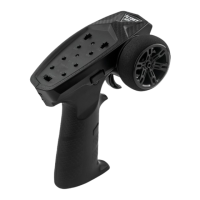

 To Next Page