Note: Keep the sensors located on the
bumper or fascia free from snow, ice and
large accumulations of dirt. If the sensors
are covered, the system’s accuracy can be
affected. Do not clean the sensors with
sharp objects.
Note: If your vehicle sustains damage to
the bumper or fascia, leaving it misaligned
or bent, the sensing zone may be altered
causing inaccurate measurement of
obstacles or false alarms.
The system warns you of obstacles within
a certain range of the bumper area. The
system turns on automatically whenever
you switch the ignition on. It becomes
active when you press the parking aid
button or move the transmission selector
lever into position R or reverse gear and
your vehicle speed is below 10 mph (16
km/h).
When receiving a detection warning, the
radio volume is reduced to a
predetermined level. After the warning
goes away, the radio volume returns to the
previous level.
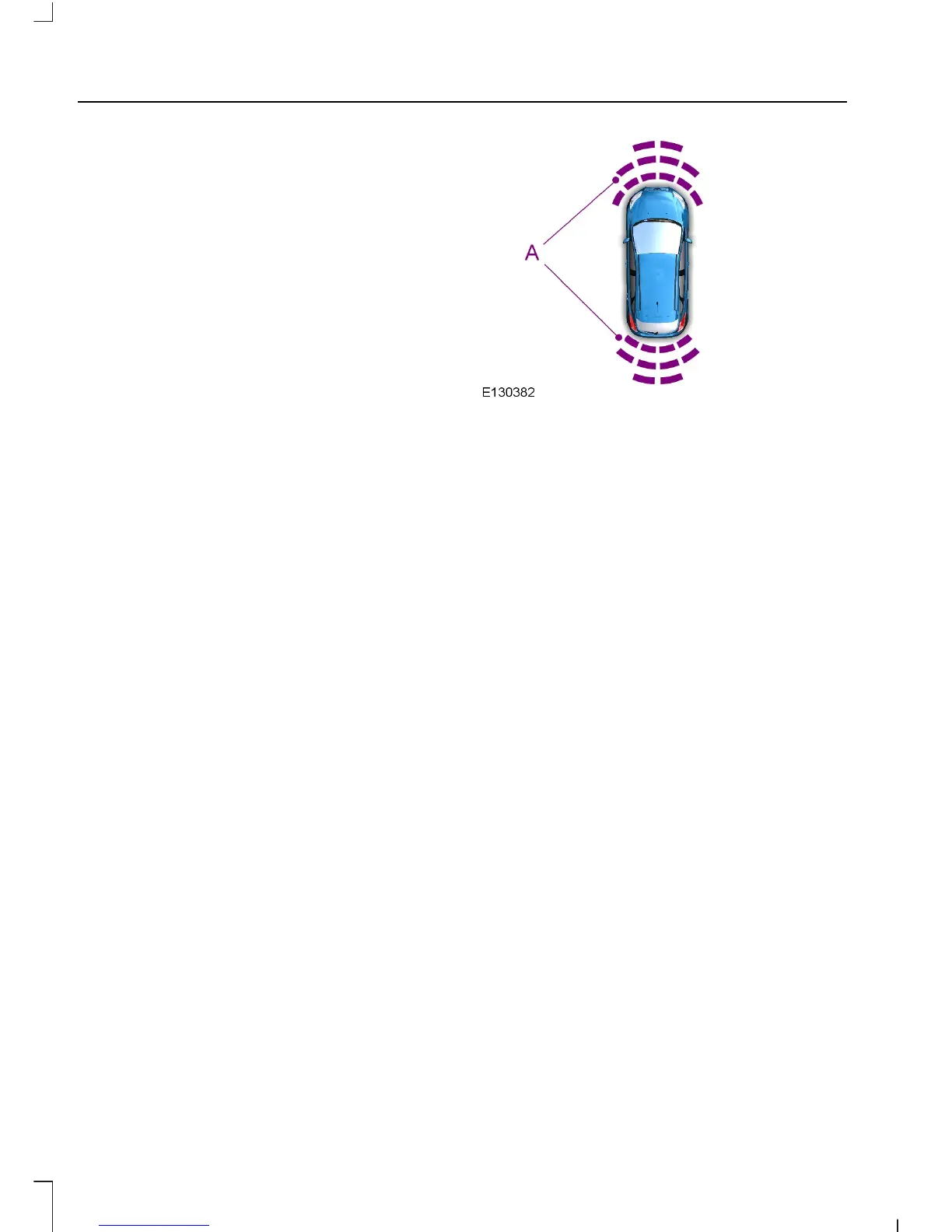
Coverage area of up to 31 inches
(80 centimeters) from the front
of your vehicle, up to 72 inches
(183 centimeters) from the rear
bumper and about 6–14 inches
(15–35 centimeters) to the side
of the front end of your vehicle.
A
The system sounds an audible warning
when obstacles are near either bumper in
the following manner:
• Objects detected by the front sensors
are indicated by a high-pitched tone
from the front speakers.
• Objects detected by the rear sensors
are indicated by a lower pitched tone
from the rear speakers. As your vehicle
moves closer to the obstacle, the rate
of the audible warning increases.
• The sensing system reports the
obstacle which is closest to the front
or rear of your vehicle. For example, if
an obstacle is 24 inches (60
centimeters) from the front of your
vehicle and at the same time, an
obstacle is only 16 inches (40
centimeters) from the rear of your
vehicle, the lower pitched tone sounds.
108
Tourneo Custom/Transit Custom (TTF)
Parking Aids












 To Next Page