GENERAL INFORMATION
WARNINGS
Use load securing straps to an
approved standard, e.g. DIN.
Make sure that you secure all loose
items properly.
Place luggage and other loads as low
and as far forward as possible within
the luggage or loadspace.
Do not drive with the liftgate or rear
door open. Exhaust fumes may enter
your vehicle.
Do not exceed the maximum front
and rear axle loads for your vehicle.
See Vehicle Identification Plate
(page 179).
Do not allow items to contact the
rear windows.
Note: When loading long objects in to your
vehicle, for example pipes, timber or
furniture be careful not to damage the
interior trim.
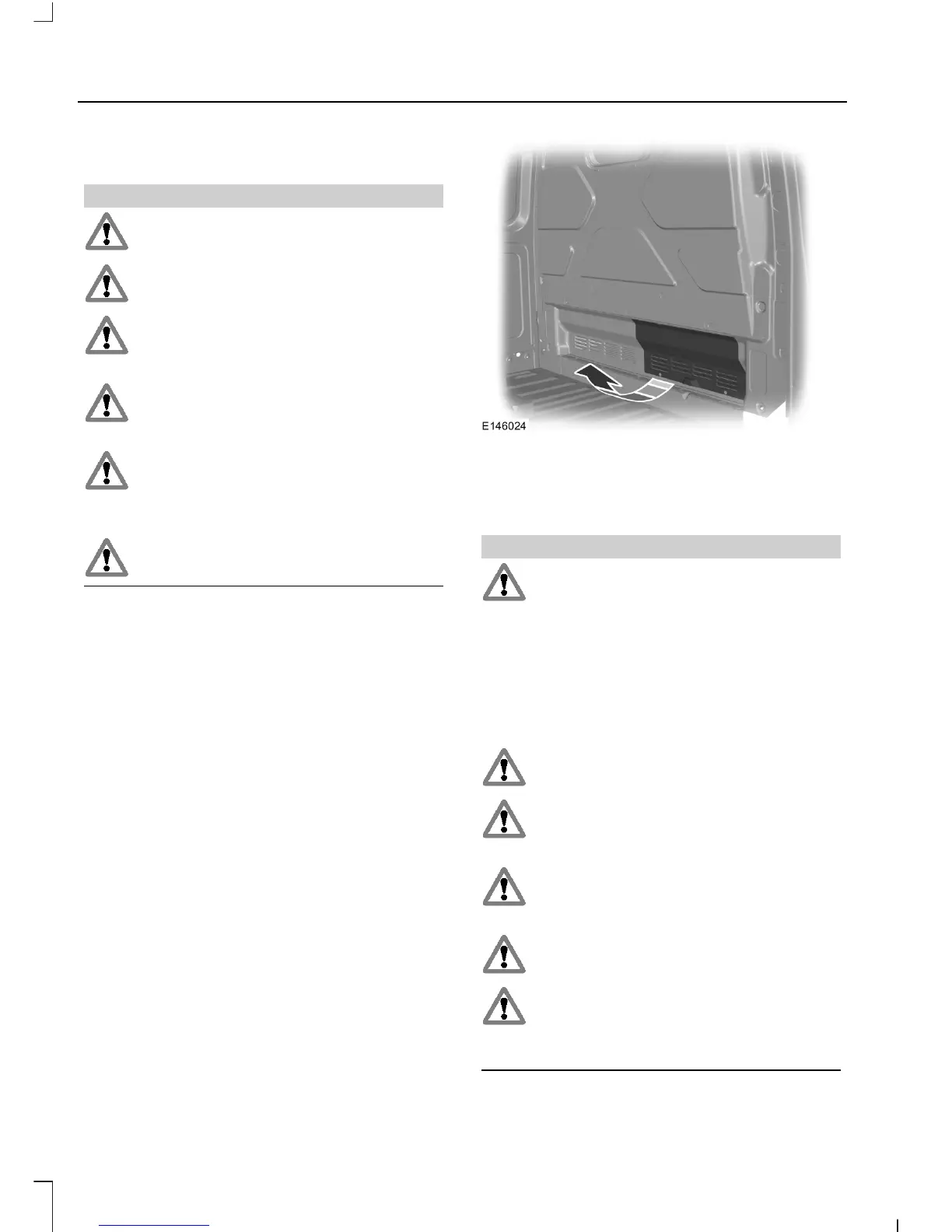
REAR LOADSPACE HATCHES
Note: Fold the hatch completely back
against the bulkhead when in use.
You can carry long items inside your vehicle
by opening the access hatch in the
bulkhead.
ROOF RACKS AND LOAD
CARRIERS
WARNINGS
When loading the roof racks, we
recommend you evenly distribute the
load, as well as maintain a low
center of gravity. Loaded vehicles, with
higher centers of gravity, may handle
differently than unloaded vehicles. Take
extra precautions, such as slower speeds
and increased stopping distance, when
driving a heavily loaded vehicle.
Do not exceed the maximum
permissible roof load.
Do not exceed the maximum axle
load for your vehicle. See Vehicle
Identification Plate (page 179).
Read and follow the manufacturer's
instructions when you are fitting a
roof rack.
Do not place loads directly on the
roof panel.
If you use a roof rack, the fuel
consumption of your vehicle will be
higher and you may experience
different driving characteristics.
120
Tourneo Custom/Transit Custom (TTF)
Load Carrying






 To Next Page