Need help?
Do you have a question about the Frick HPS 2709 and is the answer not in the manual?
Outlines the manual's scope for HPS 273/407 compressor installation, operation, and maintenance.
Stresses that only trained Frick mechanics should perform compressor repairs.
Advises on correct compressor application and system design for optimal performance and satisfaction.
Specifies operational pressure/temperature limits; notes special requirements for sour gas applications.
Provides instructions for inspecting delivered units for damage and verifying contents against shipping lists.
Lists components typically included with a standard bare compressor unit.
Details the process for filing transit damage claims, requiring immediate inspection by the carrier's agent.
Explains how to locate the identification plate for inquiries and ordering parts, noting required information.
Outlines requirements for storage longer than six months and potential warranty voiding.
Details steps for preparing the compressor for storage to prevent deterioration and maintain warranty.
Steps to maintain the compressor's condition during periods of storage.
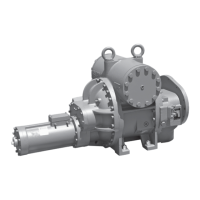
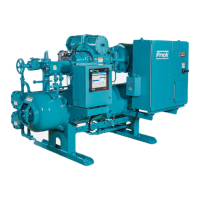
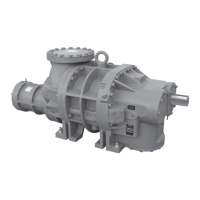
Describes the design, features, and capabilities of HPS 273 and 407 rotary screw compressors.
Warns against operating the compressor in reverse rotation, which can cause severe damage.
Explains the essential functions of the compressor's lubrication system.
Explains the method of varying the internal Vi to match system pressure ratios for efficiency.
Describes the slide valve operation for modulating compressor capacity from 100% down to 20%.
Details when an optional oil pump is necessary for low differential pressure applications.
Explains the balance piston assembly's role in counteracting rotor thrust loads for bearing life.
Details the construction materials for housing, rotors, and bearing types used in HPS compressors.
Describes the shaft seal design and the foot-mounted motor options available.
Covers design limits, pressure limitations, and oil flow regulations based on speed and Vi.
Directs users to outline drawings for dimensions and connection information.
Provides instructions for handling the nitrogen charge during shipping and short-term storage.
Guidelines for safely rigging and lifting the compressor using its designated lifting rings.
Discusses the need for a solid foundation to dampen vibrations and support compressor weight.
Steps for mounting the motor and ensuring proper shaft alignment for the coupling.
Explains the need for a flexible coupling suitable for variable speed and proper alignment.
Critical steps for aligning the coupling for shaft seal and bearing life, including hot alignment checks.
Details the ports for piping, including balance piston, shaft seal, and oil injection connections.
Information on approved oil filters, specifications, and cleanliness requirements.
Explains the need for oil cooling to control temperature and viscosity, with application examples.
Procedure for testing system vacuum levels to identify and repair leaks.
Describes how the hydraulic system actuates slide valve/stop for capacity and Vi control.
Specifies the single electrical connection for the solenoid-operated capacity control valve.
Emphasizes completing prestart checks and readiness for initial compressor start-up.
Critical step to calibrate transmitters for slide valve and slide stop position measurement.
Steps and considerations for the first start-up of the compressor unit.
Outlines standard procedures for starting, stopping, and handling standstill periods.
Safety precautions to take before performing any maintenance or service on the unit.
Highlights keeping oil clean, strainers clear, and avoiding liquid slugging for reliability.
Step-by-step instructions for safely draining, changing oil, and replacing filters.
A schedule based on operating hours for various maintenance tasks.
Importance of oil quality and regular analysis for compressor longevity and reliability.
Guidelines for vibration analysis and a systematic approach to troubleshoot abnormal operation.
Step-by-step procedure for replacing the slide valve's linear transmitter.
Procedure for safely replacing a bare compressor unit in the field.
A checklist for installers to complete before the service supervisor's arrival.
A form to record drive train alignment data, including cold and hot alignment readings.
A log to record operational parameters like pressure, temperature, and oil levels.
A form for recording vibration measurements and related operating conditions.
Diagrams showing port locations for HPS 2709/2712 and HPS 4009/4012 models.
 General
| Brand | Frick |
|---|---|
| Model | HPS 2709 |
| Category | Air Compressor |
| Language | English |

 To Next Page