Flluid 1
33
USING YOUR FLLUID
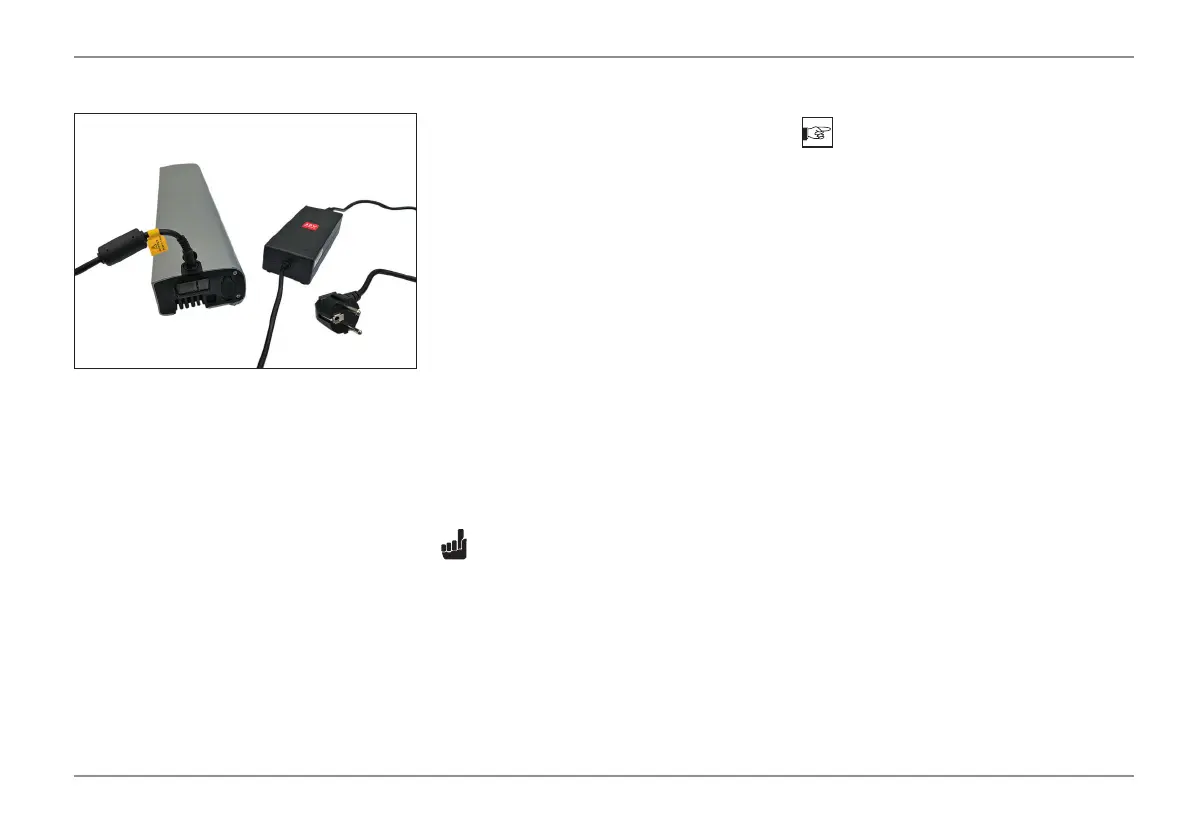
Handling of the Battery and Charger
To achieve the longest possible bat-
tery life, the following notes must be
observed:
- If the battery temperature is below 0°C
(32°F) and above + 60°C (140°F), the
charger will not become active. Bring
the battery to room temperature before
charging.
- The charger is a microcomputer-con-
trolled system with many monitoring and
control functions. Among other things,
this device turns off when the battery is
fully charged.
These systems are designed so that the
battery cannot overcharge.
Nevertheless, we recommend that you
only leave the battery on the charger
if the vehicle is to be used again in the
foreseeable future (several days).
- Never leave the battery connected to the
charger when not in use for a long time.
- When decommissioning (for example in
winter), store the battery in a dry room,
preferably when charged.
- Recharge every 2 months to prevent
deep discharge.
- When restarting the battery after a long
period of non-use (for example, after
winter shutdown), the battery should be
left on the charger for about 1 day.
CAUTION
Lack of CAUTION can lead to the deep
discharge of the battery.
Deep discharge of battery voids the bat-
tery warranty.
NOTE
Battery Temperatures:
Operating Temperature -4°F to + 140°F
(-20°C to + 60°C)
Charge 32°F to + 113°F (0°C to + 45°C)
Storage 32°F to + 104°F (0°C to + 40°C)
Thermal Protection Over 158°F (70°C)
cannot charge or use.
Self-discharge
Due to the chemistry in sealed battery cells,
the battery pack will slowly discharge. The
amount of discharge depends on the time,
the state of charge and ambient conditions
(temperature, humidity).
This will result in reduced range from the
electric drive unless the battery is recharged
before use.


 To Next Page