112 • Chapter 7 Application Programming DMC-1500
Using the MG Command to Configure Terminals
The MG command can be used to configure a terminal. Any ASCII character can be sent by using the
format {^n} where n is any integer between 1 and 255.
Example:
MG {^07} {^255}
sends the ASCII characters represented by 7 and 255 to the bus.
Summary of Message Functions:
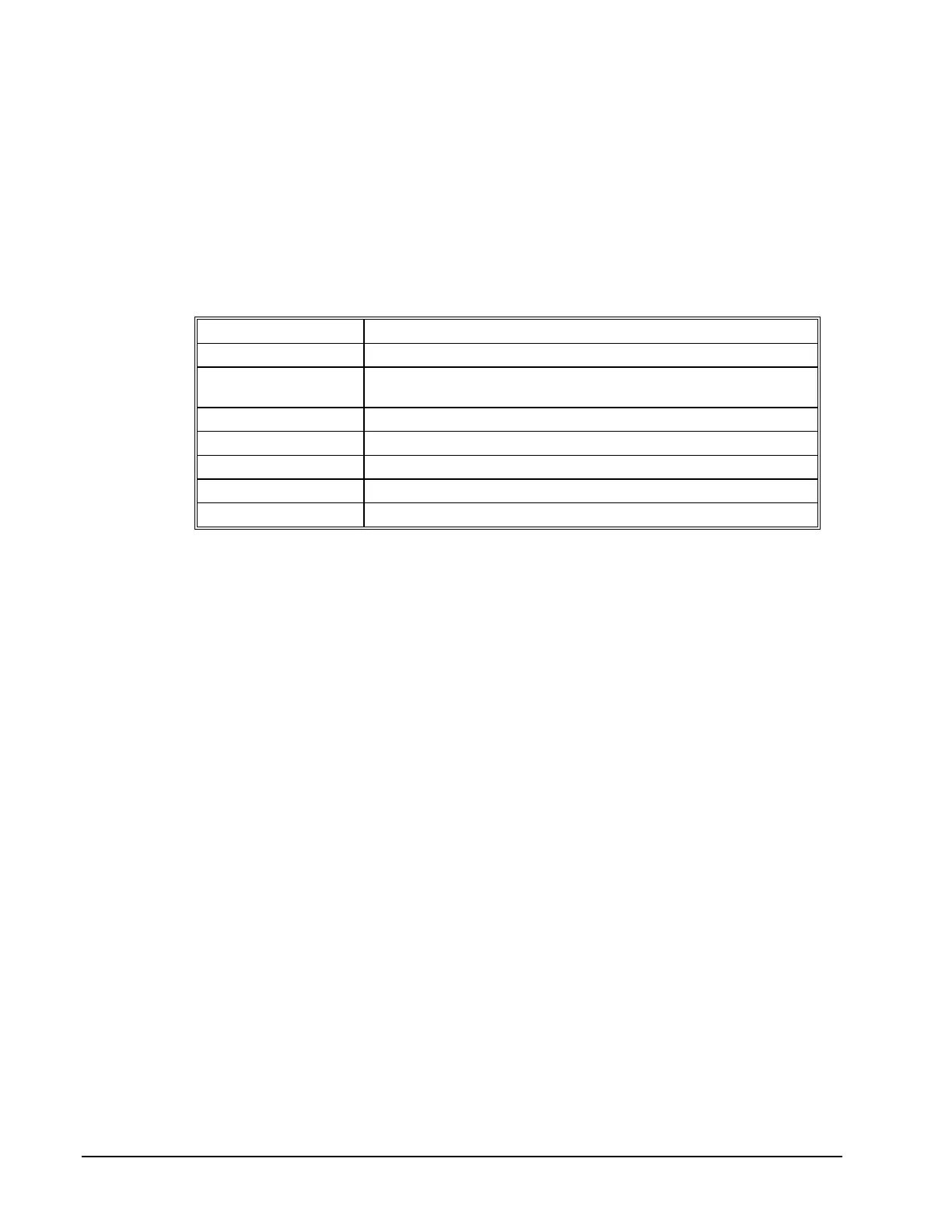
Function Description
" " Surrounds text string
{Fn.m} Formats numeric values in decimal n digits to the right of the decimal point
and m digits to the left
{N} Suppresses carriage return/line feed
{P1} or {P2} Send message to Main Port or Auxiliary Port
{Sn} Sends the first n characters of a string variable, where n is 1 through 6.
{$n.m} Formats numeric values in hexadecimal
{^n} Sends ASCII character specified by integer n
Displaying Variables and Arrays
Variables and arrays may be sent to the screen using the format, VARIABLE= or ARRAY[X]=. For
example, V1= , returns the value of V1. These values may also be displayed using the message
command, MG. If a variable was not previously defined, using the command, VARIABLE=, will
cause the variable to be defined and the controller will not return an error. If the MG command is used
to display a variable which has not been defined, the controller will return an error.
Example - Printing a Variable and an Array element
Instruction Interpretation
#DISPLAY Label
DM POSX[7] Define Array POSX with 7 entries
PR 1000 Position Command
BGX Begin
AMX After Motion
V1=_TPX Assign Variable V1
POSX[1]=_TPX Assign the first entry
V1= Print V1
Interrogation Commands
The DMC-1700 has a set of commands that directly interrogate the controller. When these command
are entered, the requested data is returned in decimal format on the next line followed by a carriage
return and line feed. The format of the returned data can be changed using the Position Format (PF),
and Leading Zeros (LZ) command. For a complete description of interrogation commands, see
chapter 5.


 To Next Page