70 • Chapter 6 Programming Motion DMC-1500
_TP Contains the value of the main encoder
Dual Loop (Auxiliary Encoder)
The DMC-1500 provides an interface for a second encoder for each axis except for axes configured
for stepper motor operation. When used, the second encoder is typically mounted on the motor or the
load, but may be mounted in any position. The most common use for the second encoder is backlash
compensation, described below.
The auxiliary encoder may also be used for gearing. In this case, the auxiliary encoder input is used to
monitor an encoder which is not under control of the DMC-1500. To use the auxiliary encoder for
gearing, the master axis is specified as the auxiliary encoder and GR is used to specify the gear ratios.
For more information, see previous section
Electronic Gearing on page 54.
The second encoder may be a standard quadrature type, or it may provide pulse and direction. The
controller also offers the provision for inverting the direction of the encoder rotation. The main and
the auxiliary encoders are configured with the CE command. The command form is CE x,y,z,w (or
a,b,c,d,e,f,g,h for controllers with more than 4 axes) where the parameters x,y,z,w each equal the sum
of two integers m and n. m configures the main encoder and n configures the auxiliary encoder.
Using the CE Command
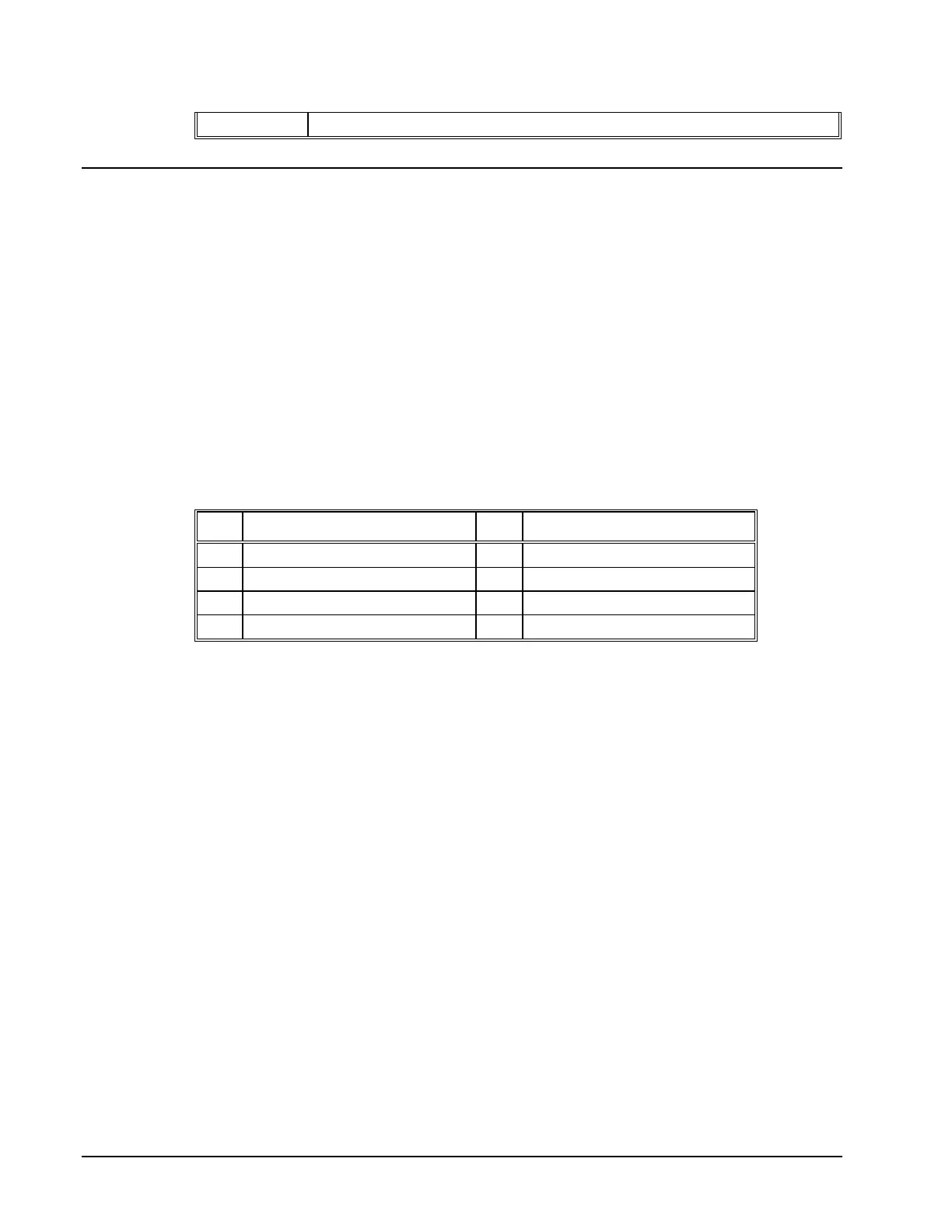
m= Main Encoder n= Second Encoder
0 Normal quadrature 0 Normal quadrature
1 Pulse & direction 4 Pulse & direction
2 Reverse quadrature 8 Reversed quadrature
3 Reverse pulse & direction 12 Reversed pulse & direction
For example, to configure the main encoder for reversed quadrature, m=2, and a second encoder of
pulse and direction, n=4, the total is 6, and the command for the X axis is
CE 6
Additional Commands for the Auxiliary Encoder
The command, DE x,y,z,w, can be used to define the position of the auxiliary encoders. For example,
DE 0,500,-30,300
sets their initial values.
The positions of the auxiliary encoders may be interrogated with the command, DE?. For example
DE ?,,?
returns the value of the X and Z auxiliary encoders.
The auxiliary encoder position may be assigned to variables with the instructions
V1= _DEX
The command, TD XYZW, returns the current position of the auxiliary encoder.
The command, DV XYZW, configures the auxiliary encoder to be used for backlash compensation.
Backlash Compensation
There are two methods for backlash compensation using the auxiliary encoders:


 To Next Page