190-02692-00 Rev. A
Garmin G100 Pilot’s Guide for the Piper PA-32 Saratoga
62
FLIGHT INSTRUMENTS
SYSTEM
OVERVIEW
FLIGHT
INSTRUMENTS
EIS
AUDIO PANEL
& CNS
FLIGHT
MANAGEMENT
HAZARD
AVOIDANCE
AFCS
ADDITIONAL
FEATURES
APPENDICESINDEX
» At 30 nm from the departure airport, the
enroute
phase of flight is automatically entered and CDI scaling
changes to 2.0 nm over a distance of 1.0 nm, except under the following conditions:
When navigating with an active departure procedure, the flight phase and CDI scale does not change
until the aircraft arrives at the last departure waypoint (if more than 30 nm from the departure airport) or
the leg after the last departure waypoint has been activated or a direct-to waypoint is activated.
» If after completing the departure procedure, the nearest airport is more than 200 nm away from the aircraft
and the approach procedure has not yet commenced, the CDI is scaled for
oceanic
flight (4.0 nm).
» Within 31 nm of the destination airport (
terminal
area), the CDI scale gradually ramps down from 2.0 nm
to 1.0 nm over a distance of 1.0 nm, except under the following conditions:
Upon reaching the first waypoint of an arrival route that is more than 31 nm from the destination airport,
the flight phase changes to terminal and the CDI scale begins to transition down from 2.0 nm to 1.0 nm
over a distance of 1.0 nm.
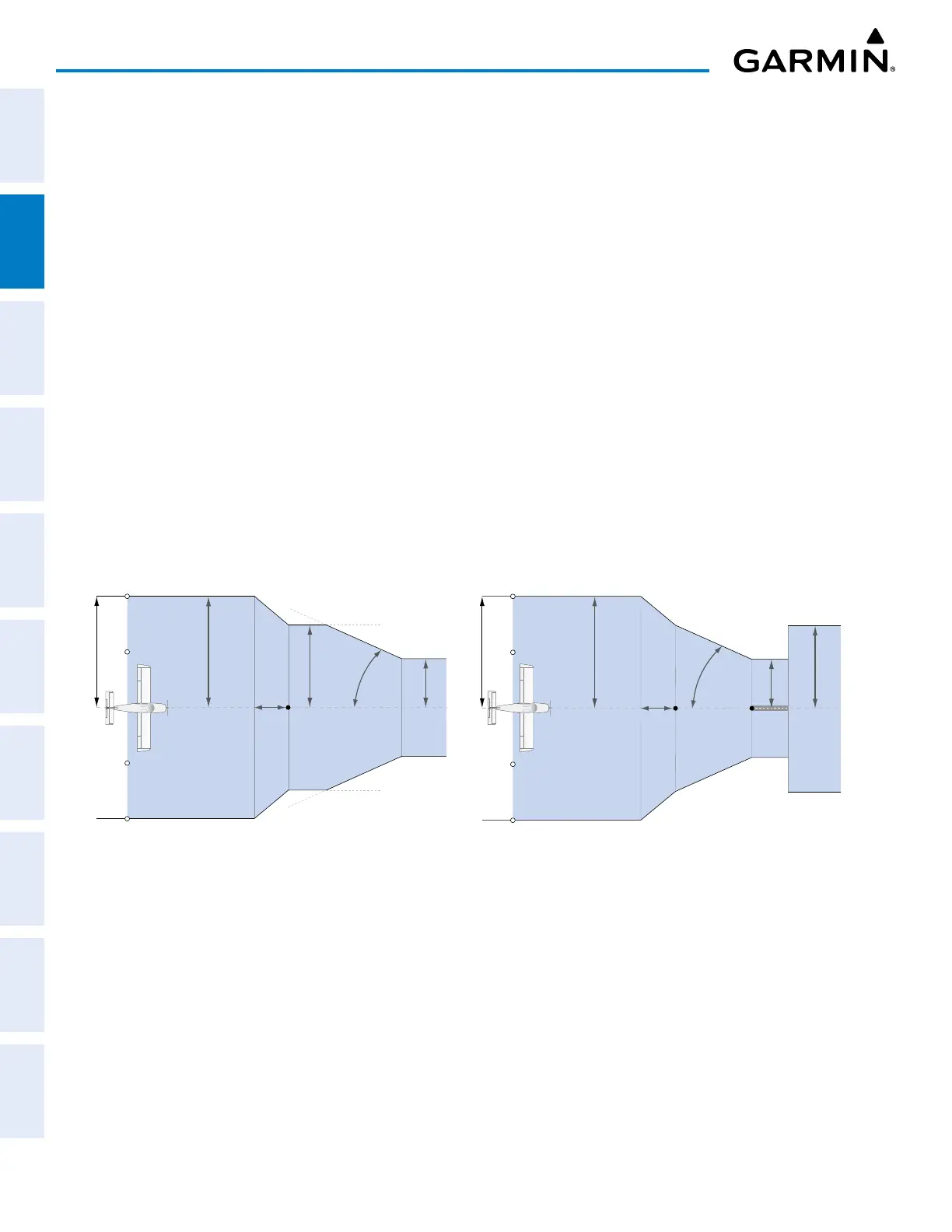
» During
approach
, the CDI scale ramps down even further (see following figures). This transition normally
occurs within 2.0 nm of the final approach fix (FAF). The CDI switches to approach scaling automatically
once the approach procedure is activated or if Vectors-To-Final (VTF) are selected.
If the active waypoint is the FAF, the ground track and the bearing to the FAF must be within 45° of the
final approach segment course.
If the active waypoint is part of the missed approach procedure, the active leg and the preceding missed
approach legs must be aligned with the final approach segment course and the aircraft must not have
passed the turn initiation point.
Figure 2-24 Typical LNAV and LNAV+V Approach CDI Scaling
1.0 nm
2 nm
350 ft
angle set
by system
0.3 nm
FAF
DI Full-scale Deflection
CDI scale is set to the smaller of 0.3 nm
or an angle set by the system
CDI scale varies if VTF is activated
Figure 2-25 Typical LNAV/VNAV, LP, LPV, and LP+V
Approach CDI Scaling
1.0 nm
2 nm
FAF
0.3 nm
course width
Landing
Threshold
CDI Full-scale Deflection
angle based
on database
information
CDI scale varies if VTF is activated
» When a
missed approach
is activated, the CDI scale changes to 0.3 nm.
» The system automatically switches back to
terminal
mode under the following conditions:
The next leg in the missed approach procedure is not aligned with the final approach path.
The next leg in the missed approach procedure is not a CA, CD, CF, CI, CR, DF, FA, FC, FD, FM, IF, or TF.
After any leg in the missed approach procedure that is not a CA or FA.


 To Next Page