33 / 44
554
Installation:
1. Ensure the suitability of the valve for
each respective use. The valve must
be appropriate for the piping system
operating conditions (medium, medium
concentration, temperature and
pressure) and the prevailing ambient
conditions. Check the technical data of
the valve and the materials.
2. Shut off plant or plant component.
3. Secure against recommissioning.
4. Depressurize the plant or plant component.
5. Completely drain the plant (or plant
component) and let it cool down until
the temperature is below the media
vaporization temperature and scalding
can be ruled out.
6. Correctly decontaminate, rinse and ventilate
the plant or plant component.
Installation - Butt weld spigots:
1. Adhere to good welding practices!
2. Disassemble the actuator before welding the
valve body into the pipeline (see chapter
12.1).
3. Allow butt weld spigots to cool down.
4. Reassemble the valve body and the actuator
(see chapter 12.3).
Installation - Flange connection:
Install the valve in the condition it is
delivered in:
1. Pay attention to clean, undamaged sealing
surfaces on the mating fl anges.
2. Align fl anges carefully before installing them.
3. Centre the seals accurately.
4. Use all fl ange holes.
5. Connect the valve fl ange and the piping
fl ange using appropriate sealing material
and matching bolting (sealing material
and bolts are not included in the scope
of the delivery).
Tighten the bolts diagonally!
6. Only use connector elements made of
approved materials!
Installation - Clamp connections:
G When assembling clamp connections,
insert a gasket between the body clamp
and the adjacent piping clamp and join
them using the appropriate clamp fi tting.
The gasket and the clamp for clamp
connections are not included in the scope
of delivery.
Installation - Threaded connections:
G Screw the threaded connections into the
piping in accordance with valid standards.
G Screw the valve body into the piping, use
appropriate thread sealant. The thread
sealant is not included in the scope of
delivery.
Observe appropriate regulations for
connections!
After the installation:
G Reactivate all safety and protective
devices.
11.2 Control functions
The following control functions are available:
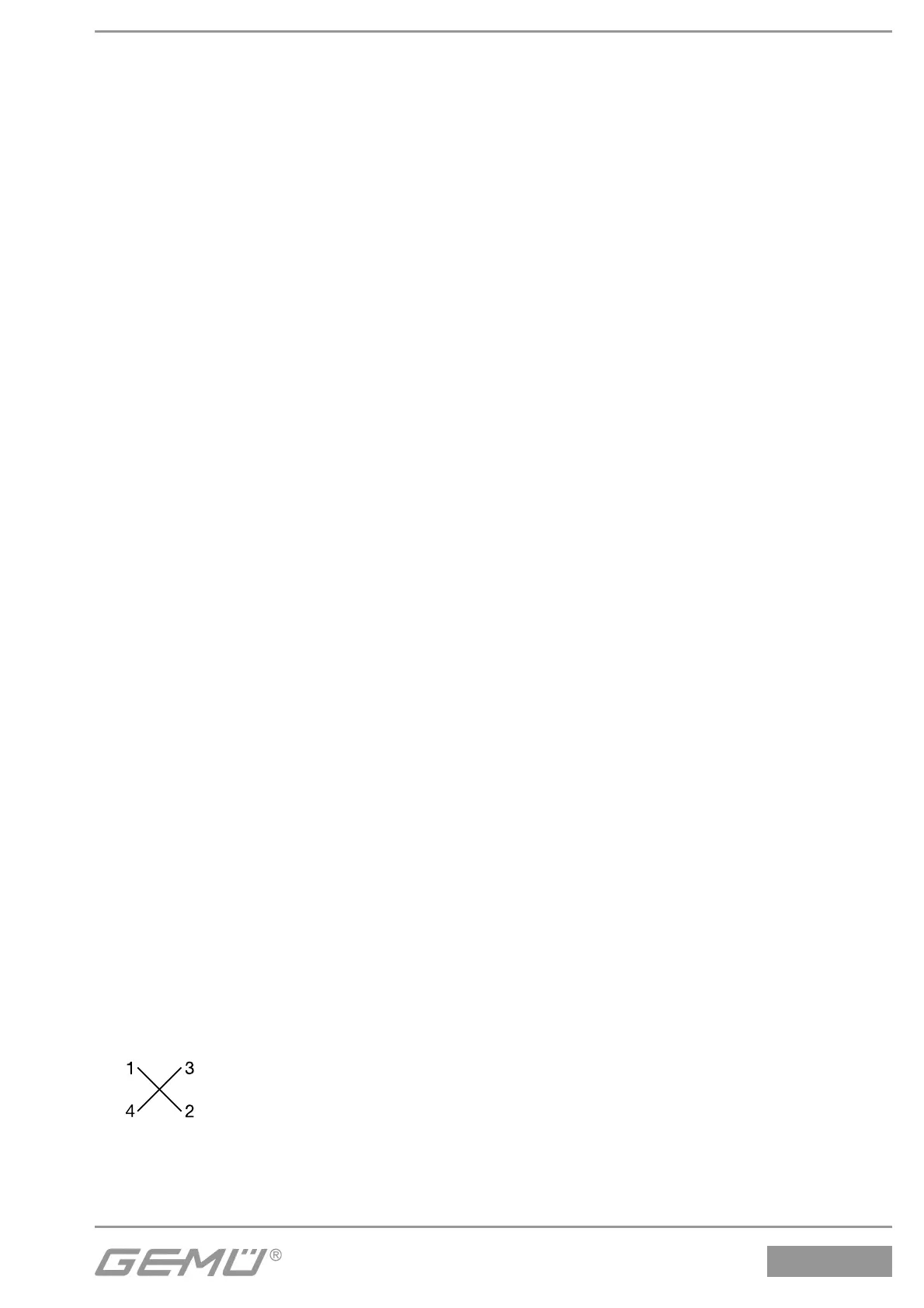
Control function 1
Normally closed (NC):
Valve resting position: closed by
spring force. Activation of the actuator
(connector 2) opens the valve. When the
actuator is vented, the valve is closed by
spring force.
Control function 2
Normally open (NO):
Valve resting position: opened by
spring force. Activation of the actuator
(connector 4) closes the valve. When the
actuator is vented, the valve is opened by
spring force.
Control function 3
Double acting (DA):
Valve resting position: no defined normal
position. The valve is opened and closed
by activating the respective control
medium connectors (connector 2: open /
connector 4: close).


 To Next Page