Comander Perimeter Security System
Engineering and Installation Manual
Page 48 of 72
5 Interceptor Cable Installation
5.1 What is Interceptor Cable?
The Interceptor microphonic cable is constructed using two conductors, loosely
encased in a screened magnetic core. When the fence fabric is disturbed, the resulting
vibrations cause the conductors to move within the core’s magnetic field, causing
current to be induced and generating a signal which is carried back to the Comander
Rack unit, digitised, then analysed by a digital signal processor.
In order to obtain the best possible signal, a good contact must be established between
the sensor and the fence fabric. For high security applications the sensor can be
supplied in Flexible Armoured Conduit made from 316 grade stainless steel, which
protects the cable but allows it still to be attached firmly to the fence fabric.
5.2 Factors To Consider When Deploying Interceptor Cable
5.2.1 The Fence
One of the most important factors in perimeter protection is the quality and condition of
the fence itself. To provide a reasonable barrier against a climb-over attack the fence
should be at least 2.4m high, and for adequate defence against a cut-through attack it
should be at least 2mm thick. The fabric should be in good condition, with firm tension,
no loose panels, no holes and no loose gates. Care should also be taken to cut back
any vegetation adjacent to the fence, especially any trees which might either assist a
climb attack or strike against the fence in adverse weather, causing false alarms.
5.2.2 The Detection Range
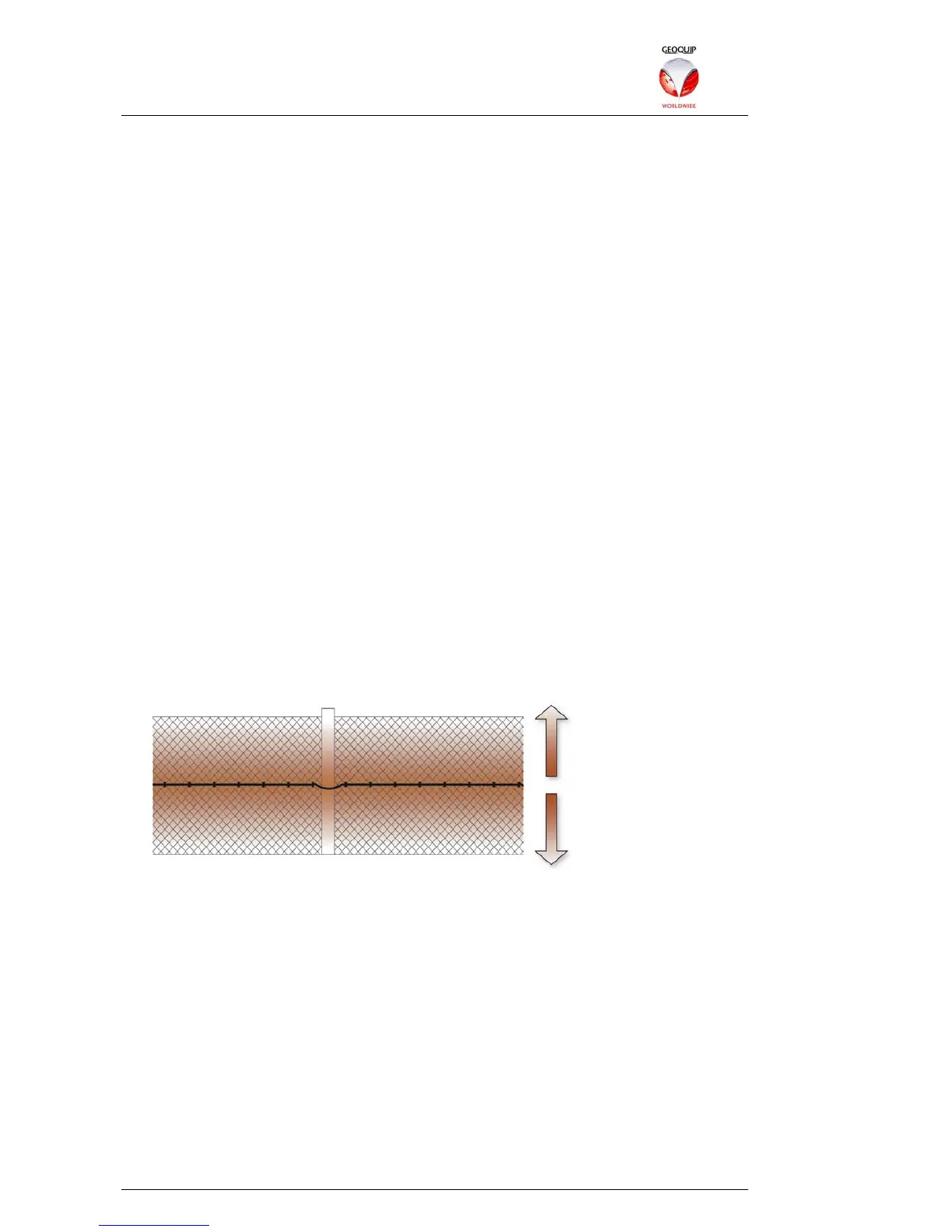
The Alpha cable is sensitive to disturbances in the fence fabric occurring some
distance away from where it is attached ...
Sensitive Area Extends
Above & Below Sensor
... but the extent of this sensitive area is a feature of the fence construction – see
section 5.2.5 below.
5.2.3 Double Runs
When the fence is taller than the height which can be protected with a single run of
sensor, then to provide the best possible protection the cable should be attached as a
“double run”, passing along the fence at about 1m above ground level then rising to
about 1m from the top before returning along the length of the zone ...



 To Next Page