Comander Perimeter Security System
Engineering and Installation Manual
Page 57 of 72
5.4 Corners, Gates, etc.
Because of the uniform response of the Alpha Microphonic Sensor Cable,
inconsistencies in the fabric and/or rigidity of the fence within the length of an individual
zone will result in similar inconsistencies in the sensitivity of the detection system at
different points along that zone. The fabric should be identical along the entire length of
each zone, and areas where a different fence fabric occurs should be protected as
separate zones - but in many cases this may result in an unreasonably large number of
separate zones.
Even a well-maintained fence with uniform fabric will present difficulties in areas where
it is firmly supported by corner posts with bracing, or where gates interrupt it. In these
areas the fence will almost always require a greater sensitivity of detection to overcome
the increased rigidity of the fabric, and the fabric of the gates themselves may well
differ so much from that of the normal fence that it is impractical to include them within
the zone. In this event the gates could be protected as separate zones, or a different
technology (such as Infra-Red Beam sensors) might be used to protect the gate.
In those cases where it IS possible to achieve comparable levels of detection between
the normal fence areas and those around corners and gates, the following pages show
how to configure the sensor on the fence to allow for the variation in rigidity.
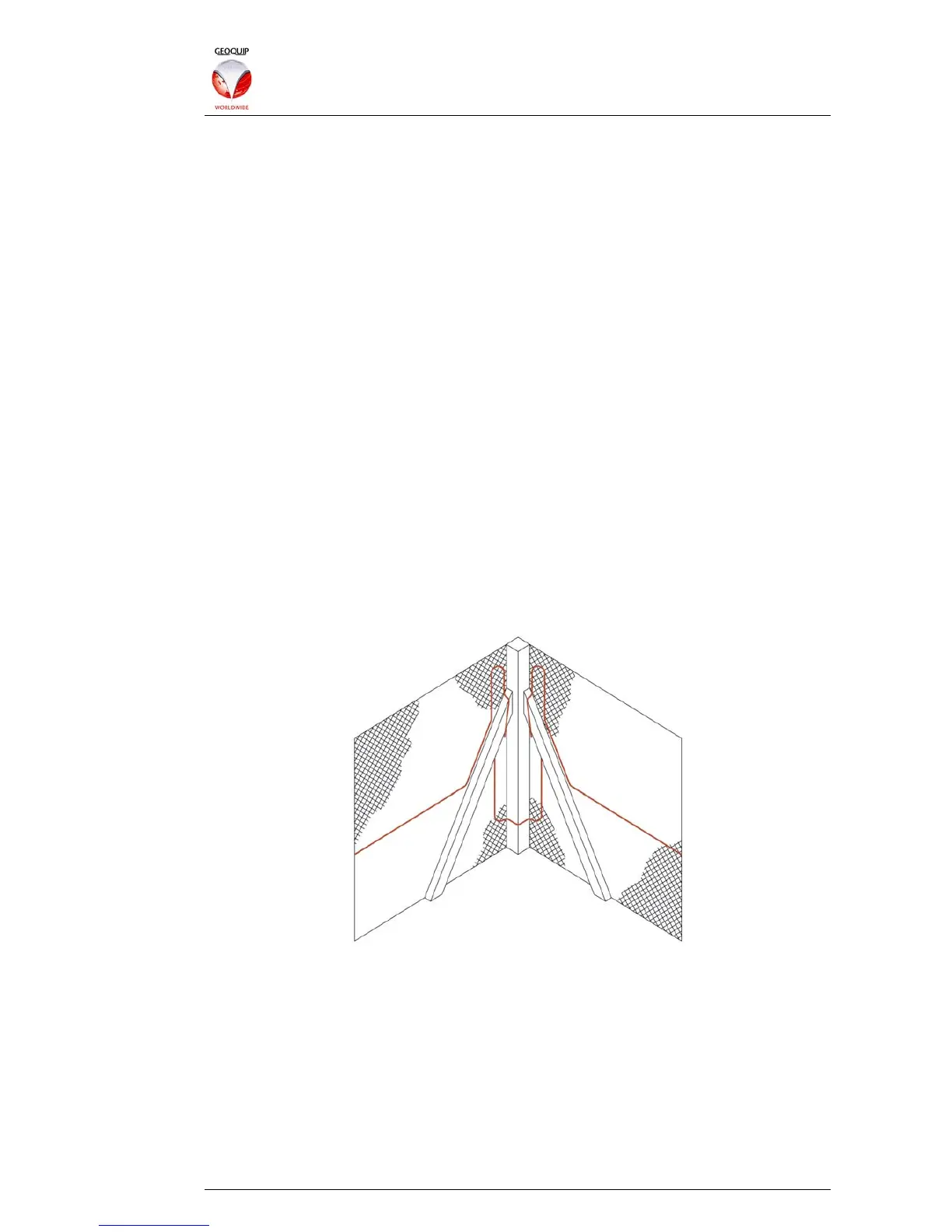
5.4.1 Corner Configuration
Corner posts are often reinforced with braces or strainer posts, making it easier for the
fence to be climbed with less detectable vibration than on a free-standing panel. To
improve the detection in such areas, the Interceptor cable should be mounted as
shown below.
This use of extra cable will compensate for the increased rigidity of the fence where it is
supported by the corner posts and braces, and give a greater chance of detecting a
climb-over attack.



 To Next Page