Comander Perimeter Security System
Engineering and Installation Manual
Page 50 of 72
strain, kinking or other damage. It should also be correctly attached to the fence fabric
as described below in order to provide a uniform standard of detection.
Never walk or drive over the sensor cable when it is lying on the
ground ready for installation. These actions could cause
irreparable damage to the cable which will prove costly to
replace.
Never apply a tension greater than 6kg to the sensor cable.
Never bend the sensor cable around a radius of less than
100mm.
5.2.7 Electrical Interference
Care must be taken to avoid installing the sensor cable close to sources of electrical
interference. Normally the sensor will reject stray interference, but if the source is of
sufficiently high power (or generates strong transient surges or spikes) then the audio
quality may be affected and false alarms may be generated.
5.2.8 Sensor Cable Deployment
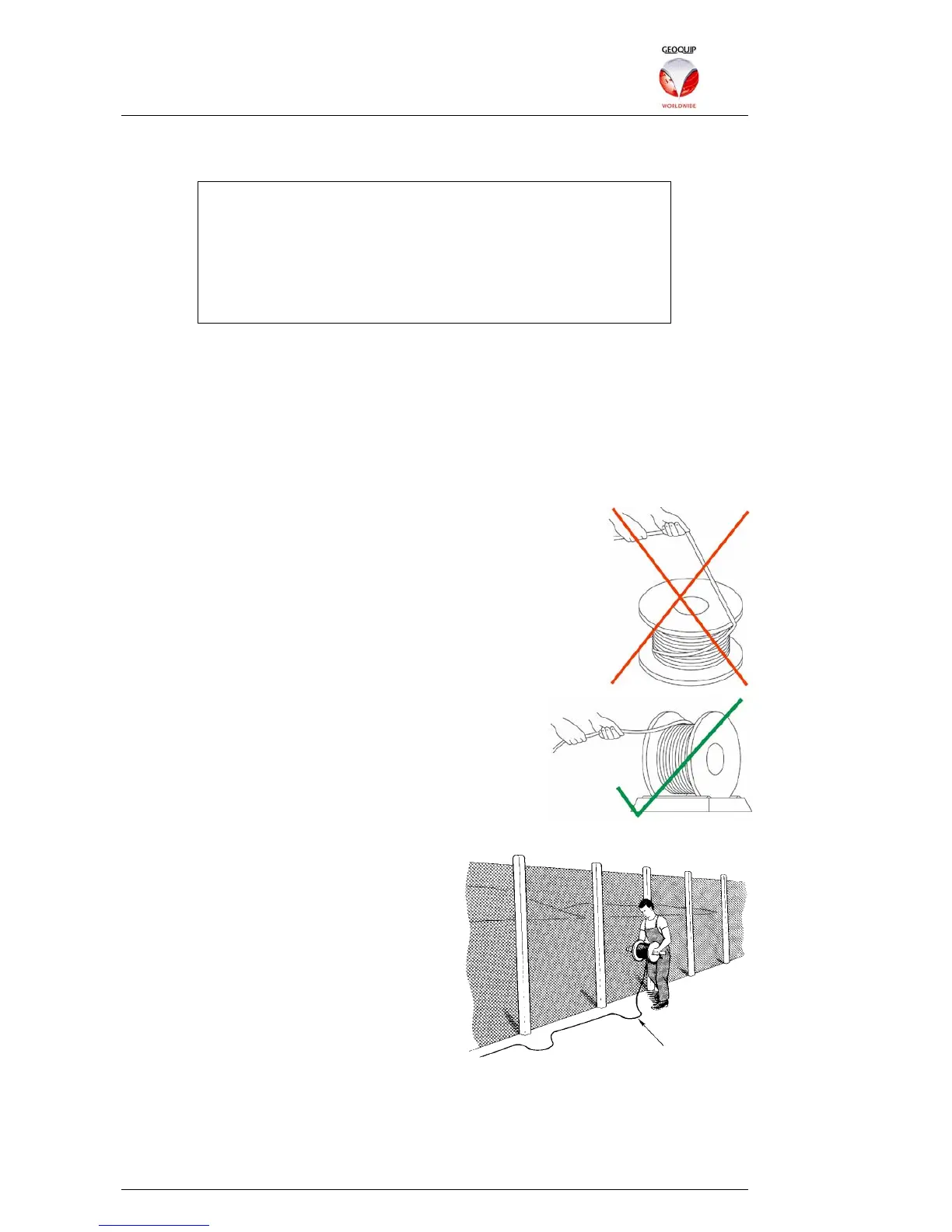
When deploying the sensor cable, it must be removed correctly
from the reel to prevent excessive strain being generated as it is
fed out.
The drum should never be laid horizontally and the cable pulled
sideways away from it as shown here. This will risk kinking the
cable or damage from excessive strain, and may also cause the
cable to become twisted. It is important to avoid this twisting
because the sensor is manufactured with a precise and even
spiral twist, to ensure the maximum possible rejection of electrical
interference.
Instead the drum should ideally be mounted vertically on
a de-reeler so that the sensor may be gently pulled off
without causing strain or kinking. Be careful with larger
drums of cable - it may be necessary to turn the drum by
hand while unreeling in order to avoid exerting more than
6kg of force on the cable itself. If a de-reeler is not
available, a pole may be placed through the axis of the
drum, so that the reel can turn freely as the
cable is deployed.
When the cable is supplied on lighter reels
which can easily be lifted and carried by a
single installer, it may be deployed by
carrying the reel with a pole through its
central axis and allowing the cable to fall
freely to the ground.
Note that when the cable is deployed,
sufficient extra length must be provided to
allow for posts and gates: see section 5.2.9
below.
After laying out the sensor cable along the
ground adjacent to the fence, leave the reel
and any remaining cable in place until the sensor has been fixed to the fence. This will
ensure that extra length is available if a miscalculation has occurred!
If the cable is to be left unterminated for any length of time, ensure that any cut ends
are sealed against moisture using heatshrink boots.



 To Next Page