PART 2
TEST 13 - CHECK AND ADJUST VOLTAGE
REGULATOR
DISCUSSION:
For additional information, refer to description and
components Section 2.1.
PROCEDURE (SINGLE CYLINDER UNITS):
With the frequency between 62-63 Hertz, slowly turn
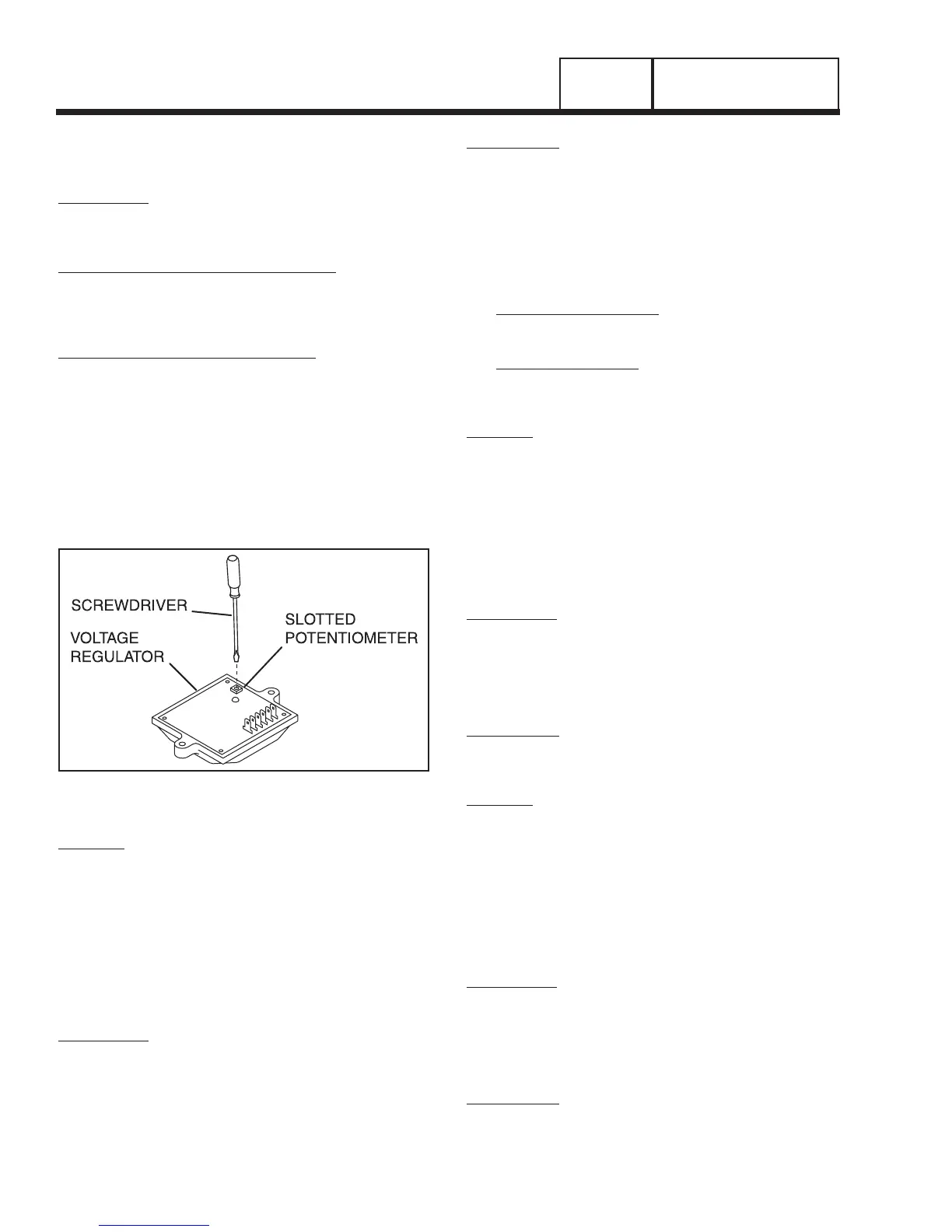
the slotted potentiometer (Figure 13) until line voltage
reads 247-252 volts.
PROCEDURE (V-TWIN ENGINE UNITS):
With the frequency between 58-59 Hertz, slowly turn
the slotted potentiometer (Figure 13) until line voltage
reads 250-252 volts.
NOTE: You must remove the access panel on top of
the control panel to adjust the voltage regulator.
NOTE: The voltage regulator is housed above the
generator control panel. The regulator maintains
a voltage in direct proportion to frequency at a 2-
to-1 ratio. For example, at 62 Hertz, line-to-neutral
voltage will be 124 volts.
Figure 13. Voltage Adjustment Potentiometer
RESULTS:
1. If the frequency and voltage are now good, discontinue
tests.
2. If frequency is now good but voltage is high or low, go to
Problem 1, Test 4.
TEST 14 - CHECK VOLTAGE AND FREQUENCY
UNDER LOAD
DISCUSSION:
It is possible for the generator AC output frequency
and voltage to be good at no-load, but they may drop
excessively when electrical loads are applied. This
condition, in which voltage and frequency drop exces-
sively when loads are applied, can be caused by (a)
overloading the generator, (b) loss of engine power,
or (c) a shorted condition in the stator windings or in
one or more connected loads.
PROCEDURE:
1. Connect an accurate AC frequency meter and an AC
voltmeter across the stator AC power winding leads.
2. Start the engine, let it stabilize and warm-up.
3. Apply electrical loads to the generator equal to the rated
capacity of the unit.
4. Check the AC frequency and voltage.
a.Single Cylinder Units: Frequency should not
drop below approximately 58 Hertz. Voltage
should not drop below about 230 volts.
b. V-Twin Engine Units: Frequency should not drop
below approximately 60 Hertz. Voltage should
not drop below about 240 volts.
RESULTS:
1. If frequency and voltage drop excessively under load, go
to Test 15.
2. If frequency and voltage under load are good, discon-
tinue tests.
TEST 15 - CHECK FOR OVERLOAD CONDITION
DISCUSSION:
An “overload” condition is one in which the generator
rated wattage/amperage capacity has been exceed-
ed. To test for an overload condition on an installed
unit, the best method is to use an ammeter. See
“Measuring Current” in Section 1.4.
PROCEDURE:
Use a clamp-on ammeter to measure load current draw, with
the generator running and all normal electrical loads turned on.
RESULTS:
1. If the unit is overloaded, reduce loads to the unit’s rated
capacity.
2. If unit is not overloaded, but rpm and frequency drop
excessively when loads are applied, go to Test 16.
TEST 16 - CHECK ENGINE CONDITION
DISCUSSION:
If engine speed and frequency drop excessively under
load, the engine may be under-powered. An under-
powered engine can be the result of a dirty air clean-
er, loss of engine compression, faulty fuel settings,
incorrect ignition timing, etc.
PROCEDURE:
For engine testing, troubleshooting and repair pro-
cedures refer to Problem 11 in Section 4.3. For fur-
ther engine repair information refer to the appropri-
ate engine service manuals
.
Page 48
AC GENERATORS
SECTION 2.4
DIAGNOSTIC TESTS



 To Next Page