Check the brake fluid reservoir. Check whether
the brake fluid quantity is within the scale; if
the liquid quantity is insufficient, please top it
up and check whether there is air in the brake
line.
Caution
Prevent dust and water from mixing with the
oil when adding brake fluid.
Brake fluid is toxic and corrosive and should
be rinsed off if you are exposed to it.
Replacement of brake fluid
See the Daily maintenance (1000 hours)
8. Light check
Ensure that the light turns on when the ignition
key switch is on.
9. Indicator light check
Toggle the indicator light control lever and
check whether the indicator light operates
normally.
10. Hand brake check
① The truck slows down.
② The truck brakes and stops when the hand
brake lever is pulled up. The forklift truck must
not swerve to one side as the brake is applied.
11. Reversing light and reversing buzzer check
When the shift lever is in the R position, the
reversing light turns on and the reversing
buzzer rings.
12. Steering
① The forklift truck should be driven slowly.
② Turn the steering wheel three turns
clockwise and anticlockwise, respectively.
Observe whether the left and right steering
force are the same.
13. Horn
Press the horn button and check whether the
sound is normal.
14. Seat adjustment and safety belt check
Pull the seat adjusting lever back, adjust the
driver's seat to a comfortable position for your
hands and feet, release the seat adjusting lever,
and lock it.
Check whether the safety belt works normally.
15. Shift lever
Check whether the shift lever is loose and
whether it is stable when shifting gear.
16. Lift lever, tilt lever and accessory lever
Check that the lift lever, tilt lever and accessory
lever are secure and they return properly.
Increase the engine speed, respectively
operate the lift lever, tilt lever, and accessory
lever, and ensure that the forks can be fully
lifted and lowered and the mast can tilt
forward and backward.
17. Instruments and sensor
Check whether the stopwatch, water
thermometer, oil thermometer, transmission
oil temperature sensor, fuel sensor, engine
water temperature sensor, oil pressure sensor
and other instruments are normal.
18. Brake and inching pedal check
Slow down and step on the brake pedal; after
stepping on the brake pedal, the brake light
should turn on.
Slow down and step on the inching pedal;
check whether the inching pedal function is
normal.
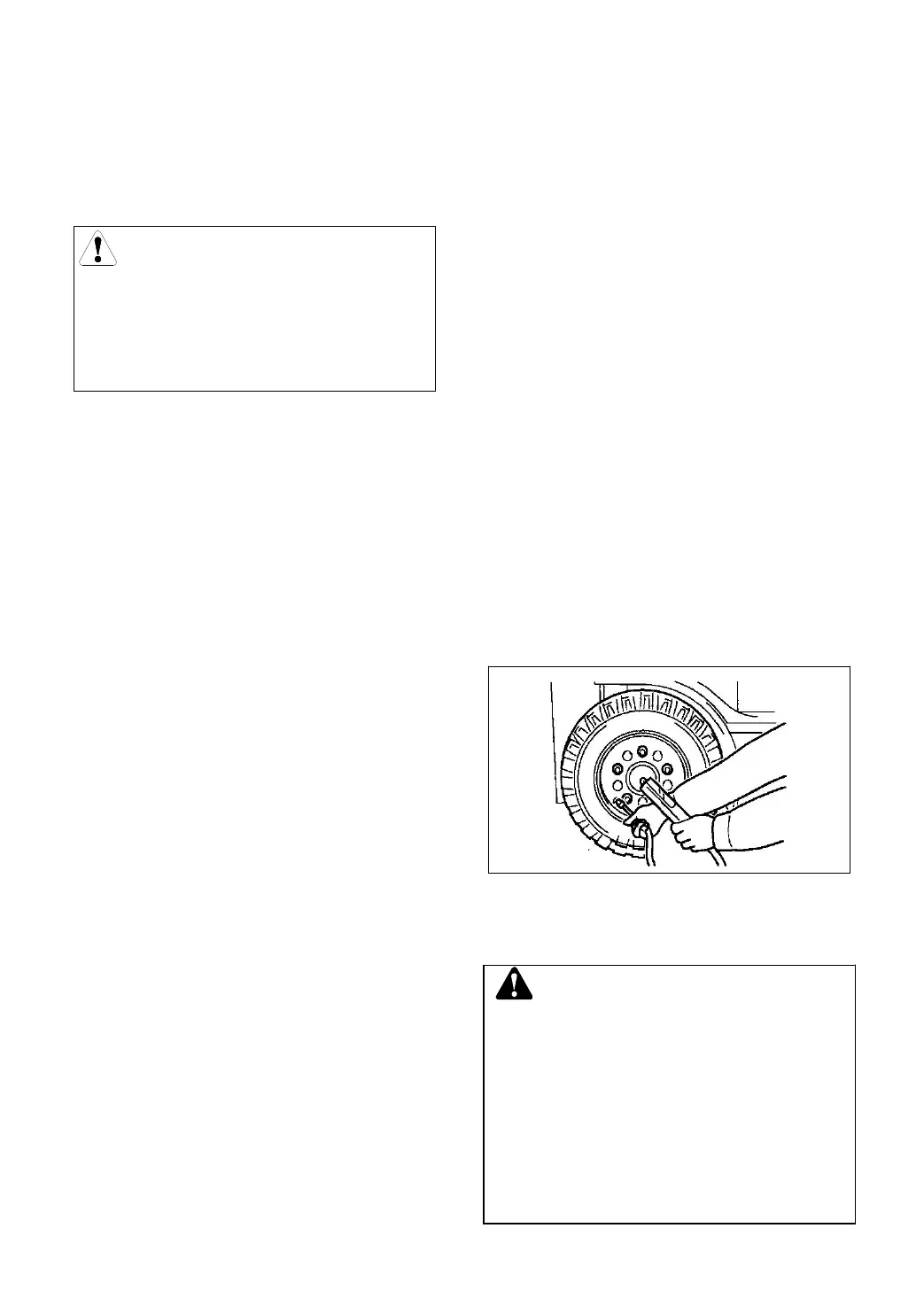
19. Tire check and tire pressure check
Screw the cap back on after confirming that
there is no air leakage; check whether there is
damage on the tire surface and sides and
whether the rim is deformed.
Unscrew the cap anticlockwise and measure
the tire pressure with an air pressure gauge.
Increase the pressure to the specified value if
it is insufficient.
Warning
The forklift truck tires require very high
pressure to bear loads; tiny deformation
of the rim or surface damage to the tire
may cause an accident.
When using an air compressor, as the
maximum output pressure of the air
compressor is higher than the specified
pressure of tire, the pressure setting




 To Next Page