Control Modes & Algorithms 84
18. CONTROL MODES & ALGORITHMS
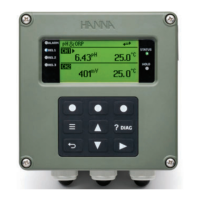
HI520 is intended to be used to control industrial processes. The instrument and sensor measure the process
variable. HI520 uses control settings to control outputs that are connected to auxiliary equipment to
control the process variable to the desired value.
The HI520 uses smart probes to measure the process variable and temperature. The smart probe stores the
probe type, calibration data, Model, Firmware version, Serial number and Factory calibration date in the probe.
In the case of a pH probe, it converts the high impedance mV value to a digital signal for clean measurement
transport to the controller.
The controlled variable can be selected between supported parameter (parameter probe) and temperature. Once
selected, any alarm conditions link to it alone.
There are three types of algorithm corrections that can be applied to the control function: On/Off, Time proportional,
and Proportional Integral & Derivative (PID).
The HI520 uses outputs to interact with pumps, valves, and other equipment to control a process. It contains
Relays and Analog Outputs for this purpose.
Control Output Element Output
Relays On or Off
Analog Outputs (AO) 0‑20 or 4‑20 mA
The On relay state occurs when the relay is energized:
` NO and COM connected
` NC and COM disconnected
The Off relay state occurs when the relay is de‑energized:
` NO and COM disconnected
` NC and COM connected
The Analog outputs can be adjusted to a minimum value of 0 mA (default) or 4 mA and a maximum value of
20 mA. See 10.2 Analog Outputs
Control Algorithms
This section describes the controller behavior with a pH smart probe. It presents a similar behavior with other
smart probes.
There are three control algorithms implemented in HI520; and each algorithm has both specific and common
settings. The common settings – overtime & minimum on time – affect control output after the specific algorithm
settings and rules are evaluated.
The overtime (safety timer) sets the maximum continuous time that the control element is running at it’s
maximum value. If this time is exceeded, the control will be stopped and an alarm generated.
The minimum on time timer sets a time value to control the speed of the relay status change. This timer prevents
the relay and connected device from “chattering” by forcing a minimum on and off time. This is necessary to
protect elements that are driven (e.g. actuators, motors, contactors) from electrical and mechanical shocks.


 To Next Page
 Loading...