Testing the EPC9 EPC9 Manual 27
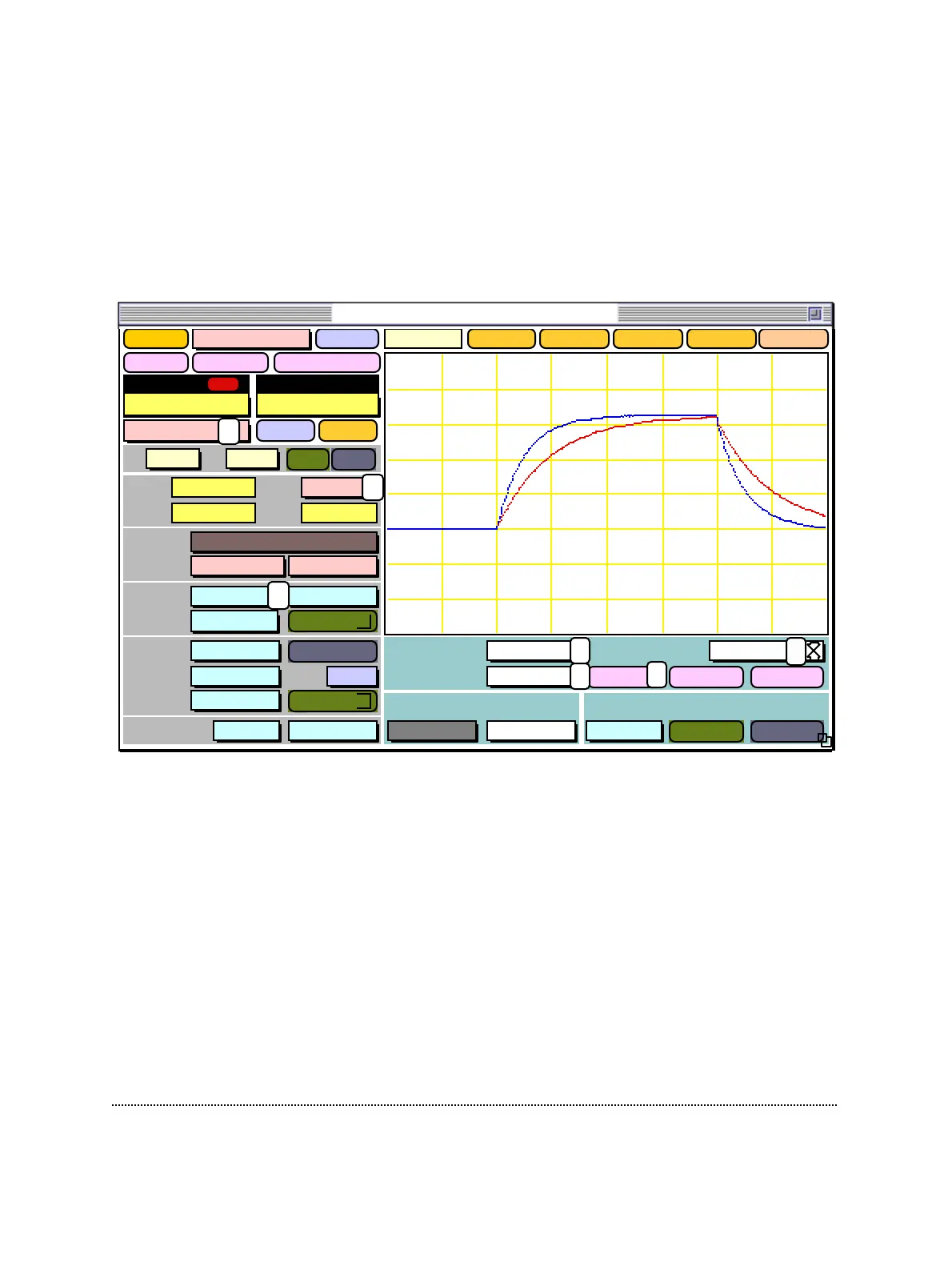
labeled CC Fast Speed and then open the oscilloscope again (6). Now, you will see a
much slower signal (red line in the oscilloscope). Please note, that the fast current
clamp mode is very sensitive to misadjustment of the C-fast setting. Especially
overcompensation causes the signal to oscillate. You can test this quickly by slightly
increasing C-fast from its value of about 6.5 pF (7). With the settings from this tutorial
you should see oscillations occur at a around 8.1 pF and above, when the fast current
clamp mode has been activated.
Note: The 500 MΩ setting of the model circuit is not a good method for testing the fast
clamp speed of the EPC9 due to the long time constant of 11 ms which the amplifier
can easily follow. If you want to have a better estimation of the amplifier’s speed
under current clamp conditions you should do the same test as above with the 10
MΩ setting. This results in a much shorter “membrane” time constant of only 60 µs.
Sound
Scope
1. Amplifier
Test Pulse
Amplitude
100.0 pA
Duration
100.0 ms
Vmon
Gain
16.00 x
Clear
Reset
OverlayClose
Stimulus External
Off20 µs
Noise 0.00 A
Leak Subtraction
Off TrackAuto
RsComp
OffOff
CSlow
<>
21.71 pF
RSeries 5.4 MΩ
Range Off Cap Track
Auto
CFast
<>
6.50 pF
67 %
8.0 µs
Auto
Filter 2 2.9 kHzBessel
Filter 1 Bessel 10 kHz
Rmem 519. MΩ
V-mon -16.0 mV
I-mon -31.3 pA
Mode CC
Vo -2.2 mV
TrackAuto
LJ 0.0 mV
Gain
10 mV/pA
ClipI-hold
-30.0 pA
+/-
emptyemptyemptyempty
WHOLE-CELLON-CELLSET-UP
Record
Delay Off
Help
16.0 mV
25.0 ms
Fast Current-Clamp
Slow Current-Clamp
2
3
4
5
6
7
1
EPC9 Patch-Clamp Amplifier, v8.3


 To Next Page