E9Screen Software EPC9 Manual 37
Note: There is a limit of 50 actions per macro. To abort recording of a macro, click again
on “Record” and the just recorded sequence will be lost.
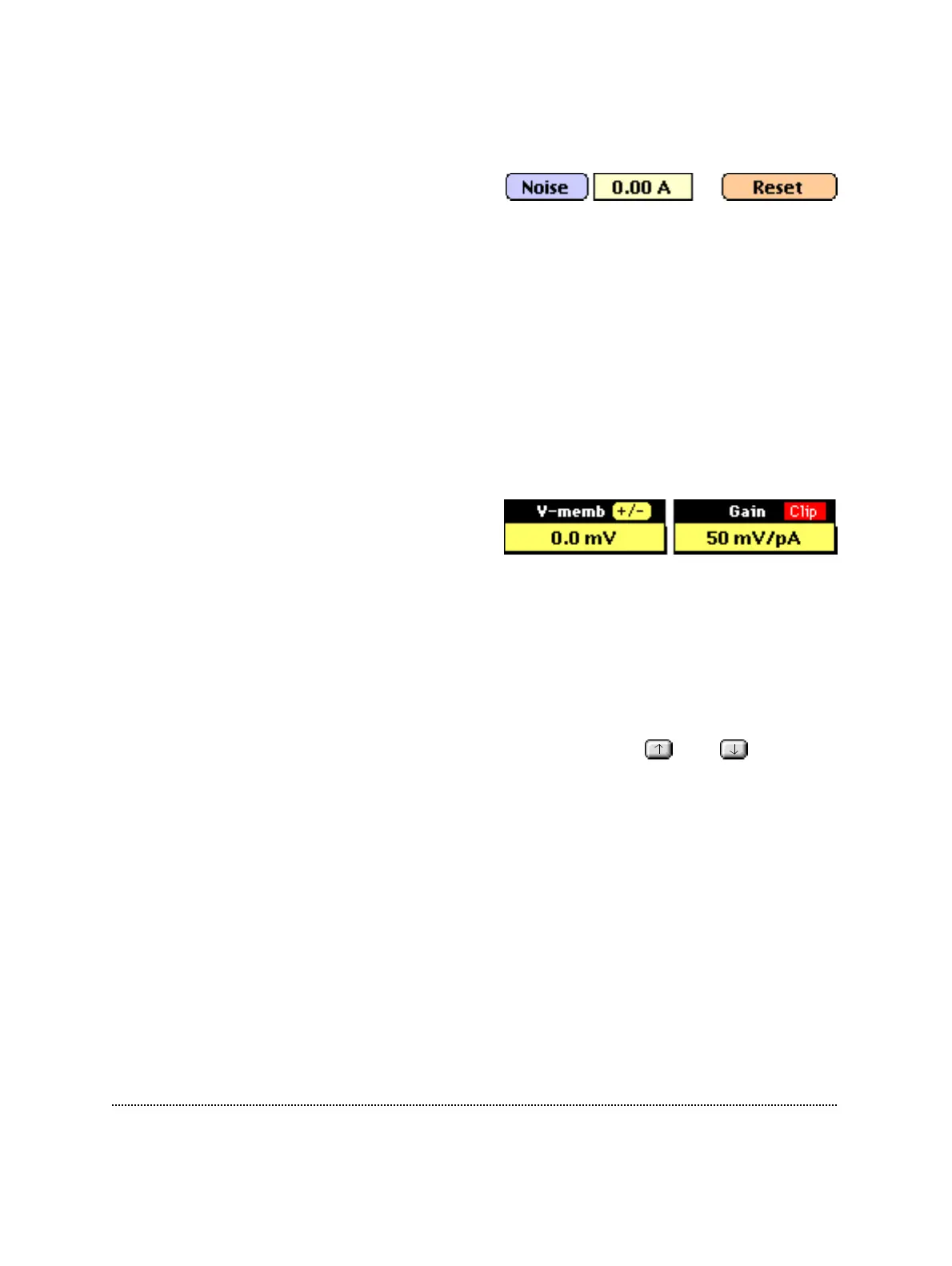
Noise: The rms noise is continuously
measured and updated when the noise
mode is selected with the button Noise. For the determination of the noise level, no
pulses are output and current is sampled via the active AD-channel using the current
filter settings (usually the Current Monitor 2 output, so that the bandwidth is
determined by Filter 2). It is sampled in sections of 10 times 256 points with a sample
interval of 100 µs, i.e., a total length of 256 ms.
I-monitor: DC current monitor.
Reset: Selecting this button will reset the EPC9 to its initial default configuration. It
will reset the DA channels to zero, which is useful to cancel the output of C-slow and
R-series set by Cap. Track. Also, Reset is very useful to define the initial state of the
EPC9, when recording a macro.
V-membrane: Displays the actually-
measured pipette voltage after correcting
for liquid-junction potentials and offsets
(provided the zero-current potential has been set correctly). This may differ
(temporarily) from the holding voltage (e.g., during long stimulation pulses) as it
indicates the average sum of V-membrane and the scaled stimulus voltage. V-
membrane is converted to I-hold in Current Clamp mode.
+/-: This button inverts the polarity of V-membrane.
Gain: Sets the scaling of the current monitor output. The range is 0.005 to 2000
mV/pA and can be set by dragging the mouse or pressing and . The gain
setting automatically selects one of the three available current-measuring feedback
resistors in the probe (5 MΩ, 500 MΩ, and 5 GΩ), corresponding to low, medium and
high gain ranges. The table below summarizes the main features and limitations of
the gain ranges:


 To Next Page