3 PREPARATION
13
Installation
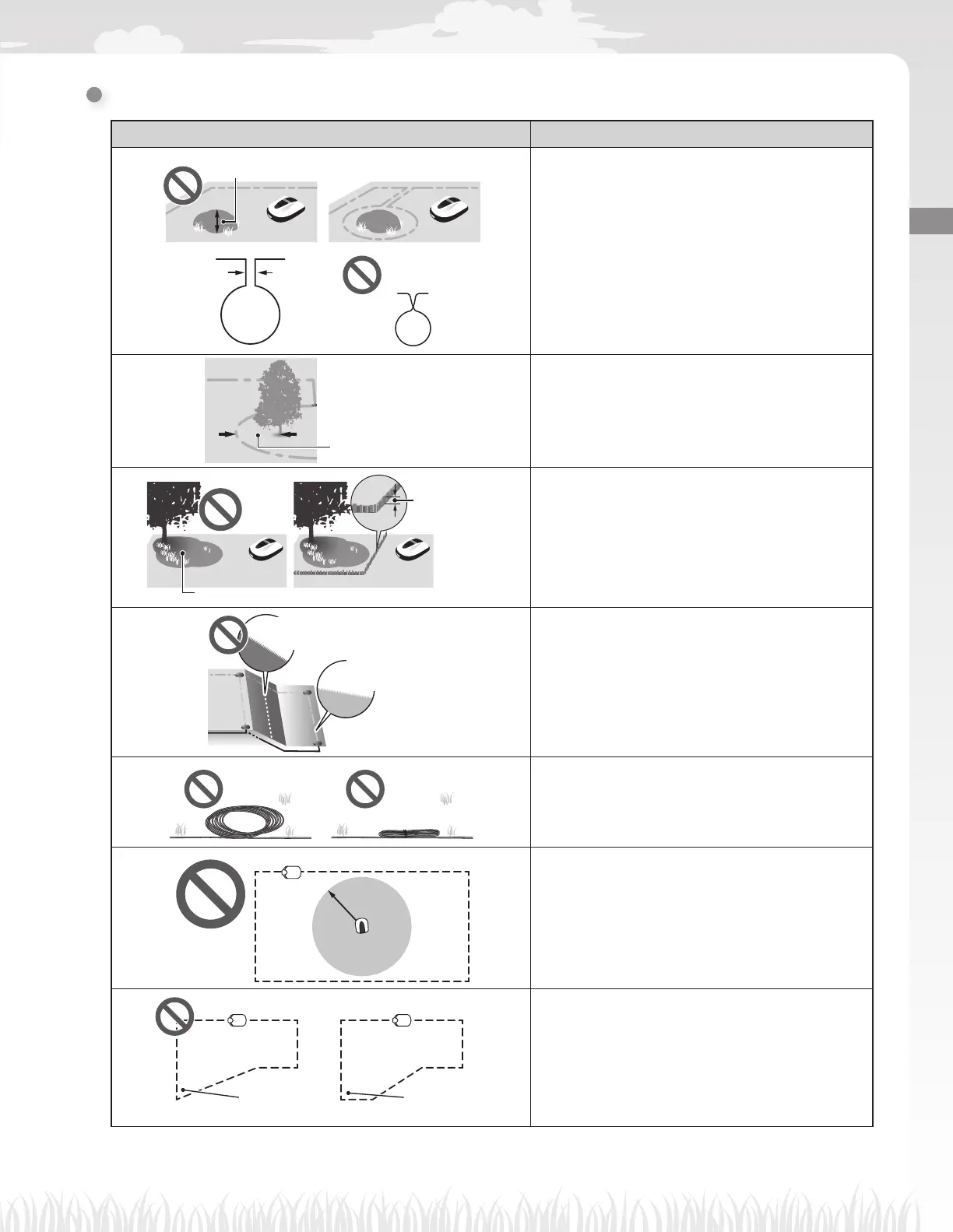
Conditions for laying the boundary wire
Image Condition
Height of objects which the lawn
mower might run on top of
Lay boundary wire around objects which the lawn
mower might run on top of (e.g. rocks, tree roots,
etc.); these objects must be removed from the work
area.
Maximum
0.2 in
(5 mm)
interval
Crossed
EX:
The boundary wire entry and exit points for a round
area should be separated by no more than 0.2 in
(5 mm). (However, the boundary wire should not
cross itself.)
11.8 in (30 cm) to
19.7 in (50 cm)
There must be 11.8 in (30 cm) to 19.7 in (50 cm) of
space between the boundary wire and large objects.
(This space can be reduced to as little as 11.8 in
(30 cm) if you set [Wire Overlap] to a low value. For
details, consult your dealer.)
Taller than
5.9 in (15 cm)
Areas which the lawn mower might fall into
Lay fencing taller than 5.9 in. (15 cm) around areas
that the lawn mower might fall into, such as uneven
ground, ponds, pools, driveways, or other areas with
differences in height.
More than
10° (17%)
Less than
10° (17%)
Do not lay boundary wire so that it intersects on a
slope of more than 10° (17%).
You can lay boundary wire parallel to a slope of
more than 10° (17%) in order to access an area with
a slope of less than 10° (17%).
Boundary wire should be laid so that there is no
excess wire.
Radius
66 ft (20 m)
The lawn mower can detect the signal from the
boundary wire within a 66 ft (20 m) radius.
If the lawn mower enters a space inside the work
area with no boundary wire within a 66 ft (20 m)
radius, the signal will not be detected and the lawn
mower will stop.
Acute angle
Right angle or
obtuse angle
The boundary wire must not be laid with any acute
angles. (Angles should be more than 90°.)



 To Next Page