\
-
FEEDBACK AMPLIFIERS EMITTER
,
RC
20
\
ATTENUATOR
--
I
FOLLOWERS
BRIDGE
(RIOA,B,C2,C71
QI
,
Q2
03,
04
SECTION
IV
I
R40A,Bh
I
I
I
PRINCIPLES
OF
OPERATION
I
FEEDBACK
Section
Paragraphs 4-1 to 4-10
4-1.
INTRODUCTION.
4-2.
The Model 204B consists of an RC bridge oscil-
lator circuit,
a
peak detector circuit, and an output
attenuator (bridged-T type). These circuits and the
front panel controls associated with them
are
shown
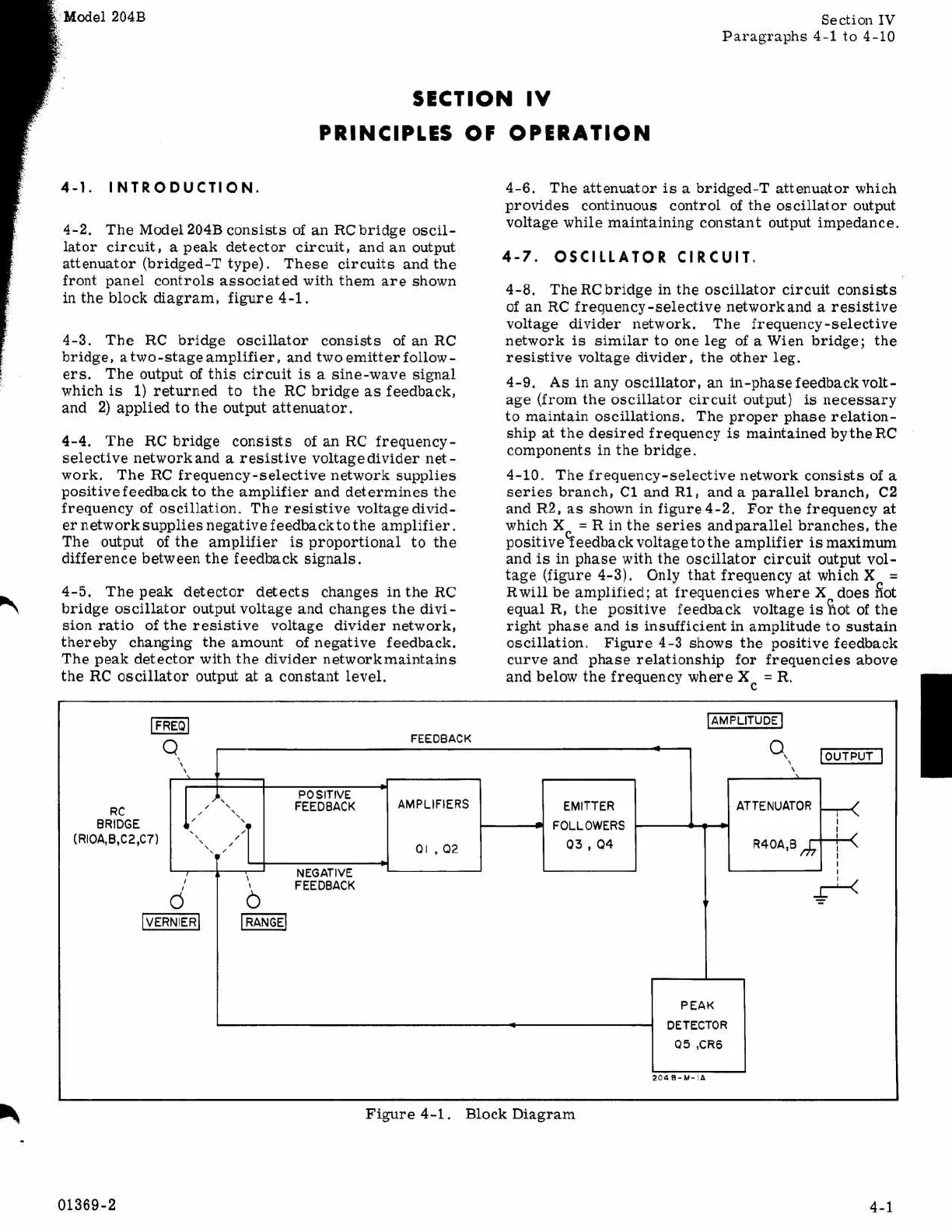
in the block diagram, figure 4-1.
4-3. The RC bridge oscillator consists of an RC
bridge, a two-stage amplifier, and two emitter follow
-
ers. The output of this circuit
is
a
sine-wave signal
which
is
1)
returned to the RC bridge
as
feedback,
and
2)
applied to the output attenuator.
4-4.
The RC bridge consists of an RC frequency-
selective networkand
a
resistive voltage divider net
-
work. The RC frequency-selective network supplies
positive feedback to the amplifier and determines the
frequency of oscillation. The resistive voltage divid-
er network supplies negative feedback to the amplifier.
The output of the amplifier
is
proportional to the
difference between the feedback signals.
4-5. The peak detector detects changes in the RC
bridge oscillator output voltage and changes the divi-
sion ratio of the resistive voltage divider network,
thereby changing the amount of negative feedback.
The peak detector with the divider networkmaintains
the RC oscillator output
at
a
constant level.
4-6. The attenuator
is
a
bridged-T attenuator which
provides continuous control of the oscillator output
voltage while maintaining constant output impedance.
4-7.
OSCILLATOR CIRCUIT.
4-8. The RC bridge in the oscillator circuit consists
of an RC frequency-selective networkand
a
resistive
voltage divider network. The frequency-selective
network
is
similar to one leg of
a
Wien bridge; the
resistive voltage divider, the other leg.
4-9.
As
in any oscillator, an in-phase feedback
volt-
age (from the oscillator circuit output)
is
necessary
to maintain oscillations. The proper phase relation-
ship
at
the desired frequency
is
maintained by the RC
components in the bridge.
4-10. The frequency-selective network consists of
a
series branch, C1 and R1, and
a
parallel branch, C2
and R2,
as
shown in figure4-2.
For
the frequency
at
which
X
=
R
in the series andparallel branches, the
positive feedback voltage to the amplifier
is
maximum
and
is
in phase with the oscillator circuit output vol-
tage (figure 4-3). Only that frequency
at
which
X
=
Rwill be amplified;
at
frequencies where
Xc
does got
equal R, the positive feedback voltage
is
not of the
right phase and
is
insufficient in amplitude to sustain
oscillation.
Figure
4-3 shows the positive feedback
curve and phase relationship for frequencies above
and below the frequency where
X
=
R.
C
01369-2
Figure 4-1. Block Diagram
4-1



 To Next Page