EasyManua.ls Logo

HP 5300A - Page 33

HP 5300A
90 pages
Print Icon
To Next Page IconTo Next Page
To Previous Page IconTo Previous Page
Loading...
~~
conduct,
pulling
its
anode
down
to
about
zero
volts.
This
turns
on
A2Q8,
which
turns
on
A2Q9.
A1Q3
base
current
is
then
shunted
through
A2Q9
to
ground,
such
that
A1Q3
receives
no
drive
voltage.
This
shuts
the
power
supply
off.
A2Q6
remains
on,
however,
as
long
as
the
input
voltage
is
present.
The
circuit
is
reset
by
removing
the
ac
input
for
about
5
seconds,
which
allows
A1C2
to
discharge
through
A2R15
and
A2R16.
4-61.
Dc-to-Dc
Converter
4-62.
This
is
basically
a
blocking
oscillator
converter
using
a
single
switch
transistor,
A1Q3,
with
the
dc
in-
put
voltage
available
across
A1C2.
Resisitor
A1R11
supplies
initial
start
current
into
the
base
of
A1Q3
to
start
oscillations.
Diode
A1CR5
allows
base
current
to
flow
to
A1Q3
during
normal
operation
with
capacitor
A1C4
as
an
ac
bypass.
Printed
circuit
wiring
is
such
that
no
drive
voltage
is
applied
to
A1Q3
if
A2
Regu-
lator
Assembly
is
removed
from
its
socket.
During
normal
operation
A1Q3
alternately
switches
on
into
saturation
and
then
off.
With
A1Q3
“on”,
an
increas-
ing
current
flows
through
A1T1
and
the
primary
of
A1T2.
4-63.
The
polarity
of
the
rectifiers
on
the
secondary
of
A1T2
is
such
that
when
A1Q3
is
turned
on,
they
do
not
conduct.
Thus,
the
dc
input
voltage
sees
only
the
primary
inductances
of
A1T1
and
A1lT2.
AI1T1
is
a
small
current
transformer
and
drops
very
little
volt-
age
across
primary
pins
1
and
3.
A2Q1
collector
cur-
rent
builds
up
linearly
when
it
is
turned
or.
The
impedance
of
AIT1
is
such
that
about
1/15th
the
A1Q3
collector
current
flows
into
the
base
of
A1Q3.
This
is
sufficient
to
keep
it
in
saturation.
After
a
period
of
time,
designated
time
Tl
and
controlled
by
the
rest
of
the
circuit
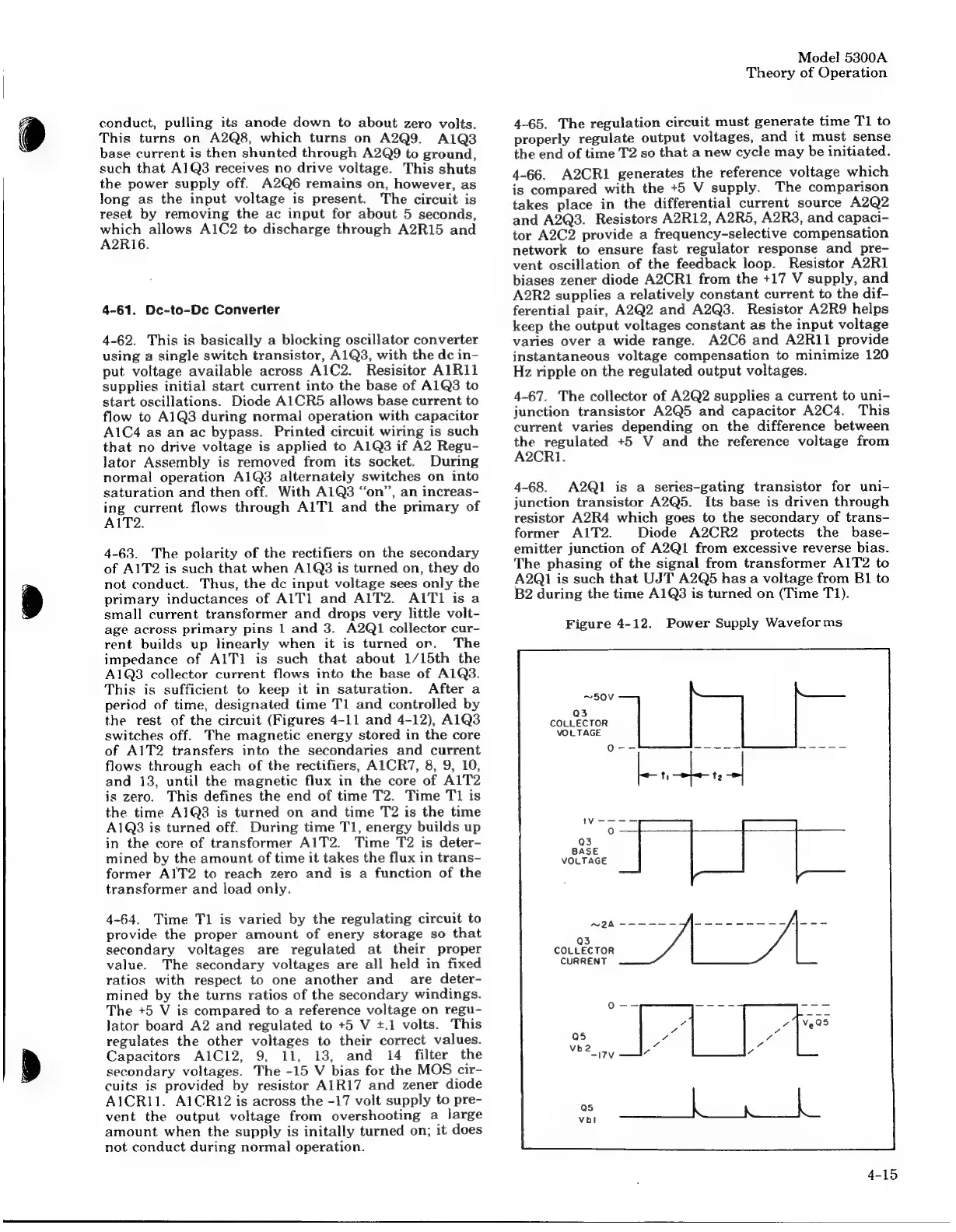
(Figures
4-11
and
4-12),
A1Q3
switches
off.
The
magnetic
energy
stored
in
the
core
of
A1T2
transfers
into
the
secondaries
and
current
flows
through
each
of
the
rectifiers,
A1CR7,
8,
9,
10,
and
13,
until
the
magnetic
flux
in
the
core
of
A1T2
is
zero.
This
defines
the
end
of
time
T2.
Time
T1
is
the
time
A1Q3
is
turned
on
and
time
T2
is
the
time
A1Q3
is
turned
off.
During
time
T1,
energy
builds
up
in
the
core
of
transformer
A1T2.
Time
T2
is
deter-
mined
by
the
amount
of
time
it
takes
the
flux
in
trans-
former
AIT2
to
reach
zero
and
is
a
function
of
the
transformer
and
load
only.
4-64.
Time
T1
is
varied
by
the
regulating
circuit
to
provide
the
proper
amount
of
enery
storage
so
that
secondary
voltages
are
regulated
at
their
proper
value.
The
secondary
voltages
are
all
held
in
fixed
ratios
with
respect
to
one
another
and
are
deter-
mined
by
the
turns
ratios
of
the
secondary
windings.
The
+5
V
is
compared
to
a
reference
voltage
on
regu-
lator
board
A2
and
regulated
to
+5
V
+.1
volts.
This
regulates
the
other
voltages
to
their
correct
values.
Capacitors
A1C12,
9,
11,
13,
and
14
filter
the
secondary
voltages.
The
-15
V
bias
for
the
MOS
cir-
cuits
is
provided
by
resistor
AIR17
and
zener
diode
A1CRI11.
A1CR12
is
across
the
-17
volt
supply
to
pre-
vent
the
output
voltage
from
overshooting
a
large
amount
when
the
supply
is
initally
turned
on;
it
does
not
conduct
during
normal
operation.
Model!
5300A
Theory
of
Operation
4-65.
The
regulation
circuit
must
generate
time
T1
to
properly
regulate
output
voltages,
and
it
must
sense
the
end
of
time
T2
so
that
a
new
cycle
may
be
initiated.
4-66.
A2CRI1
generates
the
reference
voltage
which
is
compared
with
the
+5
V
supply.
The
comparison
takes
place
in
the
differential
current
source
A2Q2
and
A2Q3.
Resistors
A2R12,
A2R5,
A2R3,
and
capaci-
tor
A2C2
provide
a
frequency-selective
compensation
network
to
ensure
fast
regulator
response
and
pre-
vent
oscillation
of
the
feedback
loop.
Resistor
A2R1
biases
zener
diode
A2CRI1
from
the
+17
V
supply,
and
A2R2
supplies
a
relatively
constant
current
to
the
dif-
ferential
pair,
A2Q2
and
A2Q3.
Resistor
A2R9
helps
keep
the
output
voltages
constant
as
the
input
voltage
varies
over
a
wide
range.
A2C6
and
A2R11
provide
instantaneous
voltage
compensation
to
minimize
120
Hz
ripple
on
the
regulated
output
voltages.
4-67.
The
collector
of
A2Q2
supplies
a
current
to
uni-
junction
transistor
A2Q5
and
capacitor
A2C4.
This
current
varies
depending
on
the
difference
between
the
regulated
+5
V
and
the
reference
voltage
from
A2CRI1.
4-68.
A2Q1
is
a
series-gating
transistor
for
uni-
junction
transistor
A2Q5.
Its
base
is
driven
through
resistor
A2R4
which
goes
to
the
secondary
of
trans-
former
A1T2.
Diode
A2CR2
protects
the
base-
emitter
junction
of
A2Q1
from
excessive
reverse
bias.
The
phasing
of
the
signal
from
transformer
A1LT2
to
A2Q1
is
such
that
UJT
A2Q5
has
a
voltage
from
B1
to
B2
during
the
time
A1Q3
is
turned
on
(Time
T1).
Figure
4-12.
Power
Supply
Waveforms
~50vV
Q3
COLLECTOR
VOLTAGE
Q3
COLLECTOR
CURRENT

Related product manuals