EasyManua.ls Logo

HP 5300A - Field Effect Transistor (FET); Light Emitting Diodes; Integrated Circuit Operation; Overall Operation

HP 5300A
90 pages
Print Icon
To Next Page IconTo Next Page
To Previous Page IconTo Previous Page
Loading...
Model
5300A
Theory
of
Operation
4-7.
INVERSION.
AND
and
OR
gates
are
shown
in
Figure
4-2
(A,B).
The
circle
on
the
output
of
a
logic
symbol
indicates
a
LOW
when
activated,
as
shown
in
Figure
4-2(C,D).
Thus,
a
circle
indicates
inver-
sion.
An
AND
gate
with
an
inverted
output
is
called
a
NAND
gate;
an
OR
gate
with
an
inverted
output
is
called
a
NOR
gate.
The
unit
gain
amplifier
with
an
inverted
output
is
called
an
inverter,
Figure
4-2
(F).
4-8.
FIELD
EFFECT
TRANSISTOR
(FET)
4-9.
Field
effect
transistors
have
three
terminals:
source,
drain,
and
gate
which
correspond
in
function
to
emitter,
collector,
and
base
of
junction
transistors.
Source
and
drain
leads
are
attached
tothe
sameblock
(channel)
of
N
or
P
semiconductor
material.
A
band
of
oppositely
doped
material
around
the
channel
(be-
tween
the
source
and
drain
leads)
is
connected
to
the
gate
lead.
4-10.
In
normal
FET
operation,
the
gate-source
volt-
age
reverse-biases
the
PN
junction,
causing
an
elec-
tric
field
that
creates
a
depletion
regioninthe
source-
drain
channel.
In
the
depletion
region
the
number
of
available
current
carriers
is
reducedas
the
reverse-
biasing
voltage
increases,
making
source-drain
cur-
rent
a
function
of
gate-source
voltage.
With
the
input
(gate-source)
circuit
reverse-biased,
the
FET
pre-
sents
a
high
impedance
to
its
signal
sources
(as
com-
pared
with
the
low
impedance
of
the
forward-biased
junction
transistor
base-emitter
circuit),
Because
there
is
no
input
current,
FET's
have
less
noise
than
junction
transistors.
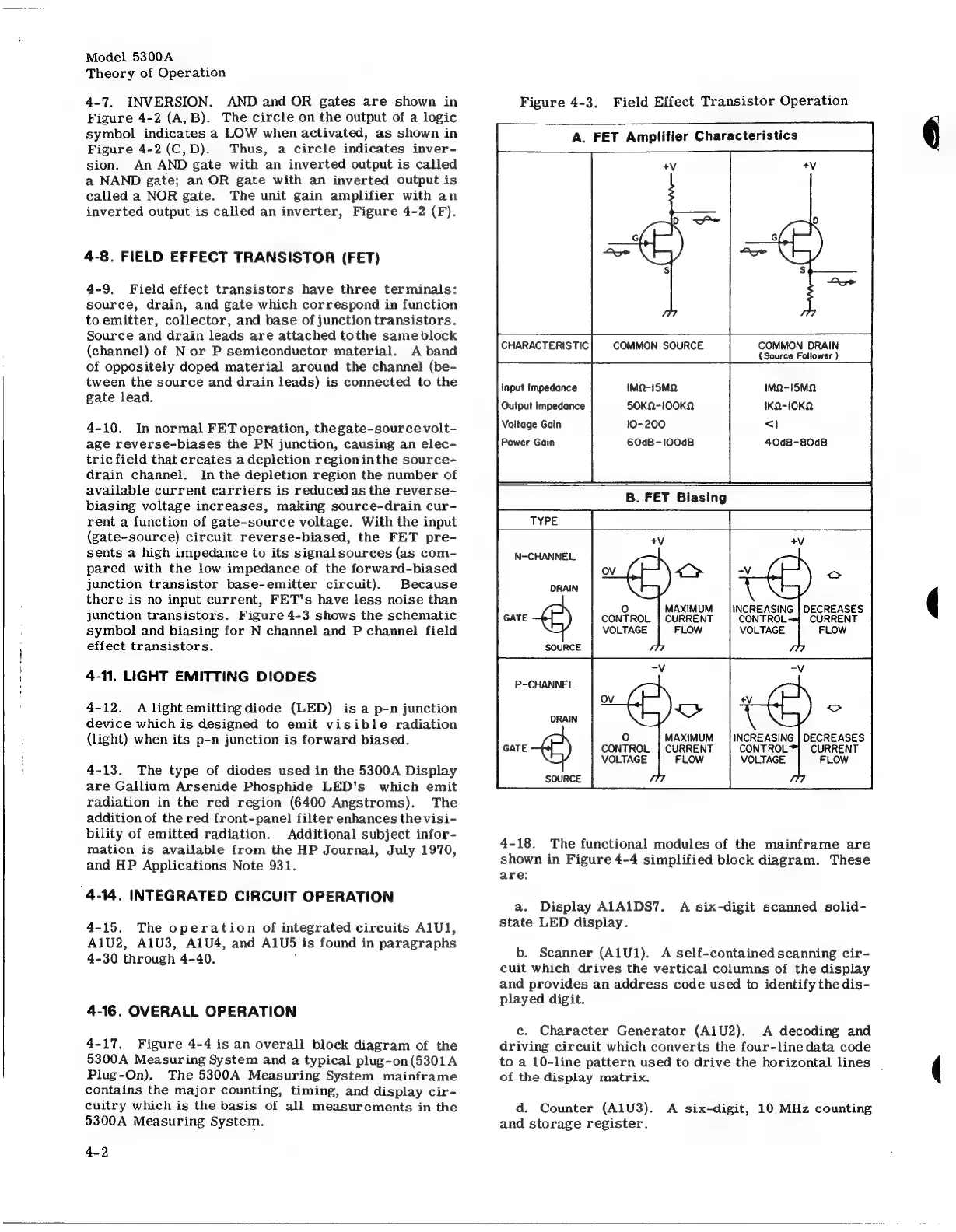
Figure
4-3
shows
the
schematic
symbol
and
biasing
for
N
channel
and
P
channel
field
effect
transistors.
4-11.
LIGHT
EMITTING
DIODES
4-12.
A
light
emitting
diode
(LED)
is
a
p-n
junction
device
which
is
designed
to
emit
visible
radiation
(light)
when
its
p-n
junction
is
forward
biased.
4-13.
The
type
of
diodes
used
in
the
5300A
Display
are
Gallium
Arsenide
Phosphide
LED's
which
emit
radiation
in
the
red
region
(6400
Angstroms).
The
addition
of
the
red
front-panel
filter
enhances
the
visi-
bility
of
emitted
radiation.
Additional
subject
infor-
mation
is
available
from
the
HP
Journal,
July
1970,
and
HP
Applications
Note
931.
4-14.
INTEGRATED
CIRCUIT
OPERATION
4-15.
The
operation
of
integrated
circuits
Al1U1,
A1U2,
A1U3,
A1U4,
and
A1U5
is
found
in
paragraphs
4-30
through
4-40.
4-16.
OVERALL
OPERATION
4-17.
Figure
4-4
is
an
overall
block
diagram
of
the
5300A
Measuring
System
and
a
typical
plug-on(5301A
Plug-On).
The
5300A
Measuring
System
mainframe
contains
the
major
counting,
timing,
and
display
cir-
cuitry
which
is
the
basis
of
ali
measurements
in
the
5300A
Measuring
System.
4-2
Figure
4-3.
Field
Effect
Transistor
Operation
A.
FET
Amplifier
Characteristics
+V
Dp
Re
G
aoe
s
CHARACTERISTIC
COMMON
SOURCE
COMMON
DRAIN
(Source
Follower
}
input
Impedance
IMQ-1SMQ
IMQ-ISMQ
Output
Impedance
S0KN-100KN.
{KQ-IOKQ
Voltage
Gain
10-200
<t
Power
Gain
60dB-100dB
40dB-80dB
B.
FET
Biasing
TYPE
poe
ee
sel
N-CHANNEL
DRAIN
MAXIMUM
18]
CONTROL
|
CURRENT
CONTROL
CURRENT
VOLTAGE
FLOW
VOLTAGE
FLOW
P-CHANNEL
ORAIN
Oo
MAXIMUM
=|
INCREASING
|
DECREASES
CONTROL
}
CURRENT
CONTROL
VOLTAGE
FLOW
VOLTAGE
4-18.
The
functional
modules
of
the
mainframe
are
shown
in
Figure
4-4
simplified
block
diagram.
These
are:
a.
Display
A1A1DS7.
A
six-digit
scanned
solid-
state
LED
display.
b.
Scanner
(A1U1).
A
self-contained
scanning
cir-
cuit
which
drives
the
vertical
columns
of
the
display
and
provides
an
address
code
used
to
identify
the
dis-
played
digit.
c.
Character Generator
(A1U2).
A
decoding
and
driving
circuit
which
converts
the
four-line
data
code
to
a
10-line
pattern
used
to
drive
the
horizontal
lines
|
of
the
display
matrix.
d.
Counter
(A1U3).
A
six-digit,
10
MHz
counting
and
storage
register.

Related product manuals